Bottom line up front: for a baby under one, the answer is a travel crib — and it is not close. A mattress on a hotel floor is not an approved infant sleep surface, and neither is the hotel bed, the sofa, or a nest of pillows built at midnight. Once your child is past the crib stage at home, that flips almost completely: a floor mattress packs smaller, costs less, works in rooms a crib will not fit, and stops being a fight. The whole decision turns on which side of the crib exit you are standing on.
I have travelled with a travel crib for one kid and a folded floor setup for the other. Affiliate links never change my verdicts.
Why it is an age question
The American Academy of Pediatrics asks for a firm, flat, non-inclined surface — anything sloping more than about 10 degrees is out — in a crib, bassinet, portable crib or play yard that meets the Consumer Product Safety Commission’s standards. That sentence rules out most improvised travel setups by itself, because a floor mattress in a hotel room is not a CPSC-certified sleep product and there is nothing stopping an infant from rolling off it into a room you have not childproofed.
The same guidance is blunt about the alternatives people reach for on the road. Adult beds, sofas and soft cushioned surfaces are not infant sleep surfaces; the AAP puts the risk on couches and soft armchairs at up to 67 times higher than an approved surface. Travelling does not soften any of that. It just makes it inconvenient.
So under one: travel crib, every time. After the crib exit at home — for most families somewhere between two and three and a half — a floor mattress becomes a legitimate and often better answer.
The travel crib case
What it buys you. A known, portable, certified sleep surface, plus walls. The walls are half the value: a baby who cannot leave the sleep space is one you can leave in a dark corner of a hotel room while you sit up reading, which is the entire logistical problem of travelling with an infant.
What it costs you. Weight, bulk and a setup ritual.
The picks that actually differ:
| Weight class | Packs as | Best for | |
|---|---|---|---|
| Guava Lotus | Lightest of the three | Backpack | Flying, stairs, small rooms |
| BabyBjörn Travel Crib Light | Light | Shoulder bag | One-move setup, frequent trips |
| Graco Pack ‘n Play | Heaviest | Duffel | Driving, grandparents’ house, budget |
The Guava is the one I own and wrote up in detail in my Lotus travel crib review, and the backpack format is not a gimmick — it is the difference between one hand free and none in an airport. The BabyBjörn opens and closes in a single motion, which matters more on trip twelve than trip one. The Pack ‘n Play is the value answer and the wrong answer for flying.
Wrong for you if you are driving to one place for a fortnight, in which case the cheap heavy option wins on every axis. And wrong for everyone if the crib comes from a listing you cannot verify: a secondhand travel crib needs the recall and date-of-manufacture check I set out for used sleep gear, because play yards are where recalls hide.
The floor mattress case
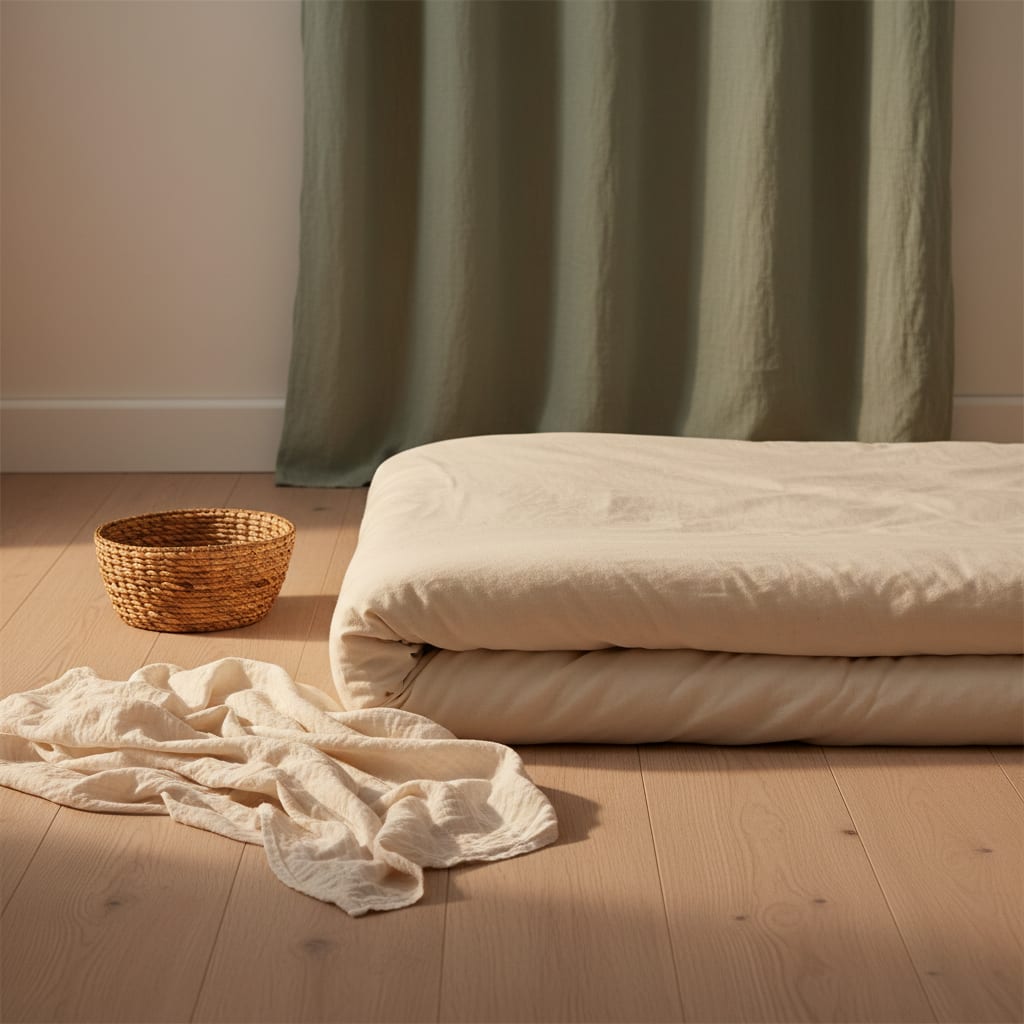
Once a toddler is sleeping in an open bed at home, a travel crib becomes a cage they have already escaped. A floor mattress is the honest version of where they have got to.
What it buys you. It packs down to something you can throw in a boot. It works in rooms where a crib will not physically fit. It removes the climb-out risk entirely, because there is nothing to climb. And it keeps the setup consistent with home, which is the thing that actually protects sleep on holiday — Betteroo’s explainer on how floor beds work as a full-time setup is the clearest description of the trade I have read.
What it costs you. The room becomes the crib. A child who can get up will get up, so every socket, cable, cord, low shelf and door has to be handled before lights out. Budget twenty minutes on arrival. It is not optional and nobody tells you about it in advance.
The gear. Two workable versions. A folding foam mattress from home is free and firm, which is the right combination. If you would rather not haul one, the hiccapop inflatable toddler travel bed has raised bumpers on all four sides and packs into a bag — and the bumpers are the reason it is a toddler product and not a baby one. Inflatable surfaces are not for infants under any circumstances, and the manufacturer says so too.
Add whatever your child sleeps with at home, within reason. Pillows are their own timing question, covered in when a toddler can use one, and a holiday is a bad time to introduce a new one.
The setups that fail on both counts
The hotel bed with a rolled towel barrier. No. This is the improvisation built at 11 p.m. when the crib did not arrive, and the one the guidance is most direct about.
The hotel-supplied cot you did not inspect. Often fine, sometimes a decade old with a bowed mattress and a missing part. Look at it before you use it — flat base, tight-fitting mattress, no gap at the edges, no damage.
An air mattress for a baby. Soft, inflatable, and not an infant sleep surface. That applies to inflatable toddler beds too, at the bottom of their age range.
Co-sleeping you did not plan. If the plan collapses at midnight, the sofa is the worst place to end up. Decide your fallback before you are exhausted.
What I would actually pack
Under one: the lightest certified travel crib you can afford, a fitted sheet made for that specific mattress, and a portable sound machine. Nothing else changes.
Past the crib exit: a folded firm mattress or an inflatable toddler bed, the home sleep sack or duvet, and twenty minutes for the room. The one thing that survives both stages is the packing discipline itself — the same logic I used to choose a travel stroller worth carrying applies to the bed, which is that weight you carry through an airport is the only spec that matters by the second day.
And if the trip goes badly regardless of the surface, it is usually the timing rather than the bed. A free age-matched sleep plan from Betteroo is worth more on a time-zone change than any gear on this page.
FAQ
Can a baby sleep on a floor mattress while travelling?
Not safely, under one year. The AAP asks for a firm, flat sleep surface inside a CPSC-conforming crib, bassinet, portable crib or play yard, and a mattress on a floor is none of those — there are no walls, and the room around it has not been childproofed. Use a travel crib until your child is out of a crib at home.
Is a Pack ‘n Play safe for a baby to sleep in every night?
Yes. A play yard meeting current CPSC standards is an approved infant sleep surface, with the mattress it came with, no added padding and a tightly fitting sheet. What it is not is comfortable to carry — it is a car-trip product rather than an aeroplane one.
What about the hotel’s own crib?
Usually fine, occasionally not. Request it when you book rather than on arrival, then inspect it: a flat, non-inclined base, a firm mattress with no gap at the sides, all hardware present and nothing torn. If it fails, do not improvise — ask for a different one.
When can a toddler use a floor mattress on holiday?
Broadly, once they are already sleeping in an open bed at home, which for most families is somewhere between two and three and a half. The prerequisite is not an age but the room: sockets covered, cords out of reach, doors handled, nothing climbable within range.
Do I need a travel sound machine as well?
It is the cheapest thing in the bag and the one that does the most work, because unfamiliar rooms are noisy in unfamiliar ways. Keep it at conversation volume and across the room from where your child is sleeping — the same rule that applies at home, and one that travel makes people forget.