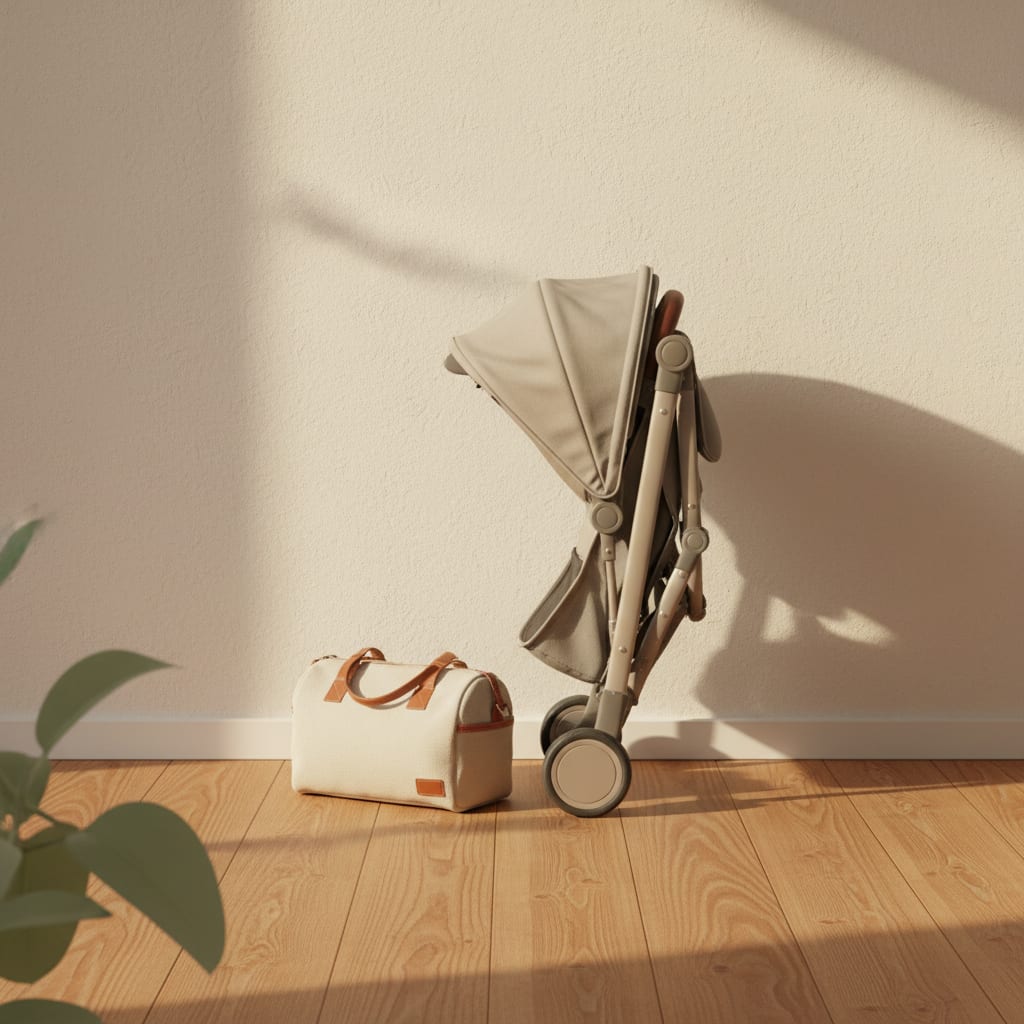
Bottom line up front: a travel stroller earns its keep with one number — the folded size — and the rule of thumb for cabin approval is a fold in the neighborhood of 22 x 14 x 10 inches or smaller, though every airline sets its own limits. Below is what actually makes a stroller travel-worthy, the criteria table I judge them on, and five named picks by use-case, from the $70 umbrella fold to the cabin-size premium lane.
I’ve gate-checked, overhead-binned, and curb-folded strollers through two kids’ worth of trips, and this guide is built from that testing plus the research. Every pick below is named, with the trade-off that earns or loses it the slot. Affiliate links never change my verdicts.
What makes a stroller “cabin-approved”
There is no universal certification — “cabin-approved” just means your airline’s overhead bin accepts your stroller’s folded dimensions. The practical rule of thumb: folds around 22 x 14 x 10 inches or smaller clear most major airlines’ carry-on allowances; anything larger is a gate-check. Weight matters less than people think for the bin (most ultra-compacts run roughly 12 to 16 pounds) and more for the six blocks of cobblestone at the other end.
Always check your specific airline’s stroller policy and the current listing’s folded dimensions before buying — both change, and this single check is the whole purchase decision for frequent flyers.
Beyond the fold, the features that separate travel strollers in real use:
The comparison criteria table
| Criterion | What good looks like | Why it matters on a trip |
|---|---|---|
| Folded size | Cabin-size (~22x14x10 in) or close | Overhead bin vs. gate-check lottery |
| Fold action | One hand, standing, under 10 seconds | You’ll fold it holding a baby and a passport |
| Weight | Roughly 12–18 lbs | Stairs, transit, carrying it folded with one arm |
| Recline | Near-flat or deep recline | Naps on the go are the whole point |
| Sunshade | Big, UPF-rated | Vacation sun is stroller sun |
| Wheels | Slightly larger, suspension | Cobblestones and curbs eat tiny wheels |
| Storage basket | Fits a real diaper bag | Airport survival |
| Age range | Newborn-adaptable vs. 6 months+ | Most ultra-compacts want a baby who sits |
No stroller wins every row — the fold and the ride quality fight each other physically. That’s why the right answer is use-case-based.
The 5 picks, by use-case
1. The frequent flyer: the BABYZEN YOYO2 (roughly $450–$500). The stroller that made cabin-size a category. One-hand fold, a folded footprint built to clear an overhead bin, a seat rated to 48.5 pounds so it lasts to the end of stroller life, and a shoulder strap you’ll actually use running for a connection. The trade is real: small wheels, a firm ride, and a price that only makes sense if you fly several times a year. Gate-check roulette breaks strollers; the bin never does.
2. The budget traveler: the Summer Infant 3Dlite (roughly $70–$110). An aluminum-frame umbrella stroller at about 13 pounds with a four-position recline, a five-point harness and a storage basket that shames most of its price class. It gate-checks rather than bins — but it’s cheap enough that airline handling is survivable, which is exactly the point when you fly once or twice a year and the everyday stroller stays home.
3. The premium do-it-all: the UPPAbaby Minu V2 (roughly $450–$550). Just under 17 pounds, one-hand fold, a 50-pound seat, a 20-pound basket that swallows a diaper bag, and an extendable UPF 50+ canopy. It is not reliably bin-sized on smaller aircraft, and that’s the honest catch — but if you live somewhere walkable and travel a few times a year, one very good stroller beats an everyday-plus-travel pair. Same buy-once logic as my minimalist registry.
4. The newborn-stage traveler: the BABYZEN YOYO2 with the 0+ Newborn Pack (roughly $600–$700). Most ultra-compacts want a baby who can sit. The newborn pack converts the same frame to a lie-flat cocoon, which is the cleanest answer if your first trip lands in the first six months. The alternative — honestly cheaper and often better — is to skip the stroller entirely and travel with a carrier; my Artipoppe alternatives guide names five at every price.
5. The all-terrain vacationer: the Baby Jogger City Mini GT2 (roughly $400–$480). Forever-air rubber tires, all-wheel suspension, a near-flat recline and a 65-pound seat. It is emphatically not a bin stroller — it gate-checks, every time — but for beach towns, cobblestoned old cities and national-park gravel, it arrives somewhere it can actually drive. If you want the same brand’s cabin-size fold instead and can live with plastic wheels, the City Tour 2 folds 85 percent smaller and weighs about 14 pounds.
How I’d decide in 60 seconds
Fly more than twice a year: pick one. Fly rarely and own a stroller you like: pick two. Buying your only stroller right now: pick three. Baby under six months: pick four or a carrier. Trip list full of cobblestones: pick five. The failure mode to avoid is buying the premium ultra-compact for one annual trip — that money is better spent almost anywhere else on the baby budget.
FAQ
Can I take a stroller through airport security and to the gate?
Yes — strollers of any size go through security (they get X-rayed or hand-checked) and to the gate, where larger ones gate-check free on essentially all major airlines. The cabin-size question only decides whether it rides in the bin with you or in the hold with the luggage-throwers. Free doesn’t mean gentle.
What size stroller fits in an airplane overhead bin?
The working rule of thumb is a fold around 22 x 14 x 10 inches or smaller, matching common carry-on limits — but airlines set their own numbers and some bins (small regional jets especially) are tighter. Check your airline’s current policy against the listing’s folded dimensions; on regional jets, expect a valet gate-check even for cabin-size folds.
Do I really need a separate travel stroller?
Only if you travel enough to resent your everyday stroller’s fold. One or two trips a year: gate-check what you own, or buy the budget category. Monthly flights: the ultra-compact pays for itself in unbroken wheels and unmissed connections. In between, the premium do-it-all category makes the question disappear.
Are ultra-compact strollers okay for newborns?
Mostly no — the category typically starts around six months, when babies sit unassisted, and the near-upright seats aren’t newborn-appropriate. For the early months use a carrycot-compatible compact, a car-seat-adapter travel system, or a carrier. Check the current listing’s minimum age before buying; it’s the spec people miss most.
Final word
Buy the fold your life actually requires, and spend the leftover on the trip. For the rest of the buy-once philosophy, the minimalist registry checklist is the master list — and if the travel-gear budget is fighting the carrier budget, Artipoppe alternatives settles that one for a lot less than you feared.