Bottom line up front: the Guava Lotus earns its price on airplanes and almost nowhere else. At around 15 pounds including the bag, folding to roughly 24 by 12 by 8 inches, and wearing as a backpack, it turns “checking a travel crib” into “carrying a travel crib” — which, with a baby on your front and a bag on your shoulder, is the whole difference. At roughly $250 against about $90 for a basic play yard, the calculation is entirely about how many trips you’ll take.
We’ve had ours through hotel rooms, a rental with no floor space to speak of, and two sets of grandparents with strong opinions about where babies sleep. Affiliate links never change my verdicts.
What you get in the bag
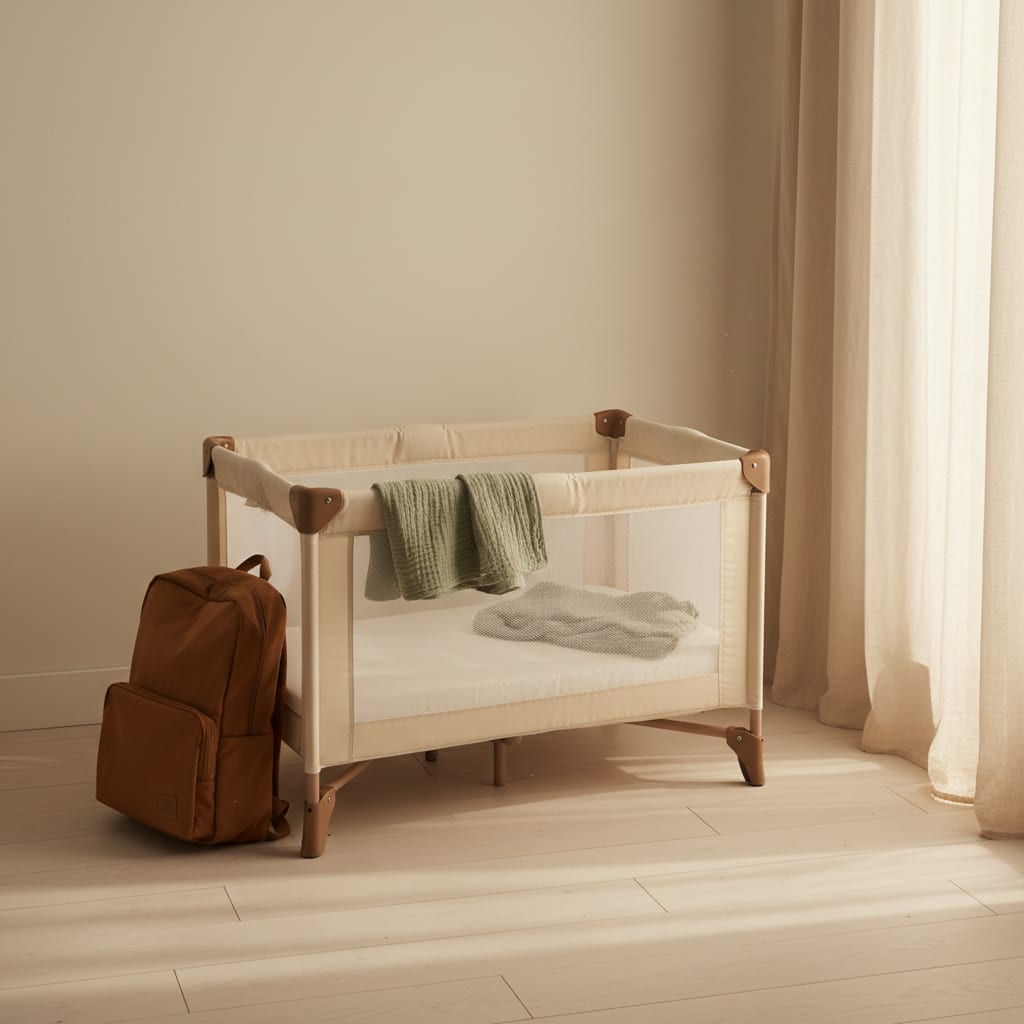
The Guava Lotus travel crib is a fabric-and-frame crib that sets up to roughly 45.5 by 31.5 inches with a 25.5-inch height, and packs into a padded backpack with clamshell access. The mattress — about 41.5 by 23.5 inches and 1.4 inches thick — comes with it, and unlike a lot of play yards, it’s meant to be the sleep surface rather than a token pad you’re expected to supplement.
It’s certified to the US federal play yard standard (16 CFR 1221 / ASTM F406) and CPSIA, and it carries GREENGUARD Gold certification for low chemical emissions — the same certification I spend a lot of time explaining in my non-toxic crib mattress guide. Because the mattress rests on the floor rather than on a suspended platform, there’s no weight limit; the real limit is age, roughly newborn to three, or until your child can climb out.
There’s also a bundle with a fitted sheet and quilted cover if you’d rather not source sheets separately, which is worth doing — generic crib sheets do not fit this mattress, and a loose sheet in a sleep space is a safety issue, not a laundry inconvenience.
What actually worked
The backpack is the product. I want to be clear that this sounds like marketing and isn’t. Hands free through an airport, both hands free on stairs, both hands free while a toddler decides the moving walkway is a ride. Every travel crib I’ve used before this one required a decision about which hand it was going in.
Setup is genuinely under a minute once you’ve done it twice. The fabric stays attached to the frame, so there’s no threading, no separate mattress bag, no wrestling a locking rail into place in the dark.
The zip side door earns more affection than I expected. For a baby who wakes at 2 a.m. in a room they’ve never seen, being able to unzip a panel, put a hand in and settle them without lifting them out is the difference between a five-minute wake and an hour. Later it becomes a crawl-in play yard, which extends its life past the sleeping phase.
It fits in an overhead bin on most aircraft. Not guaranteed on every regional jet, but on standard narrow-bodies I’ve never had to gate-check it. The cover also comes off and washes, which after a stomach-bug trip matters more than any spec on the box.
What didn’t
The mattress is thin. An inch and a bit of foam on a hotel floor is firm — which is correct for safe sleep, and also a genuine adjustment for a baby used to a plush-feeling home mattress. Some babies do not care. Some care intensely for the first two nights. Do not solve this by adding padding: the mattress that came with it, a fitted sheet made for it, and nothing else is the rule, exactly as it is at home.
The price is a real barrier. Roughly $250 buys three basic play yards. You are paying for the weight, the pack size and the certifications, and if none of those three change your life, you shouldn’t pay it.
It sits low. Every pickup is a full squat to the floor. Six weeks postpartum, that is not nothing, and a bassinet-height travel option may serve you better in the early months.
Older toddlers work out the door. The side zip is a feature until the day it becomes an exit. By around two, expect to zip it thoughtfully or stop using it.
It’s a travel crib, not a second crib. People buy one intending to use it daily at home. It’s fine for that, but a full-size crib and a proper mattress do the job better for less.
The cost-per-trip math
| Option | Rough price | Packed weight | Cost over 18 trips |
|---|---|---|---|
| Guava Lotus | ~$250 | ~15 lb, backpack | ~$14/trip |
| BabyBjörn Travel Crib Light | ~$300 | ~13 lb, shoulder bag | ~$17/trip |
| Graco Pack ‘n Play | ~$90 | ~20+ lb, duffel | ~$5/trip |
| Hotel-provided crib | free | none | free, unknown condition |
Eighteen trips is roughly six a year for three years, which is a fair benchmark for a family that flies. Below about eight or ten trips, a Pack ‘n Play wins on pure arithmetic and you carry the weight instead.
That last row deserves a note. Hotel cribs are free and their condition is a lottery. If you use one, check the model against current recalls, use its own mattress with a properly fitted sheet, and put nothing else in it.
Sleeping somewhere new
The crib is half the problem. The other half is that a baby who sleeps well at home may refuse an unfamiliar room entirely, and no amount of GREENGUARD certification fixes that. What helps is boring: the same wind-down sequence, the same sound, the same sleep clothing, and a room as dark as you can make it. Betteroo’s guide on a baby who refuses the crib covers the pattern well, and if trips have quietly derailed the whole schedule, the two-minute Betteroo quiz will get you an age-matched plan faster than another gear purchase will.
Pairing it with the right stroller matters too — if you’re flying, the crib on your back and a stroller you can fold one-handed is the combination that works, and my travel stroller testing covers the second half.
FAQ
Is the Guava Lotus safe for newborn sleep?
It’s certified to the federal play yard standard and sold for use from newborn, used flat with its own mattress and a fitted sheet made for it. The safe-sleep rules don’t change because you’re away from home: on the back, on the firm flat mattress it came with, nothing else in the crib. Never add a mattress topper, folded blanket or extra pad underneath the baby.
Can you use a regular crib sheet on the Lotus mattress?
No. The mattress is a non-standard size, and a sheet that doesn’t fit tightly can come loose and become a hazard. Buy sheets made for this crib — Guava sells them and several third parties make fitted versions specifically for the Lotus mattress.
Guava Lotus or BabyBjörn Travel Crib Light?
The BabyBjörn sets up marginally faster and is a touch lighter; the Lotus carries as a backpack and has the zip side door. If you fly with a baby and a bag and a toddler, the backpack wins. If your travel is mostly by car, the difference is small and you should buy on price.
Does the Lotus fit as carry-on luggage?
Folded it’s roughly 24 by 12 by 8 inches, which fits standard overhead bins on most full-size aircraft. Regional jets and low-cost carriers with strict sizers are the exceptions, so check your carrier’s limits rather than assuming.
How long will a child use it?
Realistically from newborn to somewhere around two to three, ending when they can climb out or unzip the door. If you have two children close together, the per-trip math improves considerably, and the fabric and frame hold up well enough to make that plausible.
Final word
Four stars. It is expensive, the mattress is thin by design, and it is unambiguously the best version of this object if your trips involve airports. Buy it for flying; buy a play yard for the annual drive to your parents’ house.