Bottom line up front: the Newton crib mattress does exactly what it says structurally — you can breathe through it, and you can rinse the entire core in a shower — but “breathable” is a materials description, not a safety claim, and it does not change any safe-sleep rule. At around $300 it costs roughly double a good firm foam mattress. Whether that’s worth it comes down to one question: how much do you value being able to wash the inside of the thing your baby sleeps on?
I’ve had a Newton in a crib and a good conventional foam mattress in the other room, which is a slightly ridiculous way to live and an excellent way to compare. Affiliate links never change my verdicts.
What it actually is
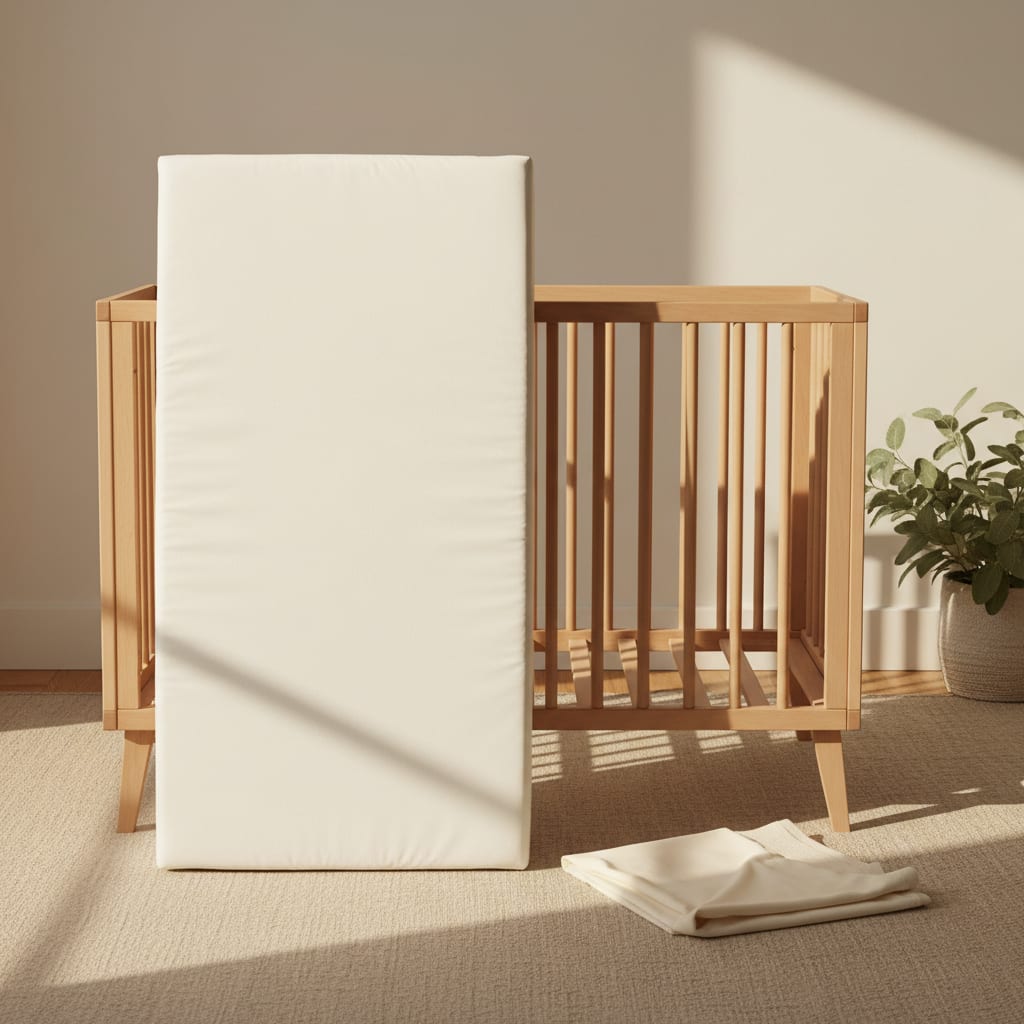
The Newton crib mattress is a dual-layer mattress with a spun polymer core — a mass of extruded food-grade polymer strands rather than foam or springs — inside a removable, machine-washable cover. The deluxe version is about 5.5 inches thick and doubles as a toddler-bed mattress, so one purchase covers crib through toddler bed. There’s also a waterproof version if the idea of rinsing a core in your bathtub is more homework than you signed up for.
The core is roughly 90 percent air by volume, and that’s the part you can verify without trusting anyone: hold a corner to your face and breathe. Air moves through it in a way it simply does not through foam. That single test is what converts most skeptics, including me.
What the testing actually shows
Newton states its mattresses were independently tested in a CPSC-accredited lab for airflow, suffocation risk and carbon-dioxide rebreathing, and claims substantially more airflow than a leading organic crib mattress. Read that carefully, because the gap between what was tested and what parents assume is where this category gets dangerous.
What it means: in laboratory conditions, air and CO₂ move through this mattress more readily than through a solid foam core.
What it does not mean: that a baby is safe sleeping face-down on it, or that it reduces SIDS risk. There is no crib mattress on the market that has been shown to do that, and Newton doesn’t claim it. Safe-sleep guidance is unchanged by what you buy: back to sleep, firm flat surface, nothing else in the crib. A breathable mattress is a margin, not a mechanism, and treating it as permission to relax any of the other rules is the one genuinely bad outcome available here.
That’s also the reason I keep the same line in my non-toxic crib mattress guide: certifications and materials decide what’s in your air, not whether the surface is safe to sleep face-down on. Nothing is.
What actually worked
The washability is the real feature. Cover into the machine, core into the shower with the handheld sprayer, both dry within a day. After the norovirus week we had, I stopped resenting the price. Every other crib mattress I’ve owned responds to a genuine soak-through by becoming a thing you scrub the surface of and then live with.
The firmness is correct and stays correct. No body impression after a year, no soft spot in the middle, which is more than I can say for the budget foam mattress in the other room.
The no-off-gassing thing is real. Out of the box it smelled like nothing. If you’ve unwrapped a foam mattress and had to air it out for three days, that difference is worth naming.
It genuinely spans crib to toddler bed. One mattress, two beds, roughly three years — which is what makes the cost math survivable.
What didn’t
The price. Around $300 against roughly $100 to $150 for a well-made firm foam or innerspring mattress. You are paying for the core and the washability, and you should decide whether you want those specifically.
It needs a fitted sheet that behaves. The core is springy in a way that makes a loose or generic sheet pop off a corner more easily than on a rigid foam mattress. Buy sheets that fit properly and check the corners; a sheet that lifts is a safe-sleep problem, not an inconvenience.
Washing the core is a two-person-ish job the first time. It’s not heavy, but it is bulky and awkward wet, and it needs real airflow to dry. Plan it for a morning, not a bedtime.
The waterproof version partly defeats the point. It’s the more practical buy for many families, but adding a waterproof layer works against the airflow that is the whole reason to consider a Newton. Pick a lane deliberately.
The cost math
| Path | Rough price | Years of use | Per year |
|---|---|---|---|
| Newton, crib through toddler bed | ~$300 | ~3 | ~$100 |
| Newton, two kids | ~$300 | ~5–6 | ~$55 |
| Good firm foam mattress | ~$120 | ~3 | ~$40 |
Over two kids the gap narrows to something most families would pay for a mattress they can actually wash. Over one kid it doesn’t, and I’d rather see that difference go to a sleep surface plus the boring things that matter — well-fitting sheets, the right sleep sack for the room temperature, and the safe-sleep basics Betteroo lays out in its guide on when babies can sleep with a blanket.
FAQ
Is a breathable crib mattress safer?
Not in any way that has been demonstrated. Breathable cores move more air in lab testing, which is a real material property, but no crib mattress has been shown to prevent suffocation or SIDS, and none is a substitute for back-sleeping on a firm, flat, empty surface. Buy a breathable mattress for the washability and the materials, not for reassurance.
Can you really wash the Newton mattress core?
Yes, and it’s the single best thing about it. The cover goes in the washing machine and the core can be rinsed in a shower or bath with plain water and left to air-dry. Give it a full day and real airflow — a damp core put back under a sheet is a worse problem than the spill was.
Is the Newton worth it compared with a regular firm mattress?
If you’re buying for one child and money is tight, a well-made firm foam or innerspring mattress does the core job — firm, flat, correctly sized — for roughly half the price. The Newton earns its premium over two children, or for any family where allergies, reflux or frequent spills make a genuinely washable core a weekly-use feature rather than a novelty.
Does the Newton work in a toddler bed?
Yes — the deluxe 5.5-inch version is sold as a crib and toddler-bed mattress, which is what stretches its useful life to around three years for one child. Check that the version you’re buying is the dual-stage one, since the thinner options are crib-only.
How does it compare with the Snoo or other premium sleep gear?
Differently, and better. The Snoo’s problem is that its useful life is measured in months against a four-figure price. A crib mattress is the opposite shape of purchase — years of use, no motor to fail, resale irrelevant because you’ll keep it. That’s exactly the kind of gear where paying up can be rational.
Final word
Four stars. The engineering is honest, the washability is a real quality-of-life feature, and the company doesn’t overclaim on safety — but “breathable” is a materials property, not a safety net. Buy it for the shower test, not for peace of mind you should be getting from safe-sleep basics instead.