Bottom line up front: the Snoo genuinely helps many newborns sleep longer stretches, but its useful life is only about five to six months — so the rational move for most families is renting or buying secondhand, not paying four figures for a new one. Here is what it actually does, the rent-vs-buy math laid out honestly, and who benefits enough to justify any version of the price.
I’ve had a front-row seat to the Snoo across my own newborn stage and several friends’ — enough hands-on time, backed by the research, to give you the framework rather than the fan club version. Affiliate links never change my verdicts.
What the Snoo actually does
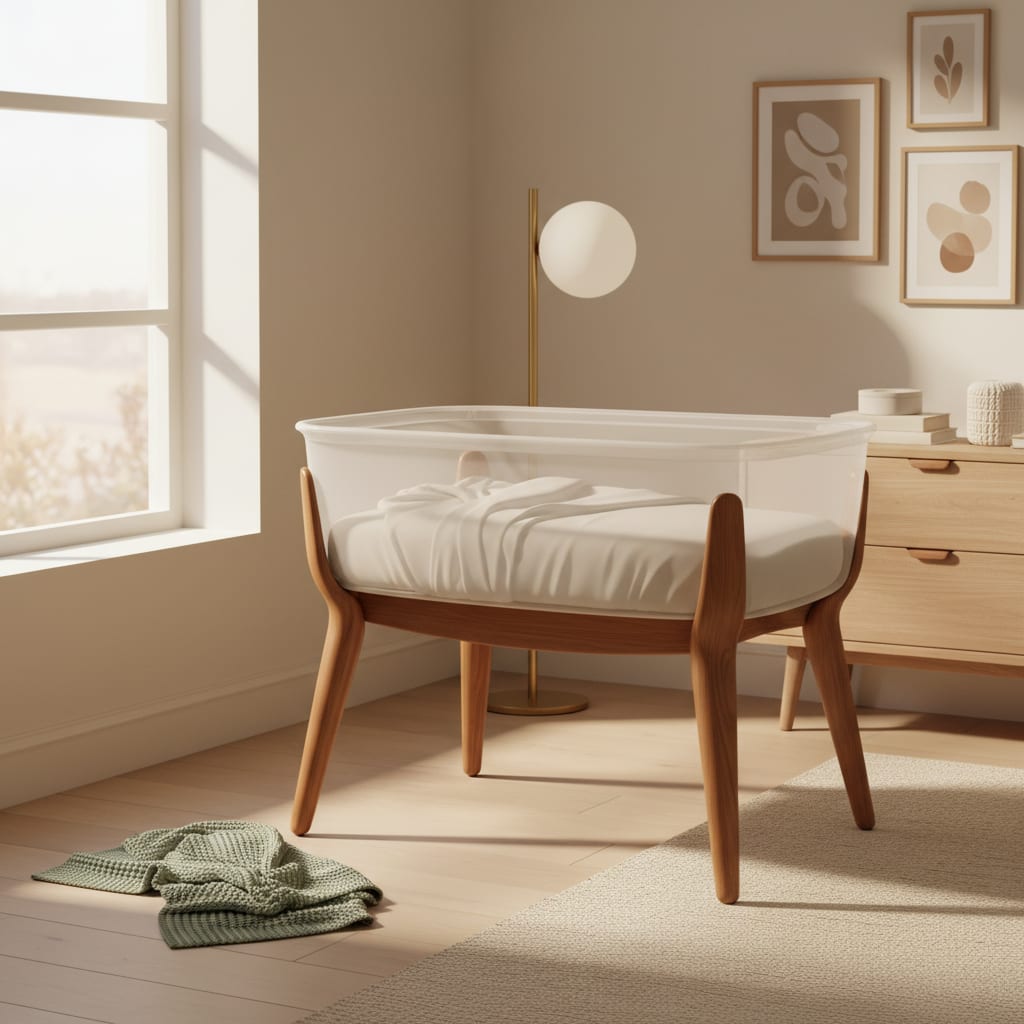
The Snoo is a robotic bassinet with three real features:
- Responsive motion and sound. It detects crying and escalates through levels of rocking and white noise, attempting to resettle the baby before you have to get up. This is the headline feature and it genuinely works on many babies — not all.
- A built-in swaddle that clips in. Baby sleeps secured on the back, which is the safety pitch: no rolling to the stomach while swaddled.
- An app with sleep logs, level controls, and a weaning mode that gradually retires the motion.
What it does not do: sleep-train, fix feeding-driven wakings, or work on the subset of babies who simply hate it. Every honest Snoo conversation includes a family whose baby filed an immediate veto.
The math: rent vs. buy vs. skip
Approximate figures, clearly framed — prices shift, so check current listings. New, the Snoo runs around $1,500 to $1,700. Renting runs somewhere around $100 to $160 per month. Secondhand units commonly go for around half retail, and resale of a well-kept unit recovers a meaningful chunk.
The variable that drives everything: usable life is roughly five to six months — it ends at the weight/mobility limits or when the baby outgrows swaddling, whichever comes first. So:
| Path | Rough total cost | When it wins |
|---|---|---|
| Rent ~5 months | around $500–$800 | One baby, want the experience, no storage/resale hassle |
| Buy secondhand, resell | often net $200–$500 | Comfortable with used gear; best cost floor |
| Buy new, resell after | often net $700–$1,000 | Want warranty and a fresh unit |
| Buy new, keep for future kids | ~$1,500+ amortized over 2+ kids | Multiple planned kids; cost per baby drops fast |
| Skip it | $0 beyond a normal bassinet | Baby sleeps okay; budget is tight |
Run per-month-of-actual-use math and the rental usually wins for a first baby: you don’t yet know whether your baby is a Snoo baby, and renting caps the cost of finding out.
Who benefits most
- Parents going back to work early, where a 3 a.m. resettle the robot handles is worth real money.
- Twins, or a baby plus a toddler, where you physically cannot resettle everyone at once.
- Postpartum mental health situations where protected sleep is medical, not luxury. This is the group for whom I’d defend even full retail.
- Reflux-free, motion-loving babies — the machine’s best customers. You find out which baby you have in the first two rental weeks.
Who benefits least: babies already sleeping in okay stretches (the Snoo improves crisis nights more than fine ones), families planning to bed-share or contact-nap, and anyone for whom the cost displaces essentials — a flat bassinet plus the free techniques in my newborn sleep schedule covers the actual requirements.
The exit problem nobody prices in
Around five to six months you must wean off the motion (the app’s weaning mode helps, and works reasonably well) — right around the age when sleep gets harder anyway. I covered that collision in the 4-month sleep schedule and regression guide. Families who treat the Snoo as a bridge through the survival months and wean on schedule love it; families who treat it as a permanent solution meet the same independent-sleep project six months later, with interest.
FAQ
How long can a baby use the Snoo?
Until roughly five to six months, ending at the weight and mobility limits or when the baby starts pushing up — check the current specs for exact cutoffs. Note that the second half of that window often includes weaning the motion down, so the full-power months are fewer than the calendar months.
Is renting the Snoo cheaper than buying?
For one baby, usually yes: around $500–$800 all-in versus four figures new, with zero storage or resale effort. Buying — especially secondhand with resale on the far side — can beat renting on pure dollars, but only if you actually execute the resale. Be honest about whether you will.
Does the Snoo cause dependence on motion?
It creates the habit it uses: babies who sleep with responsive motion get used to responsive motion. The weaning mode retires it gradually and most babies transition fine, but budget two to three weeks for the exit and start before the mobility deadline forces you. Dependence isn’t a scandal; it’s just a cost — price it in.
Is the Snoo safe for overnight sleep?
Its core design is aligned with safe-sleep basics — flat, firm, on the back, secured swaddle — and keeping baby back-sleeping while swaddled is its signature safety argument. Use the current version’s instructions, skip aftermarket accessories, and confirm any secondhand unit isn’t subject to recalls. For specifics, check the current listing and your pediatrician, in that order of convenience and the reverse order of authority.
Final word
Four stars: the product delivers, the price model is the problem, and the rental fixes the price model. Rent it for the survival months, wean on schedule, and put the savings toward the boring gear on my minimalist registry that lasts years instead of months.