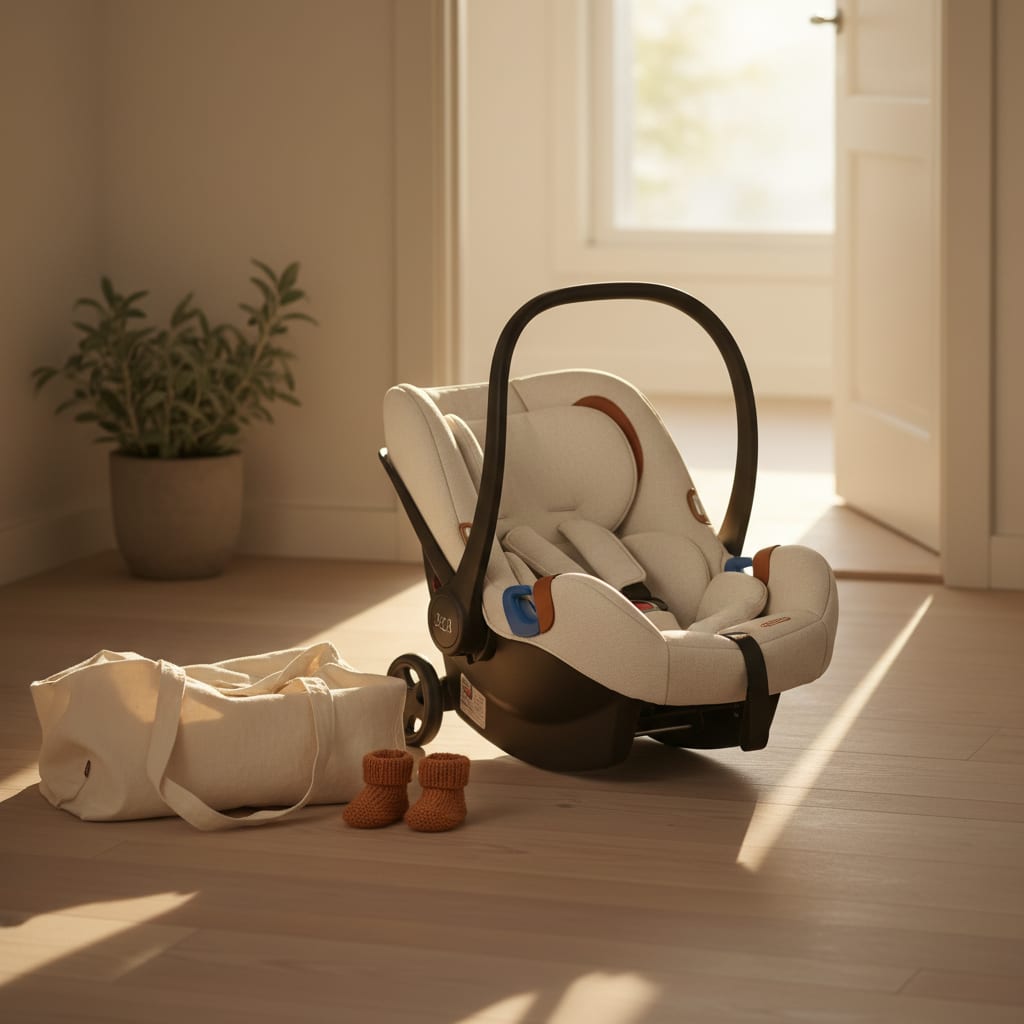
Bottom line up front: the Doona is a genuinely clever piece of engineering with a genuinely short useful life. It is a rear-facing infant car seat whose wheels fold out from underneath, so you go from buckled-in to rolling in a few seconds without transferring the baby. At roughly $550 for the standard model, and a height limit of 32 inches that most babies reach somewhere between about 12 and 18 months, you are paying a lot per month of use. Whether that’s smart depends almost entirely on where you live and how you move.
I approached this one the way I approach every four-figure-adjacent purchase: what does it replace, how long do you get, and what does the same money buy instead. Affiliate links never change my verdicts.
What it is, mechanically
The Doona car seat and stroller is a rear-facing-only infant seat rated for 4 to 35 pounds and a maximum height of 32 inches, with an integrated wheel assembly that deploys and retracts with a handle release. It installs on a LATCH base in the car, or without the base using the vehicle belt — which is also why it’s certified for use on aircraft when installed without the base.
The seat itself weighs around 17 pounds, with the base adding roughly another 10. That number is the whole review in miniature. Seventeen pounds is heavy for something you carry; it is light for something you push.
Doona has since added a newer, larger model at a meaningfully higher price. Everything below is about the standard version, which is the one most families are actually choosing between.
Where it earns its money
No transfer. The pitch is real. A sleeping baby stays asleep from the car to the pediatrician’s waiting room, because nothing gets unclipped, lifted or reclined. If your baby is one of the ones who wakes on transfer and then refuses to resettle, this is not a convenience feature, it’s a sanity feature.
Cabs, ride-shares and city life. You cannot install a stroller in an Uber. You can carry a Doona into one, belt it in, and walk out the other end pushing it. For urban families this is the single strongest argument in the category, and nothing else does it as cleanly.
Airports. Being able to roll through a terminal and then belt the same seat into the aircraft, without gate-checking a separate stroller, removes an entire category of travel-day stress.
Small trunks and small apartments. It occupies one object’s worth of space instead of two. If you’ve read my small-car car seat fit notes, you know how quickly this stops being a footnote.
Where it doesn’t
The weight is not theoretical. Seventeen pounds plus a growing baby is what you carry up a flight of stairs, into a restaurant, over a curb the wheels won’t take. By six months the arm math turns unfriendly.
It is a stroller in the loosest sense. The wheels are small, the ride is firm on anything that isn’t pavement, the canopy is modest and there is no meaningful storage without buying an accessory. It is a way of moving a car seat, not a replacement for a stroller you’d walk a mile with.
Those wheels go in your car. They roll through parking lots, then fold up under the seat that lives in your back seat. Some families never think about this. Some think about it constantly.
The useful life is short and hard-capped. Rear-facing-only, 35 pounds, 32 inches. Height comes first for most babies. You are buying months, not years.
It’s a car seat, so the sleep rules still apply. An infant napping in a Doona while you push it is fine; an infant left to sleep in it at home, in a semi-upright position, unsupervised, is not what it’s designed for. Car seats are travel devices, and safe sleep still means a firm, flat, empty surface. If naps only ever happen while you’re moving, the answer isn’t more gear — it’s usually schedule shaped, and Betteroo’s guide on naps that end after 30 minutes is a better first stop than a checkout page.
The cost math
The number that matters is cost per month of useful life, because that’s the axis where the Doona looks either brilliant or absurd depending on your postcode.
| Setup | Rough cost | Rough useful life | Per month |
|---|---|---|---|
| Doona, standard model | ~$550 | ~12–18 months | ~$31–46 |
| Chicco KeyFit 35 + car-seat frame stroller | ~$300 | ~12–18 months | ~$17–25 |
| KeyFit 35 + BABYZEN YOYO2 | ~$700 | seat ~15 months, stroller ~4 years | ~$15 blended |
| Doona resold at ~50% after 15 months | ~$275 net | ~15 months | ~$18 |
That last row is the one nobody puts in a review, and it’s the reason I don’t dismiss the Doona outright. Resale on this product is unusually strong, because the demand is constant and the supply is constrained by that same short lifespan. If you buy new, keep the box, keep the manual, and sell it before it expires, the real cost lands closer to a mid-range travel system than to $550.
Two caveats on that plan. Check the expiry date stamped on any seat you buy or sell — car seats have them. And never buy a used one whose history you can’t verify, which is a rule I hold hard enough that it has its own guide to secondhand baby gear.
Who should buy it
Buy it if you’re a city family without a car, a heavy cab or transit user, a frequent flyer, or a parent whose baby wakes on every transfer and whose whole day currently bends around that.
Skip it if you drive everywhere, park in your own driveway and would be pushing it across grass, gravel or long distances. In that life a conventional infant seat that clicks into a proper stroller frame does more for less, and my travel stroller picks cover the second half of that setup.
FAQ
How long does a baby fit in the Doona?
Until 35 pounds or 32 inches, rear-facing only — and for most babies the height limit arrives first, somewhere in the region of 12 to 18 months. Measure your own baby’s growth curve rather than assuming an average, and remember the head must sit at least an inch below the top of the shell.
Is the Doona approved for airplanes?
Yes, when it’s installed without the base using the aircraft seat belt — that’s the configuration the certification covers. It’s one of the strongest practical arguments for the product, since you roll to the gate and then belt the same seat in without gate-checking anything.
Is the Doona too heavy to carry?
It’s around 17 pounds before you add a baby, which is on the heavier end for an infant seat. Carrying it any real distance is unpleasant by the middle of the first year. If your daily route involves stairs without an elevator, try lifting one in a store before you commit.
Is a Doona worth it if I already have a stroller?
Usually not. The Doona replaces the car-seat-plus-frame step, not the stroller you actually walk with. If you already own a stroller you like and a car seat that clicks into it, the Doona is buying you seconds, not capability.
Can my baby sleep in the Doona at home?
No — treat it like any car seat. It’s a travel restraint, and unsupervised sleep in a semi-upright seat outside the car isn’t what it’s built for. Move a sleeping baby to a flat, firm surface once you’re home, however unwelcome that transfer feels in the moment.
Final word
Three stars, and an unusually conditional three. The engineering is excellent and the problem it solves is real, but the price divided by the months is brutal unless you live the specific life it was designed for. Buy it for cabs, planes and city sidewalks; buy something else for driveways and dog walks.