Bottom line up front: white noise is not a crutch, and no rule says your child has to give it up — plenty of adults use it for life. What deserves an audit is not whether the machine is on but how loud it is and how close to the crib it sits. If you do wean, the real constraint is your hardware: a machine with fine volume steps fades out over two or three weeks and nobody notices, while a two-speed unit forces a much cruder step down. That is a product review question as much as a sleep one.
I have measured, run and cursed at most of these machines in my own house, bought with my own money. Affiliate links never change my verdicts.
The “crutch” framing is mostly wrong
A sleep crutch, in the useful sense of the term, is something a baby needs you to reapply in the middle of the night — rocking, feeding to sleep, replacing a pacifier at 2 a.m. White noise is none of those. It runs continuously without you, it does not run out, and it does not wake anyone up when it stops being needed. It is closer to a blackout blind than to a rocking chair.
There is one exception worth naming. A machine on a 45-minute timer genuinely can behave like a crutch, because the sound environment your baby fell asleep in has changed by the time they surface between cycles. If your device has a timer, the fix is usually to turn the timer off, not to remove the sound.
The variable that actually matters: volume at the crib
This is the part I would want every parent to act on, and it has nothing to do with weaning.
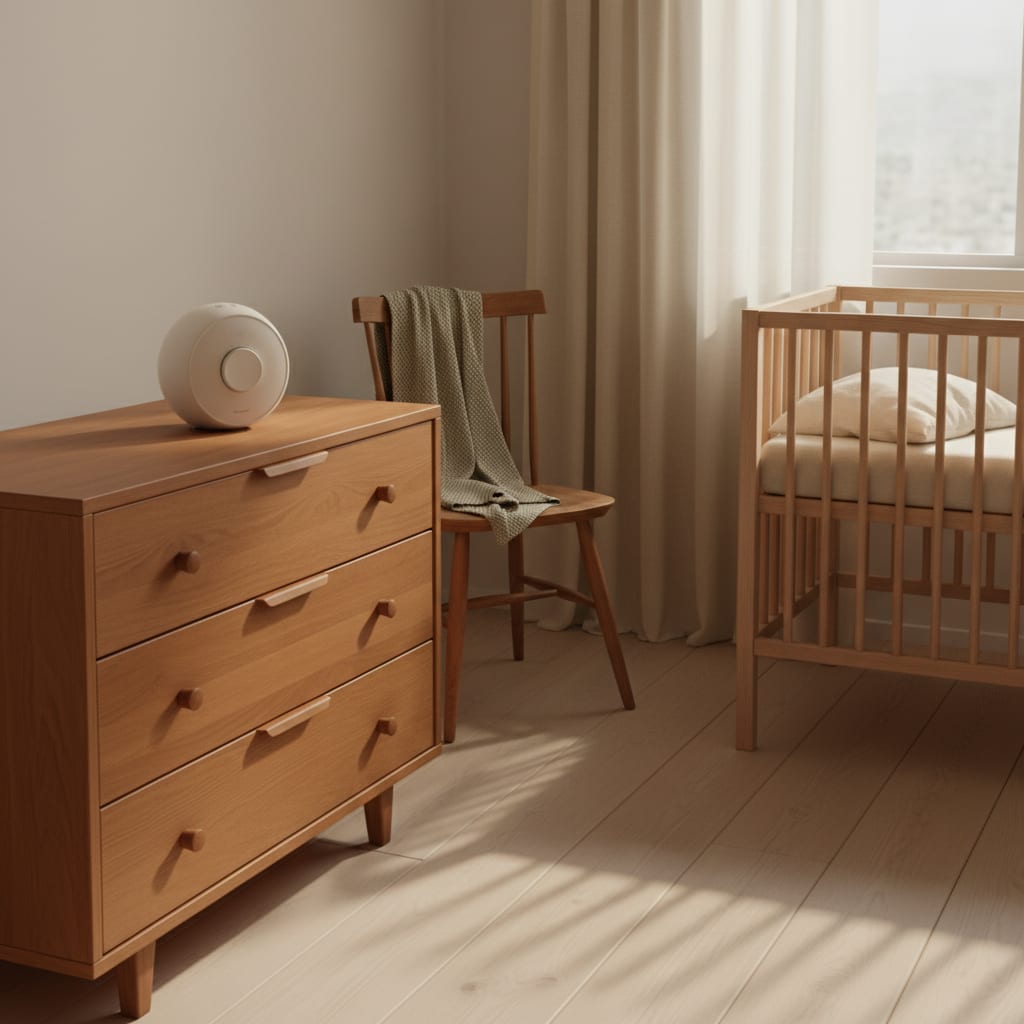
A widely cited 2014 study in Pediatrics tested a set of infant sound machines and found that at maximum volume, measured at close range, every one of them exceeded the noise limits recommended for infant hospital nurseries, and a few of them produced levels high enough to be a genuine concern with prolonged exposure. The practical guidance that came out of it is simple: place the machine as far from the crib as the room allows, keep it well below maximum, and do not run it at high volume all night.
Measure it rather than guessing. A phone sound-level app held at mattress height will tell you within a few decibels, which is close enough to make a decision with, and the number is almost always higher than people expect. While you are down there with a phone, check the room temperature too — that is the other bedside number nobody verifies, and my nursery temperature guide explains why the thermostat reading is not it.
Three real reasons to wean, and one bad one
Travel fragility. If your child cannot sleep in a hotel, at a grandparent’s house or on a plane without the exact machine from home, the dependence is on the object rather than the sound. That is worth loosening — usually by switching to a portable unit rather than by removing sound altogether.
Volume creep. Nearly everyone turns it up over months, one small notch at a time, because the number never resets. If your measurement came back high, wean the volume, not the machine.
The device has outgrown you. A Wi-Fi unit with an account, an app and a subscription tier is a lot of infrastructure for a hiss. Plenty of families step down to something dumber, which is a different kind of weaning and an entirely reasonable one.
The bad reason: someone told you it was a crutch. It is not, and removing a working sleep input to satisfy a rule that does not exist is how a settled sleeper becomes an unsettled one.
The machine decides how hard the fade is
Here is where the product review lens earns its keep, because three machines that all make an acceptable hiss behave completely differently when you try to turn them down.
Fine-grained electronic, the easy case. A unit in the LectroFan mould has many small volume steps and non-looping sound, so you can drop it by a barely perceptible amount every few nights for three weeks. Nobody in the house notices anything happening. This is the ideal weaning hardware and it is also, not coincidentally, the machine I recommend most often in my white noise testing.
Mechanical fan, the awkward case. The Yogasleep Dohm is my favourite-sounding machine and the worst one to wean with, because it has two speeds and a shell you rotate for tone rather than a continuous volume range. The workaround is distance, not volume: move it a foot further from the crib every few nights until it is across the room, then out of the room, then off.
App-scheduled, the automated case. A Hatch Baby (formerly Rest) will run a fade and a schedule for you, which is genuinely the least effort of the three — and it is also the device most likely to be doing a second job as a time-to-rise light for a toddler, in which case you are not weaning the machine at all, just its sound. My full Hatch review covers the subscription question that comes with it.
How to actually do it, if you decide to
Pick one variable and move it slowly. Either drop the volume by a small step every three nights, or move the machine progressively further away, but not both at once — you want to know which one your child noticed.
Do it across two to three weeks, not a weekend. Hold the current level for a week if night wakings increase, and expect the last stretch, from “very quiet” to “off”, to be the only part anyone reacts to. And do not start during a regression, a house move, a new nursery or a bout of teething; the machine is not the thing to change while everything else is changing.
Naps are the harder half, because daytime rooms are lighter and noisier, and daytime sleep pressure is lower. If the nap is where it falls apart, the problem is more likely the schedule than the sound — Betteroo’s guide to nap training covers that properly, and my wake windows by age is the timing side of the same question.
When not to wean at all
Shared bedrooms. Street-facing windows. Apartment neighbours. A sibling who gets up two hours earlier. In all of those, the machine is doing real acoustic work and removing it buys you nothing except earlier mornings. Keep it, set it at a sensible level, and move on to a problem that actually exists. If you want the buying-side view of what a good unit looks like, Betteroo’s overview of how sound machines are usually specced is a reasonable place to start.
FAQ
Is white noise a sleep crutch?
No, in the meaningful sense. A crutch is something you have to reapply during the night; white noise runs on its own and does not require a parent at 2 a.m. The legitimate concerns are volume and distance from the crib, not dependence.
At what age should you stop white noise?
There is no required age. Some families stop around two or three, some keep it through school age, and some adults never stop. Stop when it is causing a problem — travel, volume, or a device you no longer want — and not because of a milestone.
How loud should a baby sound machine be?
Well below maximum, and as far from the crib as the room allows. Measure at mattress height with a phone app rather than judging by ear, and reduce it if the number surprises you. Research on infant sound machines found many can exceed recommended nursery noise limits at full volume.
How long does weaning off white noise take?
Two to three weeks if you go gradually — one small volume step or one increment of distance every three nights. Faster than that and you are running an experiment on your own sleep as well as your child’s.
What if sleep falls apart when I turn it down?
Go back one step, hold there for a week, and check whether something else changed — a regression, teething, a nursery start. If sleep was already fragile before you touched the machine, the sound was not the load-bearing part; a free age-matched sleep plan will tell you more than another gadget will.