Bottom line up front: the blind comes down because of how it was attached, not because your baby is unusually strong. Suction cups, tension fits and adhesive strips all hold by friction at the bottom edge — exactly where the hands of a baby pulling to stand in a crib end up. What holds instead is screwed to the window frame or the wall above it, mounted higher and wider than the window, with no cord anywhere. And before buying anything, check what is already there: a cord your baby can reach is a bigger problem than the light.
I have replaced the same nursery window covering three times. Affiliate links never change my verdicts.
Why the one you had came off
Every quick blackout fix uses one of four attachment types, and each fails predictably.
Suction cups on the glass. Travel blinds and portable panels. They need a smooth, clean, dry surface and hold well against a straight pull — but a hand at the bottom corner peels them one cup at a time, a motion babies discover immediately.
Tension or friction inside the frame. A sideways shove is enough, and these drop on their own when the frame is textured or slightly out of square.
Adhesive or hook-and-loop to the frame. Holds until it does not, usually taking paint with it.
Foil, cardboard or a bin bag taped to the glass. The 5 a.m. solution, and a peelable sheet at exactly hand height.
The common property: each one resists a pull at its lowest edge. A baby pulling to stand at the crib rail applies exactly that force, with their body weight behind it, every morning, for months.
The safety question comes before the light question
If the covering in that room has a cord, deal with that first. The AAP is blunt about placement: “To prevent the most serious of falls and to keep children from getting caught in cords from hanging window blinds or draperies and strangling, don’t place a crib—or any other child’s bed—near a window,” and it adds that “The Consumer Product Safety Commission recommends using cordless window coverings if possible.” (HealthyChildren)
CPSC says the same two things in the same order: “The safest option when young children are present is to go cordless,” and “Move all cribs, beds, furniture and toys away from windows and window covering cords, preferably to another wall.” It is explicit that tidying, shortening or anchoring cords reduces the risk without removing it; replacing the covering is what removes it. (CPSC)
There is a useful shortcut for working out what you actually own. The Window Covering Safety Council describes the 2018 safety standard as having “mandated that all stock products available in stores and online must be cordless or feature inaccessible cords,” with a further standard effective June 1, 2024 covering custom window coverings. (WCSC) So an off-the-shelf blind bought recently is very likely already cordless; one that came with the house, or a custom order from before mid-2024, may not be. Same habit as checking a date of manufacture on secondhand sleep gear: the label tells you which rules it was built under.
The four fixes, and what each one costs you
| Fix | How it is held | In reach of a crib rail? | Where it fails |
|---|---|---|---|
| Cordless paper shade | Adhesive brackets inside the frame | Yes | Paper tears |
| Cordless cellular shade | Screwed brackets inside the frame | Bottom rail only | Needs measuring |
| Curtains on a wrap-around rod | Screwed to the wall above the window | No, if mounted high | Toddler out of the crib |
| Move the crib | Nothing at the window changes | N/A | Room layout |
1. A cordless paper shade. The Redi Shade No Tools Original blackout shade trims to fit at home and installs without tools, which makes it the fastest and most rental-friendly option here. The honest limit: it is paper, inside the frame, in reach. If your child has already destroyed one covering, this buys a month rather than ending the problem.
2. A cordless cellular shade. A cordless cellular blackout shade screws into brackets inside the frame, so the only grabbable part is the bottom rail, and pulling it lowers the shade rather than removing it. You pay more and you have to measure properly, which is where most people give up.
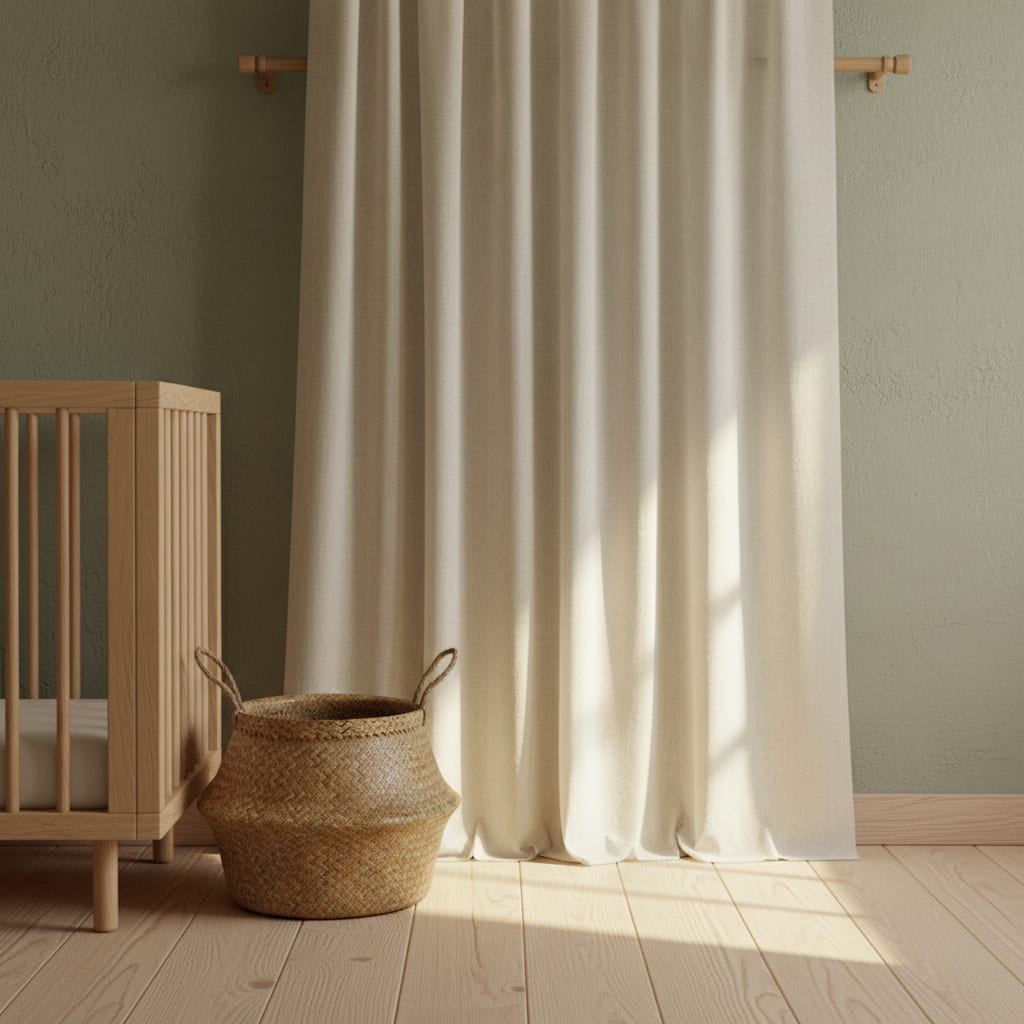
3. Curtains on a wrap-around rod, mounted high and wide. This is what solved it in our house, and the rod does more of the work than the curtain. A wrap-around rod like the Umbra Twilight set (48 to 88 inches) curves back to the wall so the panel returns flush, killing the side leak that ruins most blackout curtains. Pair it with a lined panel — NICETOWN’s 100% blackout panels are rod-pocket with a black liner, 84-inch drop, 52 inches wide each — and mount the rod near the ceiling rather than just above the window. Two things happen at once: the side leak closes, and the lowest fabric sits several feet above a crib rail. The failure mode arrives later — a toddler out of the crib can pull the whole assembly down, so anchor into studs, not drywall plugs alone.
4. Change nothing at the window and move the crib. Free, and the first thing both safety sources above recommend. If the opposite wall works, you have solved the reach problem, the cord problem and the light-on-the-face problem in one afternoon.
Travel is the opposite problem
The suction-cup panel that fails in your nursery is the right tool in a hotel, because what makes it fail — a child alone with it for eleven hours — is not happening there. Sleepout’s portable curtain runs 60 by 40 inches or 86 by 54, weighs around a pound, hangs from locking suction-cup mounts with Velcro edge strips, and lists at $129 for a single at the time of writing. Expensive for a curtain, cheap against a lost nap, and it packs smaller than everything else you are carrying — the trade-off that runs through travel sleep setups generally.
Check that it is the light before you spend
Blackout gets blamed for early waking more than it deserves. If the blind came down at 5:40 and the wake was at 5:40, causation can run either way — and light is one of three environmental variables. Measure the other two before re-buying: room temperature at crib height, the number almost nobody checks, and whether the sound floor drops out overnight, which produces a wake at the moment the machine stops. Betteroo’s rundown of the darkening options people try first is a reasonable second read, and where the real complaint is the 5 a.m. wake and its usual causes, a darker room is only part of the answer. To triage the whole picture at once, Betteroo runs a free two-minute read on where your nights are breaking.
What I am not recommending
Cord cleats and wind-up devices, as the answer. Better than a loose cord, but CPSC’s wording is that measures like these reduce the hazard without removing it — a stopgap for the week before the cordless replacement lands, not a plan.
Blackout film or foil taped to the glass in a room with a mobile baby: a peelable sheet at hand height, and the pieces end up in a mouth. And nothing extra goes into the crib to solve a window problem — whatever happens at the window, the sleep surface stays bare.
FAQ
Does a nursery actually need to be pitch dark? It helps some children a great deal and does nothing measurable for others. Test it rather than assuming it — if your child already sleeps through a bright 5 a.m., darkening the room adds nothing.
My blind has a cord and I rent. What do I do this week? Move the crib to another wall today — free and immediate. Cordless replacements for standard windows are inexpensive and reversible; store the original and re-hang it when you leave.
Will a shade my baby can reach just get destroyed again? If it mounts inside the frame, probably. That is the argument for the wrap-around rod near the ceiling instead: the point is not a tougher shade, it is putting the fabric out of range.
Do naps need the same blackout as nights? Same room, same setup — one configuration is easier to hold than two. A nap that ends after thirty minutes in a dark room is usually a timing problem, not a light one.