Bottom line up front: a baby monitor is worth buying and worth setting up so you look at it less. Four specs decide the hardware — a secure link that does not depend on the internet, a parent unit whose battery survives the night, sound-activated screen wake, and honest range for your house. What decides whether the monitor helps your sleep is a behaviour question: babies are noisy in light sleep, video makes that noise visible, and a parent who goes in for every grunt is frequently the one ending the sleep cycle rather than rescuing it.
I have owned four monitors across two kids and lost more sleep to one of them than to either baby. Affiliate links never change my verdicts.
The four specs that decide the purchase
A closed radio link. A dedicated monitor with digital FHSS transmission pairs a camera to one handheld unit and never touches the internet — no account, no cloud storage, no monthly fee, and no attack surface bigger than your street. This is the reasoning I laid out at length in my non-WiFi monitor roundup, and it has only got more persuasive.
Parent-unit battery. The spec that determines whether the monitor annoys you every single day. A unit rated for a full night of video, or considerably longer in audio-only mode, stays on your nightstand. One that dies at 4 a.m. fails the job description.
Sound-activated screen wake, usually labelled VOX. The screen and speaker stay dark until the room passes a noise threshold. This is the single most underrated feature on a monitor spec sheet, and I will come back to why.
Range, read sceptically. Manufacturers quote open-field numbers; walls and floors tax them hard. Use the figure as a relative measure between models rather than a promise, and insist on an out-of-range alert.
Everything else — pan and tilt, temperature readout, lullabies, two-way talk, multi-camera pairing — is a convenience. Useful conveniences, some of them. None of them is the reason a monitor works or does not.
What the screen does to your own night
Here is the trade nobody puts on the box. A video monitor converts a sound you would have slept through into a picture you feel obliged to look at.
The pattern goes like this. The baby grumbles. You are awake anyway, so you glance at the screen. They are moving, so you keep watching. Two minutes later they have resettled and you are wide awake with a bright rectangle in your retinas at 2:40 a.m. Nothing happened, the baby slept through the entire episode, and you did not.
Compound that over months and the monitor has cost you more sleep than it has saved. A monitor is the one screen by the bed that every sleep guide forgets to mention, and it has a pull no phone can match.
The app-connected tier intensifies it, because now there is data — a sleep score, a wakings graph, a chart that quantifies a bad night with precision. I compared what those systems actually measure in my Nanit and Owlet breakdown, and the honest summary is that the numbers are interesting but they are not instructions, and reading them at 3 a.m. helps nobody.
The noises that were never a wake-up
The thing that fixed our nights was not a device. It was learning what normal infant sleep sounds like.
Babies, and newborns especially, spend a large share of their sleep in an active phase where they squirm, grunt, half-cry, flutter their eyelids, breathe irregularly and shift position — all while genuinely asleep. On an audio monitor you hear a snuffle. On video you watch a whole performance, and the instinct to intervene climbs accordingly.
If you go in during that phase, you are frequently the reason the sleep ended. The baby was cycling; the picking up was the interruption. Betteroo’s explainer on what active sleep looks like is the clearest description of it I have found, and reading it changed how I used my monitor more than any firmware update ever did.
The practical version: give a noise a beat before you move. A real wake-up escalates and does not resolve; active-sleep noise plateaus and fades. Most parents can tell the difference within a fortnight of deliberately waiting, and the ones who cannot are usually being kept in the loop by a screen rather than by their ears.
Setting a monitor up so it does less damage
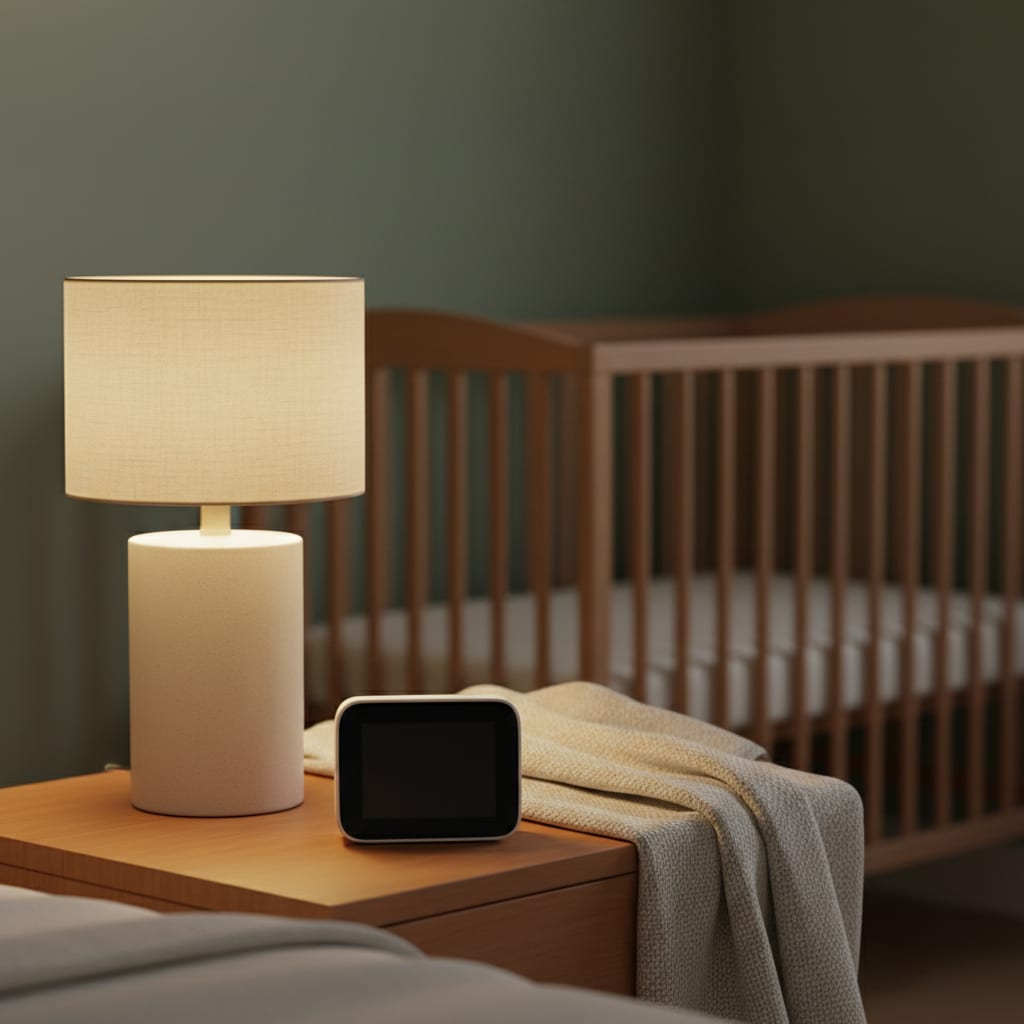
Turn VOX on and leave it on. A dark, silent parent unit that lights up when it matters is the whole point. A unit like the VTech VM924 has sound activation, a cry indicator, encrypted no-WiFi transmission and a battery rated for a full night of video or roughly double that in audio-only — which means you can run it as an audio monitor overnight and still have the camera for naps and the toddler years.
Consider going audio-only for the newborn stage. For the first months the only question a monitor answers is “is the baby crying”, and a DECT audio unit like the VTech DM221 answers it for a fraction of the price, with a sound-level LED strip you can read across a room and no picture to study. Video earns its keep later, when silent and asleep stop meaning the same thing.
Drop the brightness and turn the unit away from you. If the screen is the last thing you see, it is also the first thing you will look at.
Set a personal rule before bed, not during the night. Ours was: no screen unless the sound is still escalating after a count of sixty. Decisions made at 2 a.m. are not decisions.
Rule out the boring causes before you watch anything. Temperature and timing account for a large share of the wake-ups people end up monitoring, and both are checkable in daylight — the room number is the one nobody verifies, which is the point of my nursery temperature guide.
The limit worth stating out loud
No consumer monitor, camera or wearable, is a medical device, and the American Academy of Pediatrics has consistently said home cardiorespiratory monitors should not be used as a strategy to reduce the risk of sleep-related infant death. Safe sleep practice does that work: firm flat surface, on the back, empty crib, room-sharing.
Which reframes what you are buying. A monitor tells you your baby is awake. It has no opinion on why, and no plan for what to do about it. If the why is the part that has gone wrong, the answer is a schedule rather than a sharper picture — and the two-minute Betteroo questionnaire builds an age-matched one for free, which is a cheaper first move than upgrading the camera.
FAQ
Can watching the baby monitor make sleep worse?
It can make your sleep worse, and indirectly your baby’s. Video makes normal active-sleep movement visible, which pulls parents into intervening during a phase the baby would have slept through, and a lit screen at 3 a.m. wakes you up properly. Sound-activated screen wake fixes most of it.
Is a video monitor or an audio monitor better for newborns?
Audio is genuinely sufficient for the newborn months, when the only question is whether the baby is crying. Video becomes more useful from around the rolling stage onward, when seeing what is happening saves you a trip into the room rather than causing one.
Do baby monitors prevent SIDS?
No. Consumer monitors are convenience devices, not medical ones, and the AAP does not endorse home cardiorespiratory monitors as a way to reduce sleep-related death risk. Safe sleep practices are the intervention with evidence behind them.
Should I turn the monitor off at night?
Turning it off entirely is a personal call and not one I would push either way. The middle path most families land on is leaving it on with sound activation enabled and the screen dark, so you hear a genuine cry and sleep through everything else.
Are monitor sleep scores and wake counts worth paying for?
They are interesting data and poor instructions. A wakings graph will not tell you what to change, and checking it in the middle of the night reliably makes a bad stretch feel worse. If you like the numbers, look at them in daylight, weekly, alongside the schedule rather than instead of it.