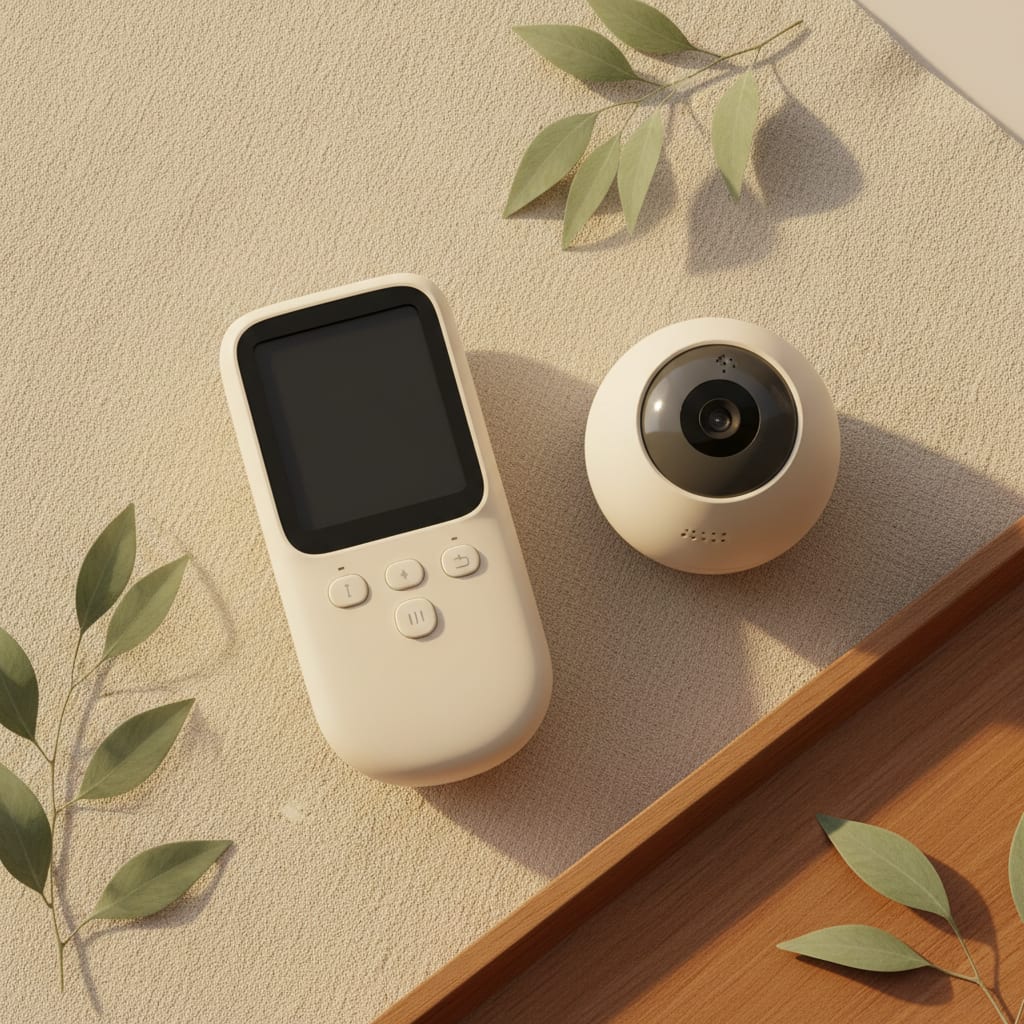
Bottom line up front: the best baby monitor without WiFi is a dedicated video unit with a digital FHSS radio link — for most homes that’s the standard handheld class at roughly $60–$120, stepping up to a large-screen long-range model only if you have a big house or a garden to cover. No account, no cloud, no monthly fee, and no way for anyone on the internet to see your nursery, because your nursery never touches the internet.
I went into monitor research as the resident privacy nerd of my mom group and came out more convinced, not less. Here’s the reasoning, the specs that matter, and four named picks. Affiliate links never change my verdicts.
Why non-WiFi is the privacy-nerd choice
A WiFi nursery camera is a small internet-connected computer pointed at your sleeping child. That means a cloud account that can be phished, firmware that needs patching, a company server holding your video streams, and — as recurring news stories about compromised nursery cams keep demonstrating — an attack surface that includes the entire internet. Even when nothing goes wrong, your footage’s privacy rests on a vendor’s retention policy and security budget.
A non-WiFi monitor is a closed radio link between exactly two devices. Modern ones use digital transmission with FHSS — frequency-hopping spread spectrum, the same family of technique DECT cordless phones use — where the signal hops across channels many times a second and the camera pairs to its own handheld unit. To intercept it, someone needs specialized radio equipment and physical proximity to your house. That’s not “unhackable” — no radio is — but it shrinks the threat model from “anyone, anywhere, forever” to “a person with unusual gear parked on your street.” I know which one lets me sleep.
The honest trade-offs: you can’t check the nursery from the office, there’s no cloud clip history, and range is finite. If remote viewing is a genuine daily need — a traveling partner, a caregiver check-in — a WiFi camera earns its risk. For the actual core job, hearing and seeing your baby from elsewhere in the house, it’s paying in privacy for a feature you’ll rarely use.
The specs that actually matter
- Digital FHSS transmission. This is the non-negotiable line. Old analog monitors broadcast in the clear — neighbors with the same model could famously hear each other’s babies. Any current digital FHSS unit closes that hole; confirm the listing says digital, not just “secure.”
- Range — and how to read it. Manufacturers quote open-field numbers, commonly in the 600–1,000 ft range. Indoors, every wall and floor taxes that hard; a realistic expectation is a fraction of the claim. The spec still matters as a relative measure: a 1,000 ft-rated unit will outreach a 600 ft one in the same house. Out-of-range warning beeps are the feature that tells you when you’ve walked too far.
- Parent-unit battery. This is the spec that determines whether the monitor annoys you daily. Look for models rated around 8–12 hours in eco/VOX mode; anything that dies overnight on your nightstand fails the entire job description.
- VOX / voice activation. The screen and speaker sleep until the baby makes noise. Saves the battery above and, more importantly, spares you eight hours of white-noise broadcast.
- The useful extras: remote pan-tilt-zoom (so a repositioned baby doesn’t mean a trip upstairs), temperature display, two-way talk, and multi-camera pairing if a second kid is anywhere in the plan.
The comparison table
| Category | Typical price | Claimed range class | What you get | Best for |
|---|---|---|---|---|
| Audio-only DECT | ~$25–$50 | ~900–1,000 ft | Sound, out-of-range alert | Small homes, minimalists, backup unit |
| Standard video handheld | ~$60–$120 | ~600–1,000 ft | 4–5 in screen, VOX, temp, two-way talk | Most families — the default buy |
| Long-range large-screen | ~$150–$250 | ~1,000 ft+ | 5–7 in screen, pan-tilt-zoom, stronger link | Big or dense-walled houses, garden coverage |
| Multi-camera system | ~$120–$250+ | Varies | Split-screen or scanning between 2+ cams | Two kids, two rooms |
Picks by category
The default buy: the VTech VM924 (roughly $110–$140). A 5-inch screen, remote 360-degree pan with 132-degree tilt and zoom, encrypted FHSS transmission with no account and no cloud, a claimed 1,000-foot range, auto night vision, two-way talk and a nursery temperature readout. The parent unit is rated to about 17 hours of video or 31 in audio-only mode, which is the spec I’d actually shop on — battery rating is what separates otherwise identical monitors. The remote pan is the feature that stops being a gimmick the week your baby starts rolling out of frame.
The minimalist: the VTech DM221 (roughly $35–$45). Before assuming you need video at all, sit with this: for the first months the question is “is the baby crying,” and DECT 6.0 audio answers it for a quarter of the price, with a five-level sound-indicator LED strip you can read across a room, a vibrating alert for loud houses and talk-back intercom. This is the minimalist registry answer, and plenty of families never feel the gap. Video earns its price at the toddler stage, when “silent” and “asleep” stop being the same thing.
The big house: the VTech VM919HD (roughly $170–$200). A 7-inch 720p screen, 360-degree pan-tilt-zoom, a 110-degree wide angle that covers a whole nursery without panning, and the same no-WiFi secure transmission. If the nursery-to-kitchen path crosses three floors or brick walls, buy the strongest radio in the class rather than discovering dead zones the hard way. The honest catch: bigger screen, shorter battery — this one is rated around 15 hours, and you will keep it docked.
Two rooms: the VTech VM924-2 (roughly $160–$200). The same unit as the default pick with a second camera in the box, split-screen or auto-scanning between rooms. If a sibling is plausible within the monitor’s lifespan, buying a system that supports extra cameras costs nothing extra up front; buying the two-camera bundle only makes sense once the second room actually exists.
The cost math
Non-WiFi monitors have a number smart cameras quietly don’t: a total cost that equals the sticker price. The subscription-backed camera systems commonly run on the order of $5–$30 a month for full features — over a typical three-year monitoring career, that’s roughly $180–$1,000 on top of hardware. A $90 FHSS handheld is $90, forever, and it still works when your internet is down.
One boundary worth stating: a monitor is a convenience device, not a safety device — no consumer monitor, WiFi or not, prevents anything. The monitor tells you the baby is awake; it has no opinion on why, or what to do at 2 a.m. For that half of the problem, the wake windows chart and a plan that adapts — the thing I ended up crediting in my Betteroo review — did more for our nights than any camera.
FAQ
Can a non-WiFi baby monitor be hacked?
Not from the internet — there’s no internet involved. The realistic risk is radio interception, which for a modern digital FHSS unit requires specialized equipment within radio range of your home, an attack model that’s expensive, local and rare. Avoid old analog units, which really could be overheard, and you’ve addressed essentially the whole threat.
What range do I actually need?
Manufacturer ratings are open-field numbers; indoors, expect a fraction of the claim once walls and floors get involved. For an apartment or single-story home, any standard 600 ft-class unit is fine. For multi-story houses, thick walls, or baby-asleep-inside-while-you’re-in-the-garden use, buy the 1,000 ft class and confirm it has an out-of-range alert.
Is audio-only enough, or do I need video?
For a newborn in a bassinet, audio genuinely covers the job. Video earns its price once the baby moves — distinguishing a resettling grumble from a stuck-limb complaint without opening the door is what you’re paying for, and by toddlerhood the ability to see silent mischief is worth the difference.
Do non-WiFi monitors work without internet at all?
Yes — that’s the entire point. The camera and parent unit talk directly over their own radio link, so the monitor works during an outage, in a cabin with no service, and in a house with no router. Nothing to configure, no account to create, no firmware server to depend on.