Bottom line up front: the safe teething remedies are the boring ones: a firm rubber or silicone teether chilled in the fridge (not frozen), a cold damp washcloth to gnaw, and a clean finger rubbed along the gums. The popular shortcuts are the ones to skip. The FDA warns that benzocaine and lidocaine gels, homeopathic teething tablets and teething jewelry such as amber necklaces “can be dangerous to children and can lead to serious injury, and even death.” For pain relief beyond that, ask your pediatrician or pharmacist. This page does not give doses.
Sources, all loaded and read on 15 October 2026: the FDA’s consumer update on safely soothing teething pain (content current as of 26 June 2024), the AAP’s HealthyChildren pages on teething pain relief, when teething starts and teething necklaces, and the NHS page on helping a teething baby.
Numbing gels: the one most people already own
Benzocaine is the numbing ingredient in many mouth-pain products; the FDA names Anbesol, Cepacol, Chloraseptic, HurriCaine, Orabase, Orajel and Topex, and says these “should not be used for teething pain in children because they can be dangerous.” The risk is methemoglobinemia, “a serious, and sometimes fatal, condition” in which “the oxygen-carrying capacity of red blood cells is greatly reduced.”
They also “offer little to no benefit,” per the FDA. HealthyChildren explains why: “excess drool washes them away quickly,” and they can numb the throat, “making it hard for them to swallow.” Prescription viscous lidocaine gets the same FDA warning, linked to “heart problems, severe brain injury and even death.”
If you have read softer UK advice: the NHS says there is “a lack of evidence that teething gels are effective” and to try teething rings first. For US products, the FDA’s warning is the one that applies.
Amber necklaces: the strangulation risk
The claim is that warm amber releases a pain reliever through the skin. HealthyChildren says “there is currently no scientific research or evidence to back up these claims,” and elsewhere that amber necklaces “do not do anything at all to relieve pain, and have caused cases of choking and strangulation.”
The FDA says it has “received reports of death and serious injuries to infants and children, including strangulation and choking, caused by teething jewelry, such as amber teething necklaces.” HealthyChildren notes the FDA’s December 2018 warning followed an 18-month-old being strangled by an amber necklace during a nap.
Switching material does not fix it. HealthyChildren says teething necklaces “made of amber, wood, marble or silicone pose serious risks for choking and strangulation.” The AAP “does not recommend that infants wear any jewelry,” and the NHS says to never tie even an ordinary teething ring around a baby’s neck.
If a necklace is already in the house, the AAP’s caution page tells parents to remove it whenever the child is sleeping, “day or night,” or unattended. My advice is simpler: put it in a drawer.
Homeopathic tablets and other “natural” remedies
The FDA groups homeopathic teething tablets with the gels as products that “can be dangerous to children.” HealthyChildren says they “provide no benefit, and in some cases they have been made with potentially harmful toxins.” Its list of products to avoid names tablets or gels “particularly those containing belladonna or coffea cruda,” and adds: “Although derived from plant sources, these ingredients may be dangerous for infants.” A plant source is not a safety rating.
The same AAP list rules out alcohol on the gums (“quickly absorbed into a child’s bloodstream,” with a risk of seizures) and liquid-filled teethers, which “can tear or spring a leak” and whose liquid “may also be contaminated with harmful bacteria.”
What actually helps, and what to buy
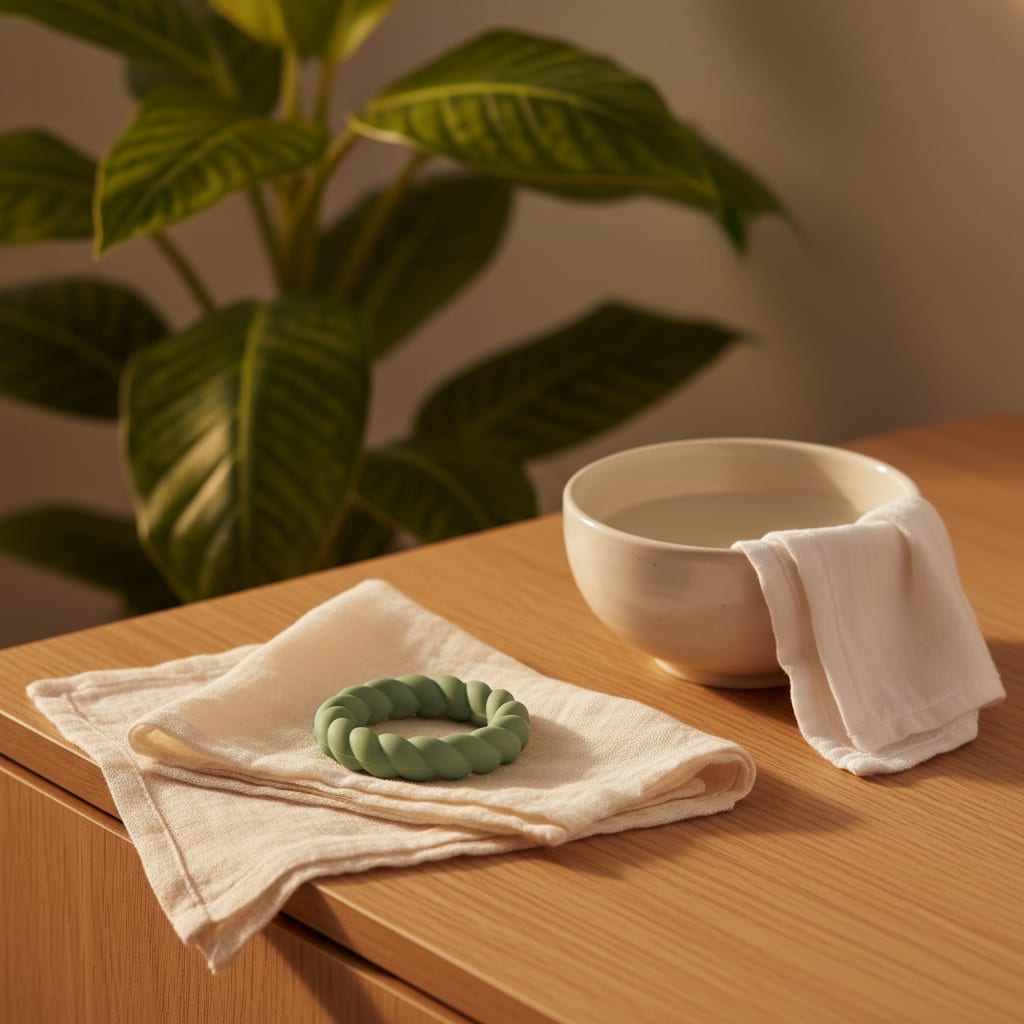
The FDA’s advice: “gently rub or massage the gums with your finger, or give the child a firm (not liquid-filled) teether made of rubber to chew on. Make sure the teething ring is not frozen. If the object is too hard, it can hurt the child’s gums.” It also says to supervise, so a child does not choke on the teether.
A firm silicone or rubber teether. The Comotomo Silicone Baby Teether is a good example. Babylist’s listing (checked 15 October 2026) describes it as “100% food-grade silicone” and safe in dishwashers and sterilizers. The spec is one firm piece with no liquid inside, the same rule as in my best toys for a 6-month-old FAQ. The Baby Banana teether-toothbrush from the baby stocking stuffers list also fits.
Chilled, not frozen. The NHS says some teething rings “can be cooled first in the fridge” but never to put one in the freezer.
A cold washcloth. HealthyChildren suggests twisting a damp washcloth, putting it in the freezer, and tying a knot in one end “for better gnawing.” Plain cotton cloths like Burt’s Bees Baby washcloths work. The same page says not to let a baby chew directly on anything “frozen solid.”
For babies already on solids. HealthyChildren mentions “special teething devices that let your baby safely suck on an ice cube or a piece of frozen fruit.” A mesh Munchkin Baby Fruit Feeder is the usual version. The NHS adds that once weaning has started, from about six months, raw fruit and vegetables can be chewed on, always watched in case of choking.
Teething at night
At bedtime, HealthyChildren suggests building comfort into the routine: a comforting bath, a gentle massage, and “a little white noise,” kept low. My guide to how loud white noise should be covers that last part. For wake-ups, the AAP suggests “light, focused pressure on the gums or a gentle gum massage” or “a cold teething cloth,” and letting your child gnaw on your fingers. HealthyChildren says this “can be especially comforting” at night.
Three rules for the dark hours:
- The teether comes out of the crib with you. The FDA’s supervision rule makes a teether a tool for awake, watched chewing.
- No bottle to fall asleep on. HealthyChildren’s when-teething-starts page says “never let your baby fall asleep with a bottle,” because the milk pools around new teeth.
- Do not blame everything on teeth. Teething can cause “a slight rise in temperature (but not over 101 degrees Fahrenheit or 38.3 degrees Celsius).” Above that, HealthyChildren says “it’s probably not from teething” and to call your pediatrician. Get an accurate reading first; my baby thermometer guide covers the method for each age.
If teething seems to be wrecking every night, Betteroo’s guide to how teething plays out across a night also makes the chilled-not-frozen point and covers what else might be waking your baby. If the nights were rough before the first tooth appeared, Betteroo has a short quiz that separates a teething blip from a schedule problem.
Pain relief: ask, don’t guess
HealthyChildren says that if your baby “seems very uncomfortable, ask your pediatrician about remedies such as acetaminophen.” The NHS says, if you are not sure, to “speak to a GP or pharmacist.” Which medicine and how much is their call, not a review site’s.
FAQ
Are teething gels safe for babies?
Not the numbing kind. The FDA says benzocaine products should not be used for teething pain in children because they can cause methemoglobinemia, a serious and sometimes fatal blood condition, and that they offer little to no benefit.
Do amber teething necklaces work?
No. HealthyChildren says there is no scientific evidence behind the claims, and the FDA has reports of children strangled or choked by teething jewelry. Wood, marble and silicone necklaces carry the same risk.
Are homeopathic teething tablets safe?
The FDA groups them with products that can be dangerous to children. The AAP says they provide no benefit and singles out tablets or gels containing belladonna or coffea cruda.
Can I put a teether in the freezer?
Chill it in the fridge instead. The FDA says to make sure a teething ring is not frozen, because too hard an object can hurt the gums. The AAP’s freezer suggestion is for a twisted damp washcloth, not a teether.
What is the safest thing to give a teething baby at night?
Gentle gum pressure or a cold teething cloth when your baby wakes, with comfort built into the bedtime routine. Take any teether out of the crib before you leave.