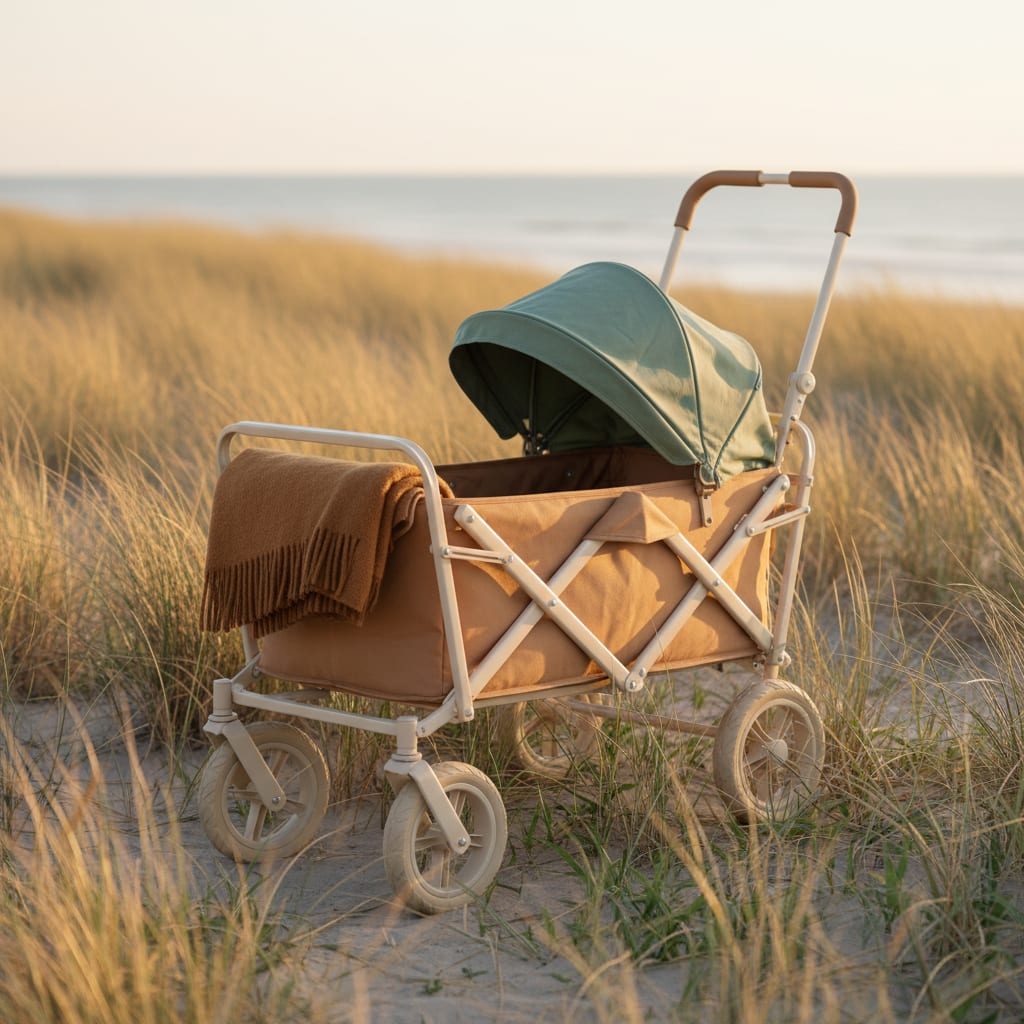
Bottom line up front: a stroller wagon is worth buying if you have two or more kids past the infant stage and an outdoor-heavy schedule — parks, beaches, sports sidelines, campgrounds — and for that family, the mid tier at roughly $200–$350 covers most needs, while the premium tier at roughly $450–$700 earns its price on push-handling and build quality. If you have one child and mostly paved, urban errands, skip the category entirely: a good stroller does that job better for less money and less trunk space.
I resisted stroller wagons for a full year as an overpriced fad, then borrowed one for a beach week and understood. This is the guide I wish I’d had before that argument with myself. Affiliate links never change my verdicts.
What a stroller wagon actually is — and isn’t
A stroller wagon is a wagon with stroller manners: forward-facing seats with harnesses, a push handle (not just a pull handle), canopies, and safety-standard certification for carrying children, which ordinary garden wagons don’t have. The good ones push like a wide stroller; the cheap ones push like a shopping cart with opinions.
What it isn’t: a primary stroller for a young baby. Most models are rated for kids who can sit unassisted — commonly around six months and up — and even then, a wagon is the second vehicle, not the first. It also isn’t universally welcome: some venues, including certain major theme parks, prohibit wagons of all kinds, so check the rules before building a vacation around one.
The specs that decide it
- Push handling. The single biggest quality gap in the category. Premium wagons track straight and turn with one hand; budget wagons wander and fight on grass. If you can only test one thing, push the wagon one-handed across turf.
- Seat capacity and harnesses. Two seats is standard; the biggest models take four. Real five-point or three-point harnesses, not lap belts, are the line between a kid-carrier and a cargo cart.
- Weight. Most stroller wagons run somewhere in the 25–40 pound range before you add children and snacks. That number decides whether it gets lifted into a trunk cheerfully or resentfully.
- Fold size. Measure your trunk before you fall in love. Some fold flat-ish; some fold into an object that still dominates a small hatchback.
- Terrain hardware. Big wheels and beach-capable tires are what separate the outdoor tiers; if your life is sand and gravel, this is where the premium money goes.
- Canopies and storage. Sideline afternoons are the wagon’s home turf — full-coverage canopies and real snack/gear storage get used every single time.
The comparison table
| Tier | Typical price | What you get | Best for |
|---|---|---|---|
| Garden wagon (not a stroller wagon) | ~$70–$150 | Cargo hauling only, no child certification | Gear, groceries, not kids |
| Budget stroller wagon | ~$150–$250 | Seats and harnesses, basic wheels, heavier push | Occasional park trips, tight budgets |
| Mid-range | ~$200–$350 | Better fold, canopies, decent handling | Most wagon families — the default buy |
| Premium | ~$450–$700 | Stroller-grade push, terrain tires, best build and resale | Beach/outdoor-heavy families, 3+ years of use ahead |
Who should buy which
The default buy: the Evenflo Pivot Xplore (roughly $280–$350). The handle flips, so the same wagon pushes like a stroller through a zoo turnstile and pulls like a wagon across grass — which is the trick that makes this category work at all. All-terrain wheels, UPF 50+ canopies over both seats, a three-position telescoping handle and 55 pounds per seat, so it lasts to roughly age five. Choose within this tier on fold size and canopy coverage; those are the two features you interact with every single outing.
The outdoor-heavy family: the WonderFold W4 Elite (roughly $600–$700). Four face-to-face seats with five-point harnesses and footrests, an adjustable canopy and push handle, a steel frame rated to 300 pounds, storage on every side, and a one-step fold. It also weighs about 53 pounds empty — that’s the honest cost of the build, and it’s a number to check against your trunk and your own back before you buy. Sand, gravel, campgrounds and daily sideline duty are where this tier stops being a luxury. These wagons hold resale value unusually well, which quietly shrinks the real cost of ownership.
The one-kid family: probably no wagon. One child’s gear fits under a stroller. A wagon for one is a lot of trunk space for the occasional picnic; rent or borrow for the beach week instead. If travel is the actual problem you’re solving, my travel stroller guide is the better rabbit hole.
The “it’s on the registry” family: wait. A wagon bought before the baby sits up is a garage ornament for six-plus months. This is a classic keep-the-registry-lean item — see my minimalist registry reasoning — because the need, if it comes, announces itself loudly around toddlerhood.
The cost math
Wagons look expensive until you count the years. The useful window runs from sitting age to roughly age five — call it four years with two kids overlapping. A $600 premium wagon over four years is about $12.50 a month; sell it used at the strong resale prices these hold and the net cost drops meaningfully further. Compare that with my Snoo math, where the entire useful life is measured in months — a wagon is the opposite shape of purchase, and that’s exactly why the premium tier can be rational here while it often isn’t elsewhere.
The counter-math: a $250 mid-range wagon used one summer and abandoned is the worst cost-per-use in this guide. The purchase only works if your actual weekly life includes the terrain and the passenger count.
FAQ
Can a stroller wagon replace a double stroller?
For sidewalk-heavy, errand-shaped life, no — a double stroller is narrower, lighter and welcome everywhere. For park, beach and sideline life, the wagon is genuinely better: kids face each other, gear rides along, and off-pavement handling wins. Families with both use both for different days.
What age can a baby ride in a stroller wagon?
Most manufacturers set the line at sitting unassisted — commonly around six months — because the seats are upright benches with harnesses, not recliners. Check your specific model’s rating, and don’t rush it; the wagon years start at toddlerhood anyway.
Are stroller wagons allowed at theme parks?
Often not — several major parks, including the Disney parks, prohibit wagons entirely, stroller-style or otherwise. Policies change and vary by park, so check the venue’s current stroller rules before packing one for a trip. For travel days, a compact stroller remains the safer bet.
Are the premium stroller wagons worth double the price?
Only if your terrain demands it. On smooth pavement, a mid-range wagon does the job and the premium push-quality is a nice-to-have. On sand, turf and gravel — the places wagons actually beat strollers — the handling and wheel difference is the whole product, and the strong resale value closes much of the remaining gap.