Bottom line up front: the best high chair for a small space is usually not a smaller high chair — it’s a different category. A hook-on seat or a booster strapped to a dining chair you already own takes the floor footprint to zero, and between them they cover most small-kitchen families for roughly $30–$60. If you specifically want a standalone chair, buy on measured footprint and wipeability, and be suspicious of “compact fold” claims that still leave a folded slab against your wall.
I taped out footprints on my own kitchen floor for this one, because “compact” on a product page is doing a lot of unsupervised work. Affiliate links never change my verdicts.
The footprint math nobody publishes
A high chair’s real cost in a small kitchen is square inches of floor you stop owning three times a day. Standalone chairs with splayed legs commonly claim stability from a base in the neighborhood of 20 by 20 inches — call it 400 square inches, about the floor space of a dishwasher door mid-cycle. In a galley kitchen or an apartment dining nook, that’s the difference between walking past the table and turning sideways.
So sort the market by what actually touches your floor:
| Class | Floor footprint | Typical price | The catch |
|---|---|---|---|
| Hook-on / clamp-on seat | Zero | ~$35–$70 | Needs a compatible table; weight limits |
| Booster on a dining chair | Zero (uses a chair you own) | ~$25–$60 | Your chair does the stability work |
| Slim-leg standalone | Small, but real | ~$20–$40 | Minimal padding, no recline, no wheels |
| Folding standalone | Full size in use | ~$60–$250 | Folded slab still needs a home |
| Convertible tower chair | Full size, permanent | ~$100–$300+ | Earns it only if it truly replaces a chair |
Picks by class
The space-eraser: a hook-on seat (~$35–$70). Clamp-on seats — the Inglesina-style fabric ones are the category’s standard-bearer — attach to the table edge and put the baby at the table with literally no floor cost. Check your table first: they need a solid edge of the right thickness, and pedestal tables and thin or glass tops can be dealbreakers, so read the manufacturer’s compatibility list, not just reviews. Bonus: they pack flat, which makes them the traveling grandparent-house solution too — the same pack-small logic that drives my best travel strollers picks.
The already-own-it play: a chair booster (~$25–$60). A booster with a tray straps to a dining chair and borrows its footprint. This is my default recommendation for small spaces because it’s cheap, it’s wipeable, and when the tray phase ends the same chair often keeps working for years as a plain boost to table height. The stability is your dining chair’s, so use a solid four-legged chair, not a wobbly vintage find.
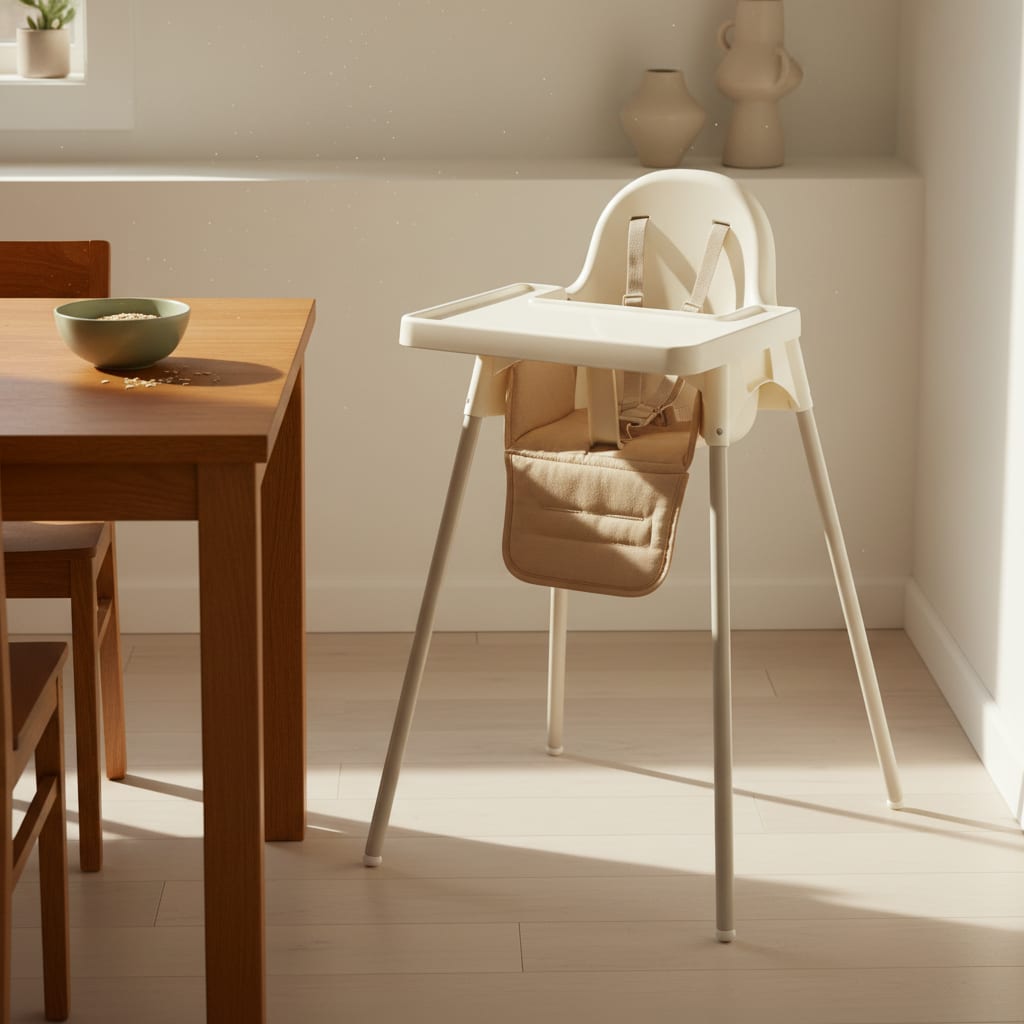
The standalone that respects your floor: the slim-leg classic (~$20–$40). The IKEA Antilop is the famous one for a reason: four thin legs, a footprint that reads as air, a shell you can hose off, and a price that makes the flagship chairs blush. What you give up is padding, recline for the pre-sitting months, and any pretense of luxury. What you get is the easiest-to-clean chair in the category and legs that pop off for storage or car trips.
The folding compromise (~$60–$250). Folding standalones make sense if you need a full-featured chair but only sometimes — a small kitchen that hosts a grandkid weekly, say. In daily use they’re full-size chairs, and the folded slab still needs somewhere to live, so measure that spot with the same tape measure.
One safety note that applies to all of them: high chairs sold in the US are covered by a mandatory federal safety standard, so buy new or known-history, always use the crotch post and straps, and follow the manufacturer’s age and weight limits — especially on hook-ons, where the table is part of the structure.
The cost math
Most kids use a tray-style seat from roughly six months to two years, then a booster or nothing. A $250 convertible chair over that core 18 months runs about $14 a month; the $25 booster is about $1.40. Convertible “grows with your child” towers can genuinely stretch the math if they permanently replace a dining chair — in a small space, a chair that earns a seat at the table forever is arguably the most space-efficient of all. But if it ends up in a corner next to a regular chair, you bought 400 square inches of guilt.
That “buy the cheap version first, upgrade only if it fails you” rule is the same one that runs through my minimalist registry checklist — the high chair is one of the clearest cases where the budget answer is also the best answer.
FAQ
Are hook-on high chairs safe?
Used within their limits, yes — they’re covered by safety standards like other high chair types, and the standard’s rules for them assume a solid, stable table. The real-world risks are user-end: an incompatible or lightweight table, a pedestal base that can tip, or a strong toddler pushing off the table leg with their feet. Check your table against the manufacturer’s requirements and retire the seat at its stated weight limit.
What age can a baby start in a small-space seat like a booster or hook-on?
The same as any high chair: when they’re sitting up steadily and starting solids, commonly around six months — your pediatrician’s guidance beats any product page. Boosters and hook-ons generally don’t recline, so they can’t do the semi-reclined early-feeding phase some padded standalones offer; in practice most families don’t miss it.
Is the cheap slim-leg chair really good enough for daily use?
For the core job — safe seat, wipeable surfaces, baby at counter height — yes, and its wipeability actually beats most expensive chairs, which hide oatmeal in fabric seams and adjustment slots. What it lacks is adjustability and a footrest; if your kid ends up eating in it for years rather than months, a footrest accessory or an upgrade becomes worth discussing.
What should I check before buying any of these for a rental or tiny kitchen?
Three numbers: the floor space you can permanently give up (tape it out), your table edge’s thickness and overhang if you’re considering a hook-on, and the width of the chair you’d strap a booster to. Five minutes with a tape measure prevents almost every regret purchase in this category.