Bottom line up front: a night feeding station is one small caddy beside a firm chair, packed so you never have to stand up mid-feed. Into it go burp cloths, a lidded water bottle for you, a diaper and wipes, a light you can switch on one-handed, and either nursing supplies or a pre-measured formula dispenser. Restock it before you go to bed. Keep the bottle warmer, the crib and the chair as they are. The caddy only exists so the feed itself stays short, calm and dim, and so you are less tempted to feed somewhere soft you might fall asleep.
Sources, loaded and read on 27 October 2026: the CDC’s pages on formula preparation and storage, breast milk storage and Cronobacter, and the AAP’s safe sleep guide on HealthyChildren. Affiliate links never change my verdicts.
Start with the chair, not the caddy
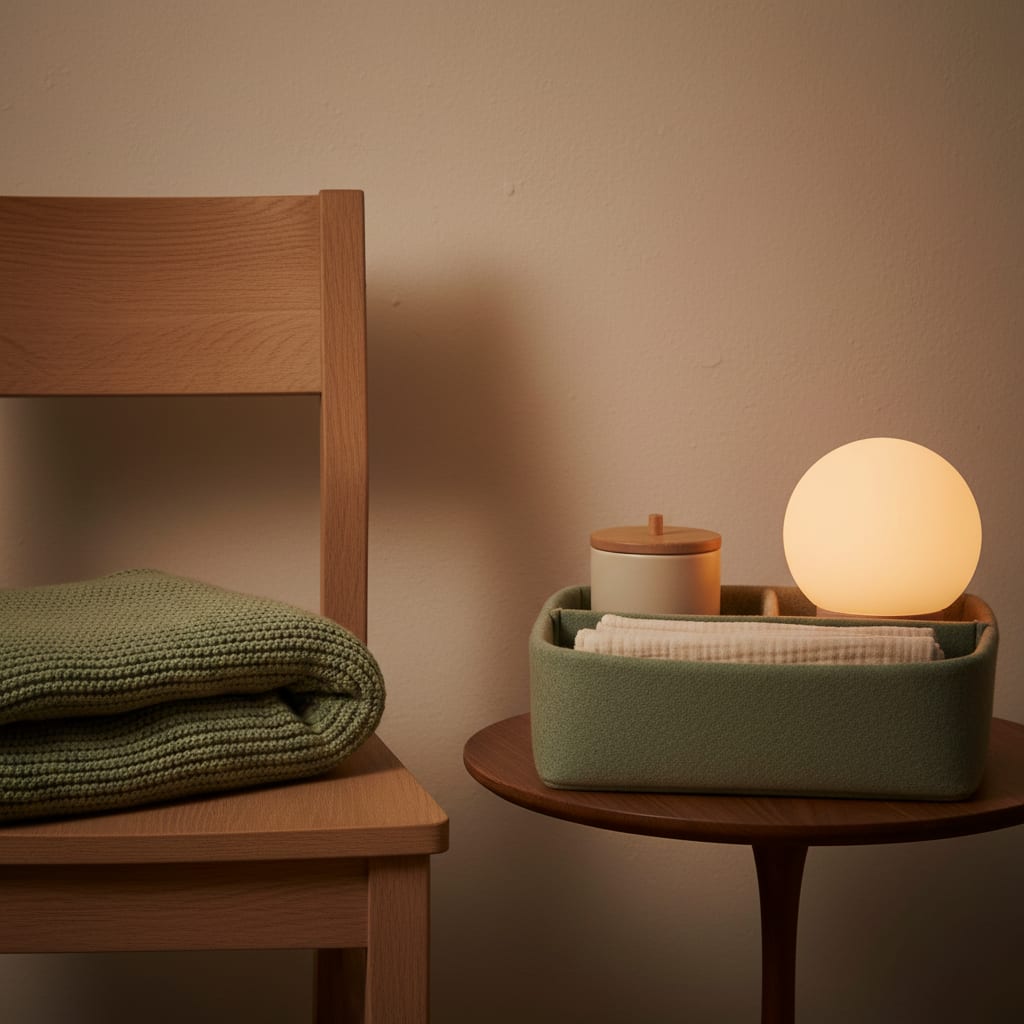
The caddy goes where you feed, so pick the place first. The AAP’s warning is the reason this matters at night: “The risk of sleep-related infant death is up to 67 times higher when infants sleep with someone on a couch, soft armchair or cushion.” A firm, upright chair with a side table or a flat spot on the floor beside it is the setup to aim for. A deep sofa with a blanket over the arm is not.
If you might nod off feeding in your own bed, the same guide says to remove “pillows, blankets, sheets and other items that could cover your baby’s face,” and “if you do fall asleep, be sure to move your baby back to their own sleep space as soon as you wake up.” My side-lying bottle feeding guide covers seating and positions in detail. This page is about what sits within arm’s reach once you are in the chair.
The caddy itself
Anything with a few compartments works. A felt organizer like the Parker Baby Diaper Caddy is sold as a bedside diaper caddy with dividers, which is exactly the job. Choose a soft-sided one that sits flat on the floor or a side table and will not tip if you grab at it in the dark. A shoebox with three sections does the job too.
Keep it on the side of your free hand. If you hold your baby in your left arm, the caddy goes on your right.
What goes in it: the core list
These are the items every night feed uses, whatever you feed.
- Two or three burp cloths. One over your shoulder, one under your baby’s chin, one spare for the spit-up that finds the first two. A pack like the Burt’s Bees Baby organic cotton burp cloths is plenty.
- A lidded water bottle for you. A closed-lid bottle you can sip one-handed, like the Owala FreeSip, beats an open glass.
- One diaper and a small stack of wipes. Only enough for the change you might need mid-feed.
- A dim light you can reach. You need to see milk at the corner of the mouth and a latch, and no more. A night light on a sound machine works if the remote or button is in reach; my Hatch Rest review covers the one most parents already own.
- A spare pacifier, if your baby uses one. Clean, in a lidded case.
Leave your phone out of the caddy if you can. A bright screen is the fastest way to wake both of you up fully.
Add-ons for breastfeeding
- Nursing pads. The side you are not feeding from often leaks. Lansinoh Stay Dry disposable nursing pads are the common choice, or washable ones if you prefer.
- Nipple cream. A small tube of Lansinoh lanolin nipple cream within reach saves walking to the bathroom. If feeding is painful, talk to a lactation consultant or your doctor; a cream does not fix a latch.
- A milk collector, if you use one on the other side. My Haakaa pump review covers what it does and when it is worth having.
Pumped milk has its own clock. The CDC says freshly expressed milk keeps “at room temperature (77°F or colder) for up to 4 hours,” and “if your baby did not finish the bottle, use the leftover milk within 2 hours.” Milk from the fridge or freezer follows a different rule: “once breast milk is brought to room temperature or warmed, use it within 2 hours.” The CDC also says to “never thaw or heat breast milk in a microwave.”
Add-ons for formula, and the timing rules
Pre-measured powder is the safe shortcut. A dispenser such as the Philips Avent formula dispenser holds measured scoops in separate compartments, so you add powder to water at the moment you need it rather than mixing ahead.
A bottle mixed in advance does not keep on the table. The CDC says to “use prepared infant formula within 2 hours of preparation and within one hour from when feeding begins,” and “if you do not start to use the prepared infant formula within 2 hours, immediately store the bottle in the fridge and use it within 24 hours.” Leftovers go: “throw out any infant formula that is left in the bottle after feeding your baby.”
Young or vulnerable babies need a different setup. The CDC lists babies “younger than 2 months old” among those who “could get very sick if they drink formula contaminated with bacteria, such as Cronobacter,” and says that “to kill germs like Cronobacter in powdered infant formula, the formula must be mixed with very hot water.” That is a kitchen job, not a chair-side one. For those weeks, many families keep ready-to-feed liquid formula for nights; the CDC notes that “liquid infant formula is made to be sterile.” Ask your pediatrician which applies to your baby.
If warming is your bottleneck, the bottle warmer comparison covers which types are fast enough at night. A warmer belongs on a counter by a socket, not in the caddy.
What stays out of the caddy
- Anything for the crib. The caddy holds supplies for you. Blankets, pillows and loveys do not go into your baby’s sleep space, however close the caddy sits.
- Medicine. A pain reliever or gas drops in the caddy invites a 3 a.m. dose decided half-asleep. Keep them where you will read the label in full light.
Restock it before bed
The caddy only works if it is full at midnight. A two-minute reset after the last evening feed covers it: clean cloths in, empty water bottle refilled, used diaper out, formula compartments refilled. If two adults share nights, agree on whose job it is. Betteroo’s guide to trading night duty so each parent gets one protected stretch of sleep includes setups for breastfed, pumped-milk and formula-fed babies.
 Fewer 3 a.m. feeds? Start with the schedule
Answer a few questions about your baby's age, feeds and naps, and see a sleep plan built from your answers. It runs in your browser, with nothing to download.
Take the free 3-minute quiz →
FAQ
What should be in a night feeding station?
Burp cloths, a lidded water bottle for you, one diaper and some wipes, a dim light within reach, and a spare pacifier if your baby uses one. Add nursing pads and nipple cream if you breastfeed, or a pre-measured formula dispenser if you formula feed.
Can I make formula bottles ahead for the night?
Only if they go straight into the fridge. The CDC says prepared formula should be used within 2 hours of preparation, or refrigerated and used within 24 hours. For babies under 2 months, the CDC says powdered formula needs very hot water to kill germs, so ask your pediatrician about using ready-to-feed formula at night.
Where should the feeding chair go?
Close to where your baby sleeps, so the walk back is short, and somewhere you can sit upright. The AAP warns that falling asleep with a baby on a couch or soft armchair carries the highest risk, so a firm chair is the safer choice.
Do I need a special nursing caddy?
No. Any small organizer with a few compartments works. The point is keeping everything within reach of your free hand, not the brand.