Bottom line up front: the Haakaa is a silicone milk catcher, not a pump, and the gap between those two things is the whole review. It suctions onto the breast you are not feeding from and collects the letdown that would otherwise soak a nursing pad — often an ounce or two a session in the early weeks. What it cannot do is express milk on demand, cycle like an electric pump, or build a freezer stash on a schedule. At roughly $13 to $20 it is still the highest-value object in my feeding drawer.
I bought mine with my own money for my first baby and used it again for my second. Affiliate links never change my verdicts.
What you are actually buying
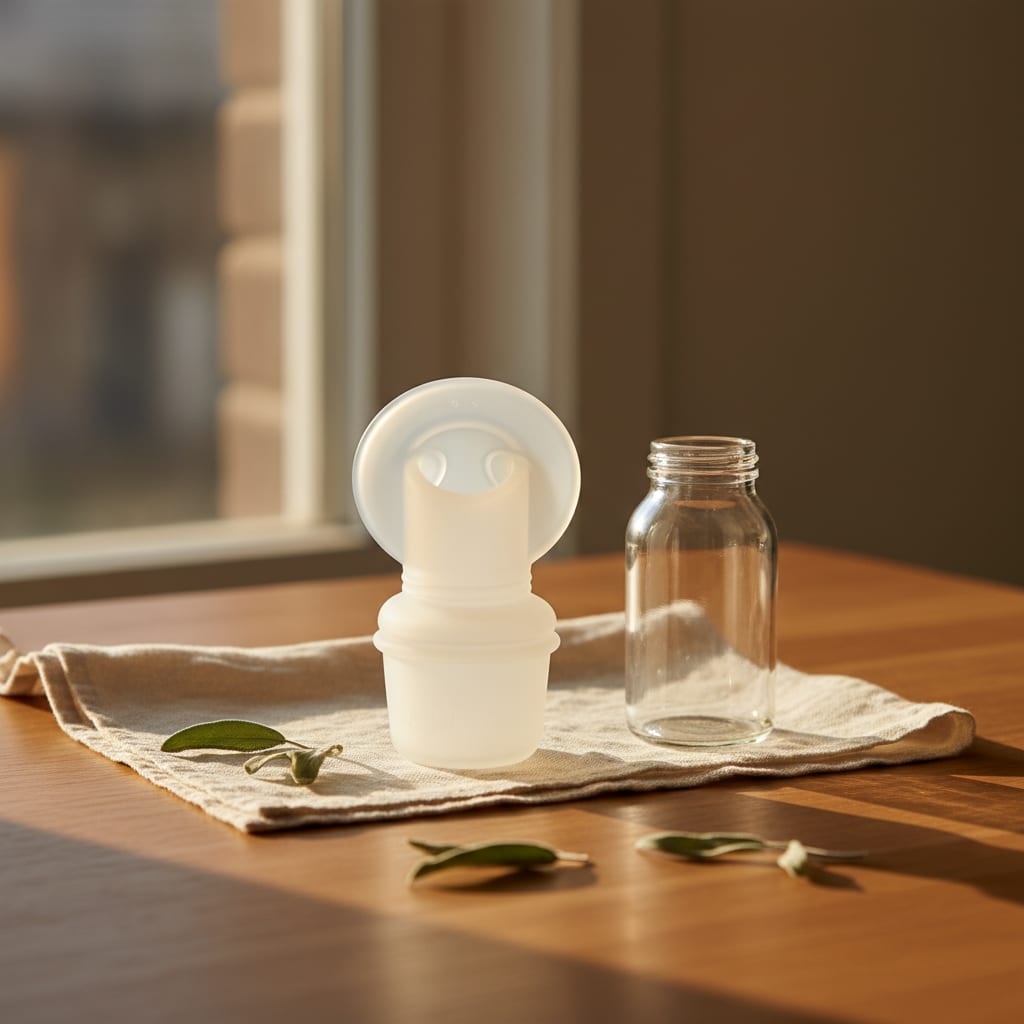
The Haakaa Gen 2 is a single piece of food-grade silicone with a flanged neck, a bulb body, a suction base so it stands up, and a leak-proof cap. There are no valves, no membranes, no tubing and no motor. You fold the bulb, press the flange over the areola, release, and the vacuum holds it in place while your baby feeds on the other side.
That is the entire mechanism. The original 4 oz version is a few dollars cheaper and identical apart from having no base — which matters more than it sounds, because a full one tips.
What it genuinely does well
It rescues letdown. Your milk ejection reflex fires on both sides at once. Without a catcher, the off-duty side drips into a nursing pad and goes in the bin. With one, it goes into a bottle. In my first six weeks that was consistently one to two ounces a feed, which added up to a usable frozen reserve without a single deliberate pumping session.
It is one object to wash. Compare that to a manual pump’s five parts or an electric pump’s flanges, valves, membranes, connectors and bottles, all of which have to be dried before the next use. The Haakaa goes in hot soapy water, gets rinsed, and air dries in ten minutes. When you are recovering from birth, dish load is a real feature.
It travels. It weighs almost nothing, needs no power, and fits in a coat pocket — worth a spot in the hospital bag if you plan to nurse.
It takes the edge off engorgement. A few minutes of gentle suction on a rock-hard breast is enough to soften things for a latch, without the deep drainage that tells your body to make more.
What it does not do
It does not replace a pump. There is no stimulation phase, no expression phase, no cycling and no way to increase suction incrementally. If you go back to work, exclusively pump, need to empty a breast on a schedule, or are managing supply on medical advice, you need an actual pump — and if you want a manual one for occasional use, the Medela Harmony is the one I would put next to it, not instead of it.
It also does not perform on command. Output tracks your letdown, so it is generous in the early weeks and tapers substantially once supply regulates around the two-to-three-month mark. Plenty of people conclude their Haakaa “stopped working.” It didn’t; your body stopped overshooting.
And it is not a measuring device. Milk caught passively on one side tells you nothing reliable about what the baby drank on the other.
The oversupply caveat nobody prints on the box
The Haakaa applies suction, and suction is demand. Used on every single feed, around the clock, it can read to your body as a second baby — and the possible consequences are oversupply, forceful letdown, clogged ducts and a fussier, gassier baby working against a fire hose. Lactation consultants raise this often enough that I treat it as the default caution rather than an edge case.
The fix is not to throw it out; it is to use it deliberately. I used mine at the first morning feed, when supply is highest and the loss is largest, and left it in the drawer for the rest of the day. During the cluster-feeding stretch in the evenings I skipped it entirely, because that is exactly the window where your baby is deliberately placing an order for more.
If you want the collection without the suction signal, a wearable shell is the better tool. The Haakaa Ladybug sits inside your bra and catches drip passively — less volume, no demand message.
The cost math
Roughly $15 buys the Haakaa. A manual pump runs somewhere around $40, and a double electric commonly lands in the low hundreds before insurance. If the Haakaa saves you even a single ounce a day for two months, it has collected several hundred ounces’ worth of attention for the price of a takeaway lunch, and it has done it while you were sitting down anyway.
The honest counter-math: it is not a substitute purchase. Most families end up owning both, which means the Haakaa is an addition to the budget, not a deletion. On a minimalist registry it still earns its slot, because almost nothing else at that price point does a job you cannot do another way.
Practical notes from two babies
Store what you collect the same way you store pumped milk, on the same clock — passive collection does not change the rules. Get the base version; a tipped Haakaa on a sofa is a genuinely upsetting way to learn this lesson. Check the flange against a lit window every few weeks for cracks or cloudiness, because silicone does eventually degrade. And do not size up to the 5 oz body expecting more milk. You will get the same letdown in a bigger cup, plus more weight hanging off your breast.
One last note for the gas-and-fussiness crowd: if a fast, heavy letdown is making feeds miserable, that is a flow problem, and the fixes are positional and paced-feeding ones. My bottles for gas piece covers the equipment side of that, but the Haakaa is not the culprit or the cure.
FAQ
Is the Haakaa a real breast pump?
Not in the sense most people mean. It is a suction-based milk collector with no cycling, no adjustable vacuum and no way to express on demand. It is superb at catching letdown from the side you are not feeding from, and it is not a tool for emptying a breast on a schedule.
Can using a Haakaa cause oversupply?
It can, if you use it at every feed from the start. Suction reads as demand, and demand raises supply — which for some people means clogs, forceful letdown and a struggling baby. Using it once or twice a day, ideally at the morning feed, gets you most of the milk with much less of the risk.
Is the milk collected in a Haakaa safe to keep?
Yes. Treat it exactly like pumped milk: clean container, straight into the fridge or freezer, standard storage timings. The only extra care is the tipping risk while it is attached, which the suction-base version largely solves.
Which Haakaa size should I buy?
The 4 oz with the suction base is the right default for almost everyone. The 5 oz makes sense only if you have a genuinely heavy letdown and are consistently filling the smaller one, and it is noticeably heavier on the breast.
Do I still need a pump if I have a Haakaa?
If you will ever be away from your baby at a feed time — work, a hospital appointment, a night out — yes. The Haakaa depends on a baby nursing on the other side. No baby, no letdown, no milk. If nights rather than feeds are the thing falling apart, that is a schedule question instead of a gear question, and the free Betteroo sleep quiz will get you a plan faster than another purchase will.
Final word
Four stars, docked one only because the marketing photograph of a bottle brimming with milk sets an expectation the product cannot meet past the newborn haze. Judged as what it is — a $15 piece of silicone that stops your letdown going into the laundry — it is close to perfect, and it is the first thing I hand a friend who is about to nurse.