Bottom line up front: Lovevery costs roughly $40 a month across the whole 0–4 range, Monti Kids costs roughly $99 a month across 0–3, and the gap is not explained by twice the toys. It is explained by Montessori-trained support, video walkthroughs and a smaller number of more expensive materials. If you want a genuine Montessori program shipped to your house with a person on the other end, Monti Kids is the one. If you want good, well-made, age-matched toys with no fuss and an exit ramp, Lovevery wins on every axis that matters to most families — including the axis where you buy two items outright and skip the subscription entirely.
I have run play-kit subscriptions in my own house, paid for with my own money, and cancelled both at different points. Affiliate links never change my verdicts.
What each one actually is
Lovevery ships Play Kits on a schedule tied to your child’s age: kits arrive every two months for the 0–12 month range at around $80 a kit, then every three months from age one to four at around $120 a kit. Each kit is a set of wooden and fabric objects plus a play guide that explains what the objects are for and roughly when a child tends to get interested in them. Individual kits bought outside the subscription cost more.
Monti Kids is a Montessori program for birth to three, structured as eight levels that ship roughly every three months at around $297 a level. Each delivery contains at least six premium Montessori materials, plus setup videos, short written guides on the reasoning behind each material, and access to Montessori-trained advisers by email and one-to-one video call. That last piece is the product. The toys are the delivery mechanism.
Both let you skip, pause and cancel. Check current prices before you commit — subscription pricing on both sides has moved more than once.
The cost table
| Lovevery | Monti Kids | |
|---|---|---|
| Age range covered | 0–4 years (kits available to 5 in places) | Birth to 3 years |
| Shipping cadence | Every 2 months to age 1, then every 3 | Roughly every 3 months, 8 levels |
| Price per delivery | ~$80 (0–12m), ~$120 (1–4y) | ~$297 |
| Cost per month of use | ~$40 | ~$99 |
| Items per delivery | A handful of objects plus a play guide | At least 6 materials |
| Human support included | Written guides, app content | Montessori advisers by email and video call |
| Buy individual items | Yes — several sold standalone | No, program only |
| Cancel anytime | Yes | Yes |
Cost per month is the only fair comparison
Per-box pricing flatters Lovevery and per-item pricing flatters Monti Kids, because Monti Kids ships fewer, larger, more expensive objects. Per month of use is the number that survives both sales pitches.
Run it across a full year in year one: Lovevery is six kits at around $80, so roughly $480. Monti Kids is four levels at around $297, so roughly $1,188. Over the whole birth-to-three window, the Monti Kids program lands somewhere in the region of $2,400 all in. That is a real number, and it is worth saying plainly that it buys a genuine service rather than a markup on plywood — but it is also more than most families spend on every toy their child owns before kindergarten.
The honest question is not “which is better value per toy”. It is: will you use the adviser calls? If yes, Monti Kids is priced fairly. If you know perfectly well you will never book one, you are paying roughly $60 a month for a feature you have already decided not to open.
Montessori fidelity, without the marketing
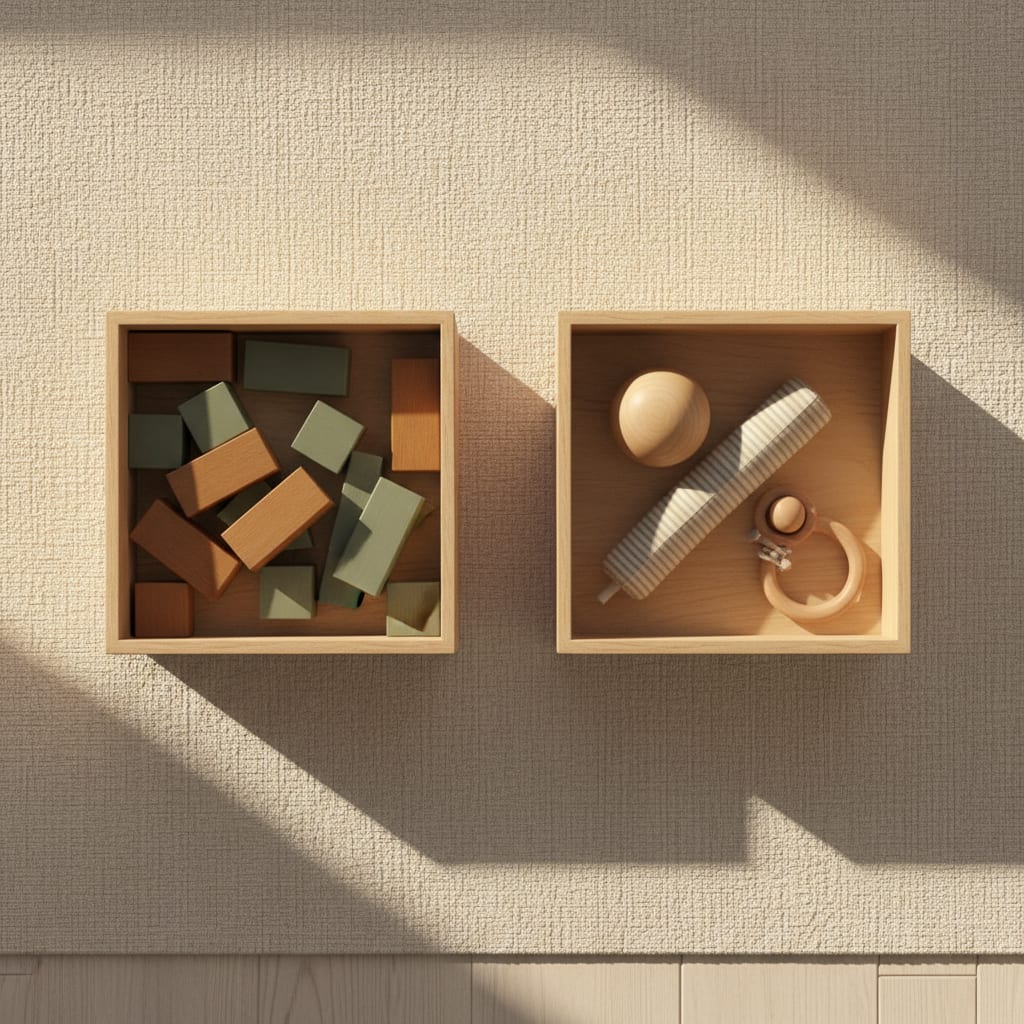
Monti Kids is the more orthodox program. Fewer objects presented one at a time, natural materials, a deliberate sequence, and guidance that tells you to put things away rather than pile them up. If Montessori principles are the reason you are shopping, this is the one that follows them.
Lovevery uses developmental-stage framing and plenty of wood, but the kits are broader and more eclectic — some objects are straightforwardly conventional baby toys with a nicer finish. That is not a criticism. It is why the kits land well with families who are not running a method, and it is why the objects survive being shared with a sibling who is off-schedule.
Neither program is required for a child to develop normally. What both do genuinely well is stop you buying six wrong things off a shelf at the wrong month, which is a real service and also achievable for free with a library card and a rotation shelf. Betteroo’s tummy-time progression by age covers the first-months version of that sequencing without charging you anything.
The piecemeal route, which nobody sells you
Lovevery’s real advantage is that you do not have to subscribe. The two items that most consistently earn their space are sold on their own.
The Lovevery Play Gym is the one I would buy first at any budget — it is the object with the longest useful life in the whole catalogue, and my full play gym review covers what got used and what did not. The Block Set is the one I would buy second, from about 18 months, and it is still in rotation in my house years later. If you want to sample the subscription format without joining it, single kits like The Babbler are sold as one-off boxes.
Monti Kids has no equivalent. It is the program or nothing, which is a legitimate design choice and also a real barrier to trying it.
What I would actually do
Buy the play gym outright in month one. Skip both subscriptions until around month six, when a baby starts having opinions and you can see whether a curated box is solving a problem you have. Then subscribe to Lovevery for two or three kits and judge it on what your child returns to after week three — which is exactly the test I apply in my six-month toy roundup, where the abandoned toys tell you more than the hits.
Only escalate to Monti Kids if you have decided you want the method and the coaching. And keep both off the registry itself; a subscription is a recurring cost dressed as a gift, and my minimalist registry checklist exists partly because of how many of these get gifted for two months and then quietly renewed onto a parent’s card.
FAQ
Is Lovevery or Monti Kids better value?
Lovevery, by a wide margin, on cost per month — roughly $40 against roughly $99. Monti Kids is better value only if you use the Montessori adviser support, which is the thing you are actually paying the difference for.
Are play kit subscriptions worth it at all?
They are worth it if the alternative is buying toys reactively at 11 p.m. They are not worth it if you already have a rotation system, a library, and hand-me-downs from a sibling. Neither program does anything a thoughtfully chosen shelf cannot.
Can I buy Lovevery without a subscription?
Yes. Several items — the play gym, the block set, some individual kits — are sold standalone, which makes Lovevery the far easier program to try at low risk.
Do the toys hold up for a second child?
Both are built to. Wood and fabric survive two children easily; the paper play guides do not, though Lovevery’s guidance is largely available digitally. Check any second-hand or hand-me-down item against current recall listings before it goes into rotation.
When should I cancel?
The month you notice the box arriving and sitting unopened for a week. That is the honest signal, and both programs make cancelling straightforward, so there is no reason to ride out a subscription you have stopped using.