Bottom line up front: no, most families do not need a dedicated bottle sterilizer — you need to clean bottles after every feed and sanitize them daily for the first couple of months, and you almost certainly already own equipment that does it. US public-health guidance is narrower than the marketing suggests: daily sanitizing is specifically recommended for babies under two months old, babies born prematurely, and babies with a weakened immune system. Everyone else cleans thoroughly, sanitizes for extra reassurance, and moves on.
I ran a countertop sterilizer for one baby and a pan of water for the other. Affiliate links never change my verdicts.
The guidance, quoted plainly
The CDC’s advice on infant feeding items separates two jobs that marketing deliberately blurs.
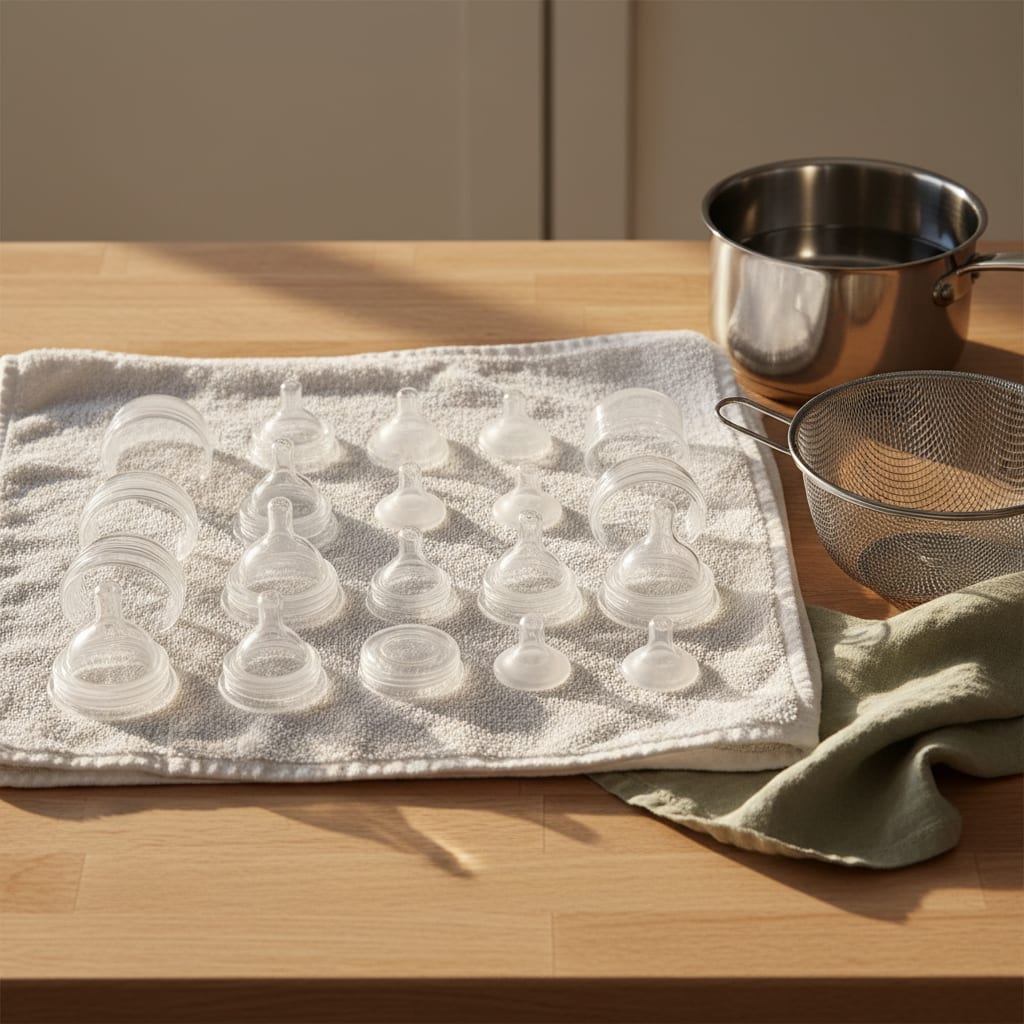
Cleaning happens after every feed: take the bottle apart completely, wash all parts in hot soapy water — ideally in a wash basin used only for feeding items rather than directly in the sink — rinse, and air-dry on a clean towel without rubbing them dry.
Sanitizing is the extra step. The guidance says to sanitize feeding items daily if your baby is younger than two months, was born prematurely, or has a weakened immune system. For older, healthy babies it is described as extra germ removal, not a daily requirement. Accepted methods are boiling, steaming, a dishwasher cycle with hot water and a heated drying setting, or a bleach solution where nothing else is available.
Two things follow from that. The threshold is an age and a health status, not a product. And a dishwasher you already own is on the approved list.
The three methods that already qualify
The dishwasher, if it has the right settings. Run bottle parts on a hot cycle with a heated dry or sanitize setting. The only genuine problem is small parts — valves, membranes, sealing discs — going through the rack and into the filter. A closed dishwasher basket with a flip-open lid for the tiny parts solves that for roughly the price of two coffees, and it is the single most useful object in this whole category.
Boiling water. Submerge disassembled parts in a pan of boiling water for about five minutes, lift them out with clean tongs, air-dry on a clean towel. Free, effective, and the method that works when the power is out or you are at your mother-in-law’s. Check the bottle’s care instructions first — most silicone and polypropylene parts are fine, some vent components prefer steam.
Microwave steam bags. A pack of Medela Quick Clean bags takes a little water and a few minutes in the microwave, and each bag is reusable for a stated number of cycles before you replace it. This is the method I would actually put on a registry: it costs about a tenth of an appliance, it lives in a drawer instead of on the counter, and it goes in a suitcase.
When the appliance genuinely earns its counter space
There is a real case, and it is a volume case rather than a hygiene one.
If you are exclusively pumping, you are washing and sanitizing pump parts as well as bottles, several times a day, on no sleep. If you are feeding twins, the load doubles. In both situations the argument for a machine is that it batches the job and runs unattended — you are buying back minutes and a dish rack, not buying a safety margin the pan of water lacks.
Even then, the cheap version usually wins. A microwave steam sterilizer — a lidded plastic tray that holds a few bottles and runs in a couple of minutes — costs a fraction of an electric countertop unit, stores in a cupboard, and does the same steam job. The electric machines add a drying cycle and a bigger capacity; whether that is worth several times the price depends entirely on how many bottles a day you are actually running. My pump-side view of the same trade-off is in my Haakaa review, where the cheapest object in the drawer keeps beating the expensive ones.
The part that matters more than sterilising
Here is the thing I wish someone had told me at 3 a.m.: how thoroughly you take the bottle apart matters more than what you do to it afterwards. Milk residue in a vent tube, a valve left inside a collar, a nipple never separated from its ring — no sterilising method reaches trapped residue, and a bottle with more parts has more places for it to hide.
That makes parts count a hygiene spec, not just a washing-up complaint, which is exactly the conclusion I reached comparing the two big vent systems in my Dr. Brown’s versus Philips Avent notes. If bottle washing is the part of your day you dread, the answer is often a simpler bottle rather than a machine — and if you are choosing on colic and gas rather than washing, my bottles for gas roundup covers what the vents actually do.
Air-drying is the other overlooked half. Store everything fully dry, in a clean covered container or a closed cupboard, not assembled while damp. Damp storage undoes a sanitize cycle quietly.
And if the bottle itself is going badly — gulping, arching, a feed that ends in tears — that is a technique question rather than a hygiene one. Betteroo’s guide to slowing a bottle feed down is the free version of the advice I paid a lactation consultant for.
FAQ
How long do you need to sterilize baby bottles?
Daily sanitizing is advised while your baby is under two months old, and for longer if they were born prematurely or have a weakened immune system. After that, thorough cleaning after every feed is the routine, with sanitizing as an occasional extra rather than a daily obligation.
Does the dishwasher really sanitize bottles?
Yes, when the cycle uses hot water and a heated drying or sanitize setting — that is one of the methods public-health guidance lists. Put small parts in a closed basket so they survive the cycle, and let everything air-dry fully before it goes back in the cupboard.
Do I need to sterilize new bottles before first use?
Sanitize them once before the first feed, which most manufacturers also recommend. Boiling, steam or a sanitize cycle all work. After that, follow the age-and-health guidance rather than sterilising every bottle out of habit.
Are microwave steam bags as good as an electric sterilizer?
For killing germs, steam is steam — the bags and the electric units both use it. What you give up is capacity and an automatic drying cycle, and what you gain is a tenth of the price, a drawer instead of a counter, and something you can pack for a trip.
Should I sterilize breast pump parts too?
Clean pump parts after every use and sanitize them daily while your baby is in the under-two-months, premature or immunocompromised group, exactly as with bottles. Steam bags are popular here because pump valves and membranes are fiddly to boil and easy to lose in a dishwasher.