Bottom line up front: Philips Avent’s Natural Response is the right first bottle for most babies, and Dr. Brown’s Options+ is the right second bottle for the ones Avent does not fix. The question is not which brand is better — it is how much venting hardware your particular baby needs, and how many pieces of it you are willing to wash eight times a day. Dr. Brown’s runs a full internal vent tube through the milk; Avent puts a valve in the nipple and stops there. One is more thorough. The other is the one you will still be using in month five.
I bought both systems with my own money, across two babies with very different opinions about air. Affiliate links never change my verdicts.
The two mechanisms, honestly
Dr. Brown’s Options+ is a tube-and-reservoir system. A vent insert sits inside the narrow 8 oz bottle and channels incoming air past the milk to the top of the bottle, so the milk never sits under vacuum and the nipple never collapses. The ”+” in Options+ is the part people miss: the vent assembly is removable, so once your baby outgrows the fussy stage you can pull it out and run the same bottles as ordinary three-part bottles. That is a genuinely good design decision and it is the reason the system ages better than its reputation.
Philips Avent Natural Response puts the whole mechanism in the nipple. The 9 oz Natural Response bottle uses a nipple with an opening that releases milk only while the baby is actively drinking, plus an integrated anti-colic valve that routes air away from the milk. Pause, and the flow stops — which is closer to how a breast behaves than a standard nipple, and which matters if you are switching back and forth.
Avent also sells a middle option: the Anti-Colic bottle with the AirFree vent, a single extra plastic piece that keeps the nipple full of milk even when the bottle is held horizontally, so you can feed a baby more upright without them drawing air. One piece, no tube, no brush. It is the most underrated object in this entire comparison.
The comparison table
| Dr. Brown’s Options+ | Avent Natural Response | Avent Anti-Colic + AirFree | |
|---|---|---|---|
| Venting method | Internal vent tube and reservoir through the milk | Valve integrated into the nipple | Nipple valve plus a one-piece AirFree insert |
| Washable pieces per bottle | Around 5–6 with the vent in | 3 | 4 |
| Vent removable later | Yes — becomes a 3-part bottle | N/A | Yes — insert is optional |
| Special cleaning tools | Yes, a thin vent brush | No | No |
| Neck options | Narrow and wide-neck | Wide neck only | Standard Avent neck |
| Dishwasher | Top rack | Top rack | Top rack |
| Best for | The genuinely gassy, gulpy baby | Almost everyone else | Reflux-ish babies fed upright |
Pack sizes and prices move constantly on both lines, so treat any figure you read anywhere — mine included — as a starting point and check the current listing.
The washing math is the real verdict
This is where the two systems separate, and nobody runs the numbers before buying a boxed set of six.
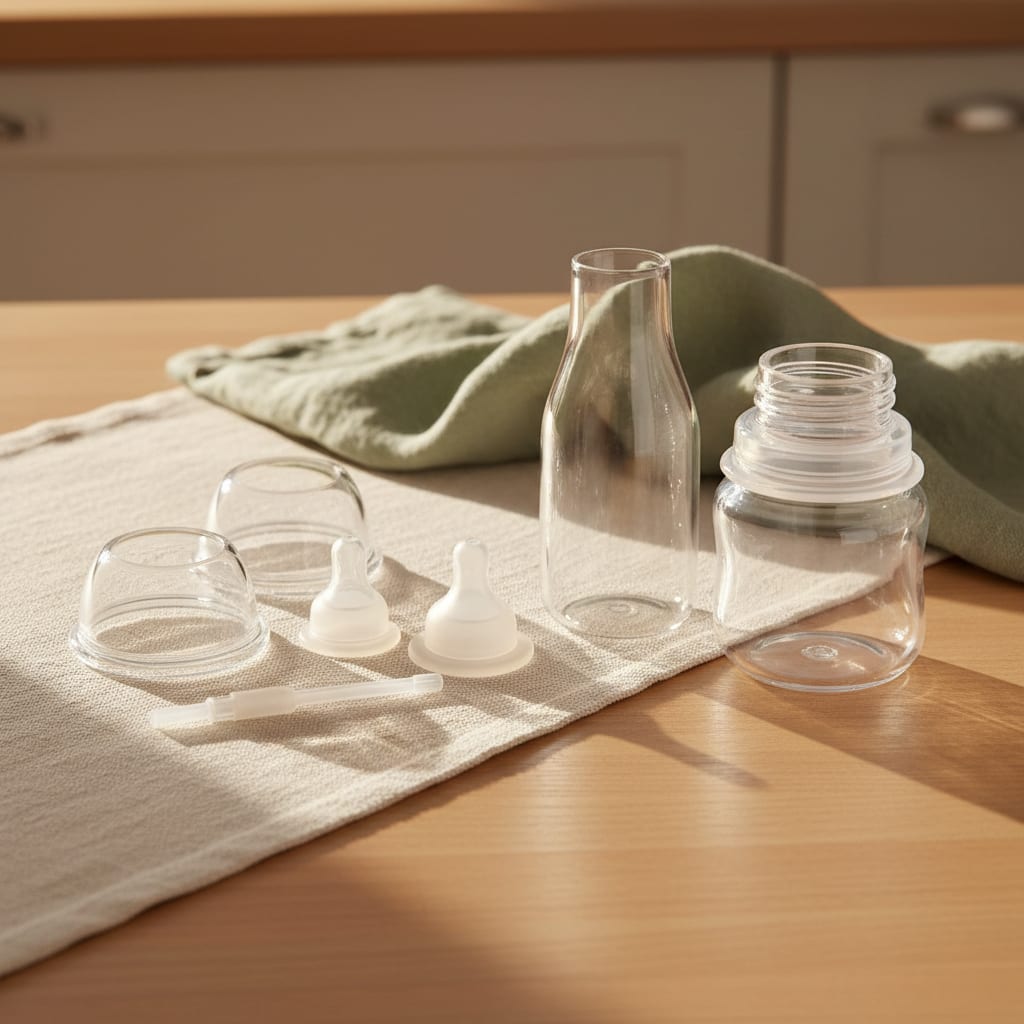
A newborn takes roughly eight bottles a day. With a six-bottle Dr. Brown’s rotation, vent in, you are pushing somewhere in the region of 30 to 36 separate pieces through the sink or the dishwasher basket daily, and the vent tube wants its own thin brush because a dishwasher jet does not reliably reach through it. With six Avent Natural Response bottles you are washing about 18 pieces, all of them wide and reachable by a normal bottle brush.
Over a year that difference is measured in hours of your life at a sink at 10 p.m. It is not a reason to refuse Dr. Brown’s — if your baby needs the vent, the vent is worth it. It is a very good reason to confirm your baby needs it before you buy eight of them, which is the same strategy I argue for in my bottles-for-gas teardown: two or three singles across designs first, boxed sets only after a winner emerges.
Where Dr. Brown’s genuinely wins
One scenario, and it is a real one: the baby who audibly gulps, pulls off the nipple mid-feed, arches, and then spends the next forty minutes working air out of one end or the other. In my house that baby existed, and the full internal vent was the thing that changed the evening. Nipple-valve bottles reduce air. The tube system reduces more of it.
Two caveats that belong in the same paragraph. First, “less swallowed air” and “calmer baby” are correlated, not guaranteed — the independent evidence that any bottle reduces colic specifically is thin, and Betteroo’s overview of what colic actually is is a useful reality check before you spend anything. Second, what is in the bottle can matter as much as the bottle. Switching formula moved the needle for us at least as much as switching hardware, which is the whole point of my Bobbie vs ByHeart comparison.
Where Avent genuinely wins
Three places. The nipple shape and the pause-when-they-pause behaviour make it the easier bottle for a breastfed baby to accept — a bottle nobody drinks from is not a bargain at any parts count. The wide neck means you can pour and scoop without a funnel, and it takes a silicone collection pump output straight in. And it survives a distracted assembly at 3 a.m., because there is no orientation to get wrong.
The AirFree version deserves its own mention. If your baby’s problem is reflux-adjacent rather than gas-adjacent — better upright, worse lying flat — the insert lets you feed at a genuinely upright angle with the nipple still full of milk. That is a cheap piece of plastic solving a problem people routinely try to solve with an expensive wedge.
The variable that beats both bottles
Flow rate and pacing. A nipple that is too fast makes any baby gulp, and flow numbering is not standardised between brands, so an Avent Flow 2 and a Dr. Brown’s Level 1 are not interchangeable claims. Start slow, move up only when your baby is visibly working for it, and hold the bottle closer to horizontal with breaks built in. Betteroo’s walkthrough of paced bottle feeding is free, and in my house it outperformed the third bottle brand we tried.
Buy A if, buy B if
Buy Philips Avent if you are starting from zero, you are combination feeding, or you value sink time and simplicity — which describes most families, including most families whose babies have some gas.
Buy Dr. Brown’s if you have already run two weeks of paced feeding with a valve bottle and your baby is still gulping and still miserable afterwards. Buy the narrow version if you have a small dishwasher basket, the wide-neck version if you are pouring from a pump.
Buy the AirFree insert if your baby is better upright than flat. It is the cheapest experiment on this page.
Buy neither yet if you have six unopened bottles of one brand in a box. Return them, buy three singles, and let the baby vote.
FAQ
Is Dr. Brown’s better than Avent for colic?
It vents more air, which is one contributor to gas. Whether that produces a calmer baby depends on the baby, and colic has causes that no bottle touches. Fair expectation: fewer gulpy feeds. Not a personality transplant.
Can I stop using the Dr. Brown’s vent later?
Yes, and that is the point of the Options+ line — the vent insert lifts out and you are left with an ordinary three-part bottle. Most people do this somewhere in the second half of the first year, when the gassy stage has passed and the washing has not.
Do Avent nipples fit Dr. Brown’s bottles?
Treat them as closed systems. Nipple, collar and bottle are engineered as a unit, and mixing brands is how you end up with leaks and unpredictable flow. If you want to try the other brand’s nipple, buy that brand’s bottle.
Which one is cheaper over a year?
Per bottle they land in similar territory, so the real cost difference is replacement nipples — both brands want you to size up two or three times — and your time at the sink. Price those when you compare, not just the starter pack.