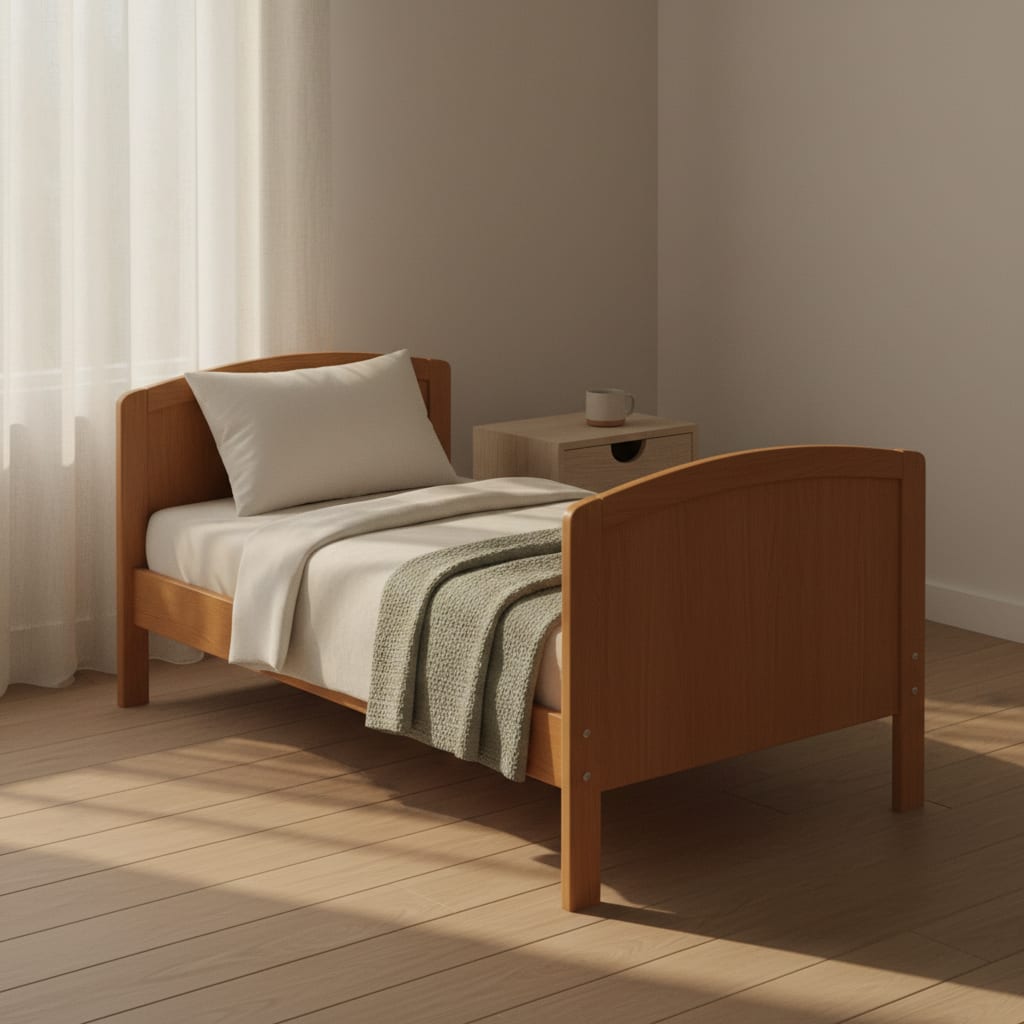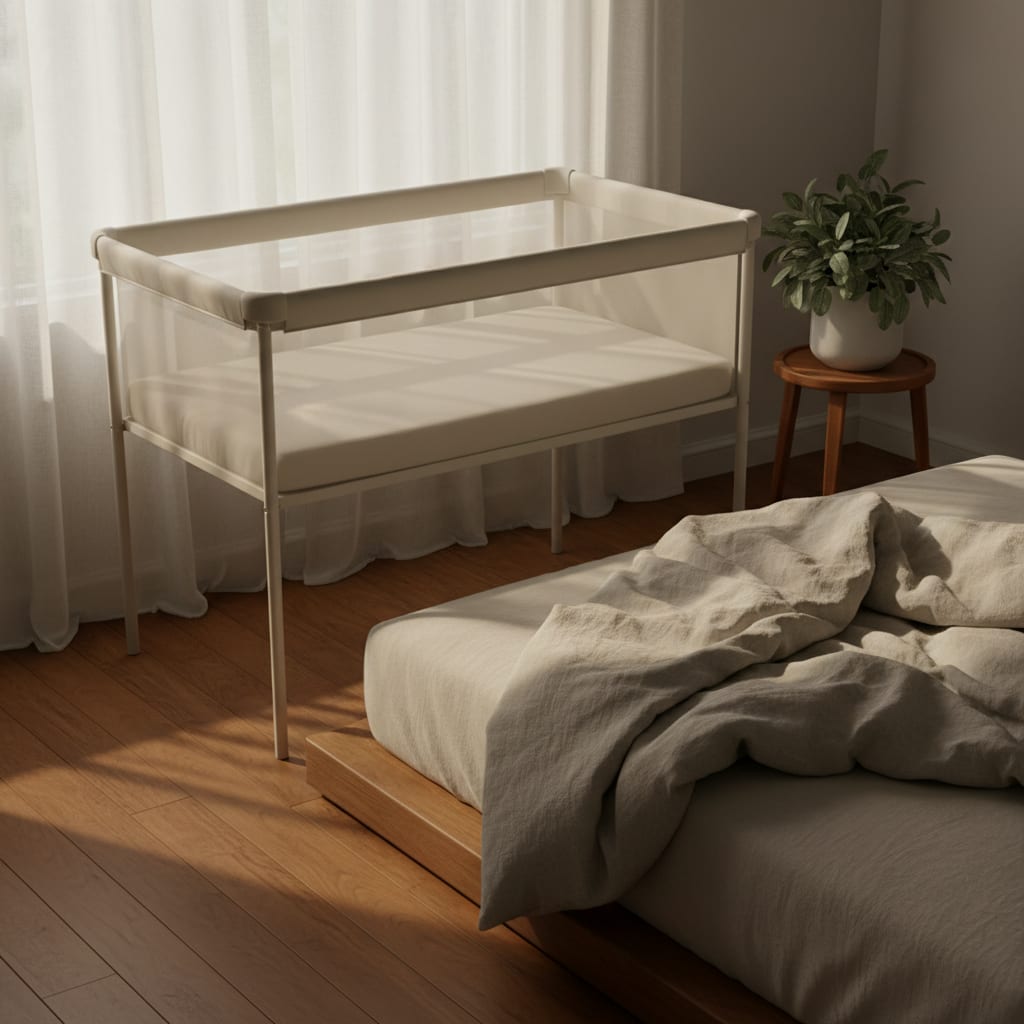
Bottom line up front: you do not need a bassinet. You need your baby sleeping on a firm, flat, empty surface in your room. A bassinet is one way to achieve that. A crib in your bedroom is another, a portable playard with a bassinet insert is a third, and all three satisfy the same guidance. The bassinet’s actual selling point is footprint and bedside height, not safety — so the honest question is whether your bedroom and your body need those two things enough to justify a product your baby outgrows somewhere around four to five months.
I bought a bassinet for my first and skipped it for my second. Affiliate links never change my verdicts.
What the guidance actually says
Share a room, not a bed, for at least the first six months and ideally the first year. The sleep surface is firm and flat with a fitted sheet and nothing else in it — no bumpers, no pillows, no positioners, no loose blankets — and the baby goes down on their back every time, for naps as well as nights.
Nothing in that sentence names a product. A full-size crib pushed against the wall of your bedroom meets it exactly as well as a $400 bedside sleeper does. Whatever you choose, it must be flat: inclined sleep surfaces are not appropriate for infant sleep, and no amount of reflux marketing changes that.
The case for buying one
Your bedroom cannot take a crib. This is the honest majority case. A bassinet has a footprint measured in a couple of square feet and most models fold or come apart. If the alternative is your baby sleeping in a different room from you, buy the bassinet.
You are recovering from a caesarean or a difficult birth. Getting out of bed, standing, bending over a crib rail and lifting is a genuinely different proposition when your abdomen has been operated on. A swivel model like the HALO BassiNest 3.0 rotates a full 360 degrees over your bed and has a wall that lowers, so you can reach a baby without standing up. In the first two weeks after a section that is not a luxury feature.
You need a second surface. If your daytime life happens on a different floor from your bedroom, a light bassinet you can carry downstairs saves you either a second crib or four months of contact naps by default. Something like the Chicco LullaGo Anywhere weighs around 13 pounds, snaps apart in seconds and is GREENGUARD Gold certified — independently tested for low chemical emissions, which is the same certification I weigh up in my crib mattress testing.
The case for skipping it
You have room for the crib. Put it in your bedroom for six months and move it into the nursery afterwards. You have bought one sleep surface instead of two and skipped a transition entirely.
You already own a playard. A Pack ‘n Play with a full-size infant bassinet does the newborn job, then becomes a travel crib, then a containment pen for a mobile toddler. One object, three jobs, and it is the single best-value purchase in this whole category for a second baby.
The useful life is short and inflexible. Bassinets end when your baby reaches the weight limit — commonly around 20 pounds — or shows signs of rolling or pushing up on hands and knees, whichever comes first. That is not a suggestion you can stretch. For many babies it lands somewhere between four and five months, which is the same stage that ends motion bassinets, and it is exactly the timing trap I laid out in my SNOO cost analysis.
The upgrade question nobody frames properly
Once you have decided you want a bassinet, the market immediately tries to sell you a motion one for five to ten times the price. Treat that as a separate decision with a separate justification, because it is one — a $600 responsive bassinet is not a better bassinet, it is a different product with its own expiry date at the same rolling milestone. If you are tempted, my SNOO alternatives roundup covers what the middle of that market actually offers, including the swivel-not-rock option.
And if the reason you are shopping at all is that your newborn will not settle anywhere except your arms, hardware is unlikely to be the fix. Betteroo’s guide to a baby who refuses the bassinet covers the usual causes, most of which are timing, temperature or a startle reflex rather than the mattress.
What I would actually do
Measure your bedroom first. If a crib fits with a walkable path around it, buy the crib and stop reading. If it does not, buy the cheapest well-reviewed bassinet that meets current safety standards, unless you are having a caesarean — in which case buy the swivel one and consider it part of your recovery kit rather than baby gear.
Either way, plan the exit before it arrives. Know the weight limit, know the rolling signs, and have the next surface ready in the room, because the bassinet stage tends to end on a Tuesday with no notice. And keep the whole decision in proportion — a bassinet is one line on a registry, not a foundation, which is the framing behind my minimalist registry checklist.
FAQ
Is a bassinet safer than a crib for a newborn?
No. Both are safe when they meet current standards and are used correctly — firm, flat, empty, baby on their back. The bassinet’s advantage is that it fits in a bedroom, which makes room-sharing practical, and room-sharing is the part that matters.
How long do babies use a bassinet?
Until the stated weight limit, commonly around 20 pounds, or the first signs of rolling or pushing up on hands and knees — whichever arrives first. For most babies that is somewhere around four to five months, and for some it is considerably earlier.
Can I use a Pack ‘n Play instead of a bassinet?
Yes, and for a lot of families it is the better buy. A playard with an infant bassinet insert covers the newborn months, then travels, then contains a toddler. Use only the bassinet insert that came with it and follow the weight limit exactly.
Do I need a bassinet if the crib is in my room?
No. That configuration already satisfies room-sharing guidance and saves you a transition, a purchase and a storage problem. This is the single most common piece of registry money I would take back.
My baby only sleeps on me, not in the bassinet. What now?
Extremely common in the first weeks, and rarely a gear problem. Check the room temperature, check how long they have been awake, and give a new surface a fair trial across several days rather than one bad night. If it persists, the free sleep quiz Betteroo runs builds an age-matched plan in a couple of minutes, which is a cheaper first move than replacing the bassinet.