Bottom line up front: a fan or an air purifier is fine in a nursery if the device and its cord are out of the baby’s reach and its airflow goes across the room rather than straight at the crib. Run it at one fixed speed overnight so the noise does not rise and fall. Neither is a safe-sleep tool. The often-quoted fan study is a single observational study that found no clear effect for babies already sleeping on their backs. A fan moves air, a HEPA purifier removes particles, and neither fixes a room that is too warm.
This page is the hardware question only. Room temperature is covered in nursery temperature for sleep, safe sound levels in how loud white noise should be, and why a changing sound wakes babies in baby wakes when white noise stops.
What the fan study found, and what it did not
Most “fans prevent SIDS” headlines trace back to one 2008 paper by Coleman-Phox, Odouli and Li. The abstract on Kaiser Permanente’s research site gives the design and the numbers:
- A case-control study in eleven California counties: mothers of 185 infants who died of SIDS, compared with 312 randomly selected infants. A ScienceDaily summary adds that the data came from interviews with the mothers.
- “Fan use during sleep was associated with a 72% reduction in SIDS risk (adjusted odds ratio [AOR], 0.28; 95% confidence interval [CI], 0.10-0.77).”
- The association was strongest in adverse sleep environments: warmer rooms (AOR 0.06), and babies placed on their stomachs or sides (AOR 0.14).
- For babies placed on their backs, the figure was 0.84 with a confidence interval of 0.21 to 3.39. That interval runs well past 1, so it shows no clear effect either way.
- The authors conclude, cautiously, that fan use “may be an effective intervention for further decreasing SIDS risk in infants in adverse sleep environments.”
So it is one association, from interviews after the fact, strongest in exactly the situations safe-sleep advice already tells you to avoid. NIH’s Safe to Sleep and the AAP’s parent guide to safe sleep (both loaded 11 October 2026) list back to sleep, a firm flat bare sleep space, room-sharing without bed-sharing and avoiding overheating. Neither mentions fans. Buy a fan for comfort if you want one, not as a safety device.
Fan or purifier: what each actually does
| Fan (air circulator) | HEPA air purifier | |
|---|---|---|
| What it does | Moves air around the room | Filters particles from the air passing through |
| Lowers room temperature? | No | No |
| Helps with | Still, stuffy air | Dust, pollen, smoke particles |
| Does not help with | Overheating from too many layers | Mold: the EPA says it “will not resolve a mold and moisture problem” |
| Running cost | Electricity | Electricity plus replacement filters |
The EPA’s guide to air cleaners in the home sets the priority: “The most effective ways to improve your indoor air are to reduce or remove the sources of pollutants and to ventilate with clean outdoor air.” Filtration is “an effective supplement.” A purifier earns its place when the problem is particles you cannot remove at the source: pollen season, wildfire smoke, a dusty older house.
Noise: run it at a fixed speed
Both devices make a steady whoosh, and in a nursery that becomes part of the soundscape. The EPA notes that purifier “noise levels depend in part on the fan speed setting,” and gives a reference point: “a noise rating around 50 decibels (dB) is roughly the operating noise of a modern refrigerator.” If you also run a white-noise machine, check the combined level at the crib.
Auto mode is the trap. Many purifiers ramp the fan up when a sensor detects particles and back down when the air clears. At 2 a.m. that means the room’s noise floor rises and falls without warning, the same mechanism that wakes babies when a sound machine stops: the change wakes them, not the sound itself. Set a fixed speed for the night and keep auto mode for daytime. A fan that oscillates past the crib does a milder version of the same thing, so fix its direction.
Placement: out of reach, across the room, cord away
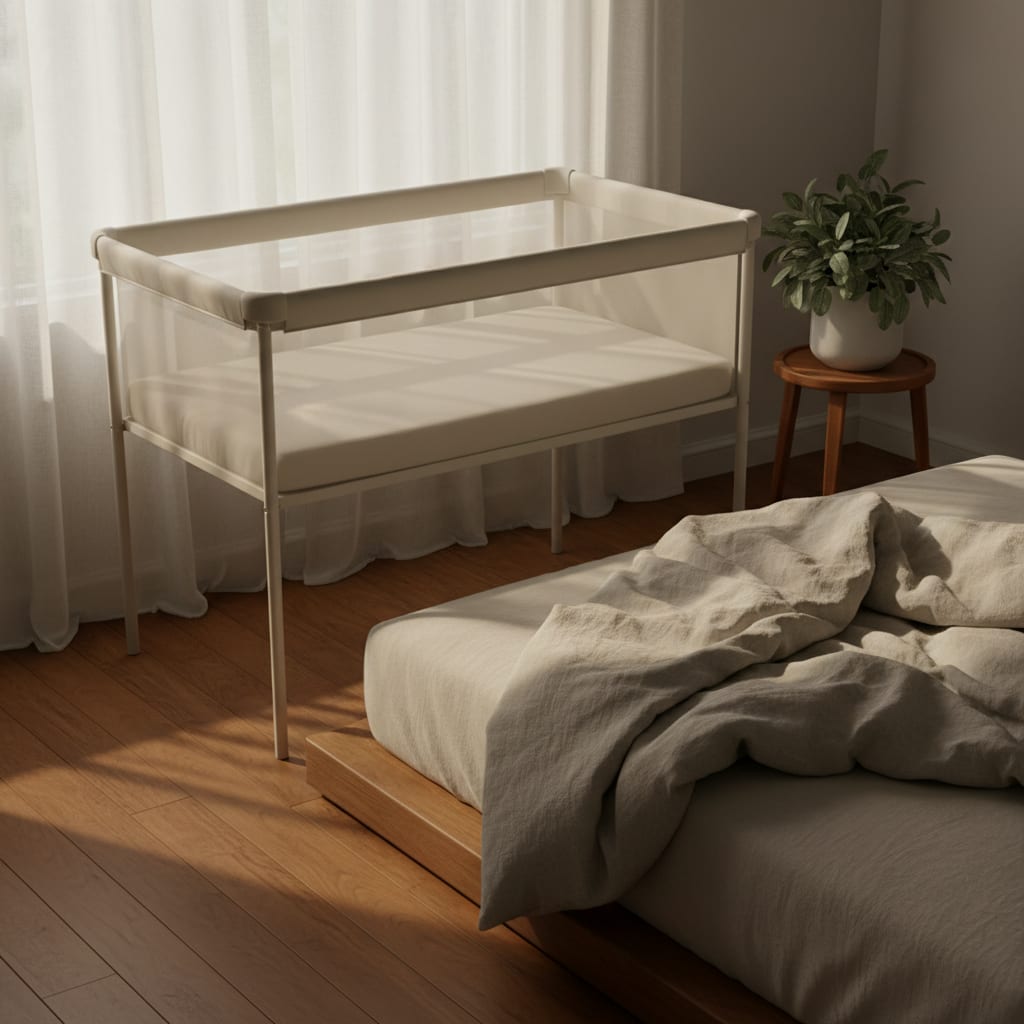
- Out of reach, cord included. HealthyChildren’s nursery safety page says: “Don’t let strings or cords dangle in or anywhere near the crib.” A power cord counts. Put the device on the far side of the room and run the cable behind furniture. Re-check reach once your baby stands.
- Nothing on or in the crib. No clip-on crib fans. Temperature is managed by the room and the clothing, not by objects added to the sleep space.
- Airflow across the room. The EPA’s purifier advice works for fans too: “If the air cleaner causes an uncomfortable draft, then redirect the airflow away from you.” Aim at a wall or across the room, not at the crib.
- Unblocked intake. The EPA says to keep air cleaners “away from curtains and anything that might block airflow.” In a nursery, that also keeps it away from the window, where HealthyChildren already advises against putting a crib because of blind and curtain cords.
- Stable footing. A tall tower unit on carpet is something a pulling-to-stand baby can tip. Keep floor units where a baby cannot reach them.
Sizing a purifier, and the one rule
The EPA’s sizing chart pairs room area with a minimum clean air delivery rate (CADR) for an 8-foot ceiling: 100 square feet needs 65, 200 square feet needs 130. A 10-by-12-foot nursery is 120 square feet, so look for a smoke CADR of about 80 or more. Extra capacity is useful, because it lets the unit hit the target on a lower, quieter speed.
The rule is no ozone. The EPA’s page on ozone generators sold as air cleaners says “when inhaled, ozone can damage the lungs,” and that no federal agency has approved these devices for occupied spaces. Its air-cleaner guide adds that ionizers, electrostatic precipitators, some UV lights and plasma cleaners “may have the potential to emit ozone,” and points to the California Air Resources Board and AHAM lists of cleaners tested to emit little or none. For a nursery, choose a plain mechanical HEPA filter and check the model against one of those lists.
The worked examples
- Fan: the Vornado 630, a medium air circulator with three speeds and an adjustable tilt, so it can sit on a high shelf and aim across the room.
- Purifier: a plain HEPA unit such as the Levoit Core 400S-P. Levoit’s page for the Core 400S (checked 11 October 2026) lists a 231 CFM CADR, a 22–52 dB range, a sleep mode and California Air Resources Board certification: far more capacity than a nursery needs, which is the point. The -P sold on Amazon is a variant, so confirm the box figures match.
Neither one fixes a warm room
Overheating is on every safe-sleep list. Safe to Sleep says to dress your baby in “clothes suitable for the temperature of the room” and to watch for “sweating, flushing/red or hot skin.” A fan across a hot room makes it feel better to you without changing the number. Measure at crib height and fix the clothing or thermostat first. Betteroo’s layer-by-layer nursery checklist puts room, sound and sleep space in one place. If the room is right and nights are still rough, the cause is usually the schedule, which the free Betteroo sleep quiz is built to sort out.
FAQ
Is it safe to have a fan in a baby’s room?
Yes, if the fan and its cord are out of reach and it blows across the room rather than at the crib. Attach nothing to the crib. A fan does not replace safe-sleep basics or a correct room temperature.
Does a fan reduce the risk of SIDS?
One 2008 observational study found fan use associated with lower SIDS risk, concentrated in warm rooms and among babies placed on their stomachs or sides. For babies on their backs it found no clear effect. Neither NIH Safe to Sleep nor the AAP’s safe-sleep guide lists a fan as a risk-reduction step.
Is an air purifier safe for a newborn?
A mechanical HEPA purifier that makes no ozone is a reasonable choice. Place it out of reach with its airflow unblocked, and run it at a fixed, quiet speed overnight. Avoid ozone generators, and check ionizing models against the CARB or AHAM lists.