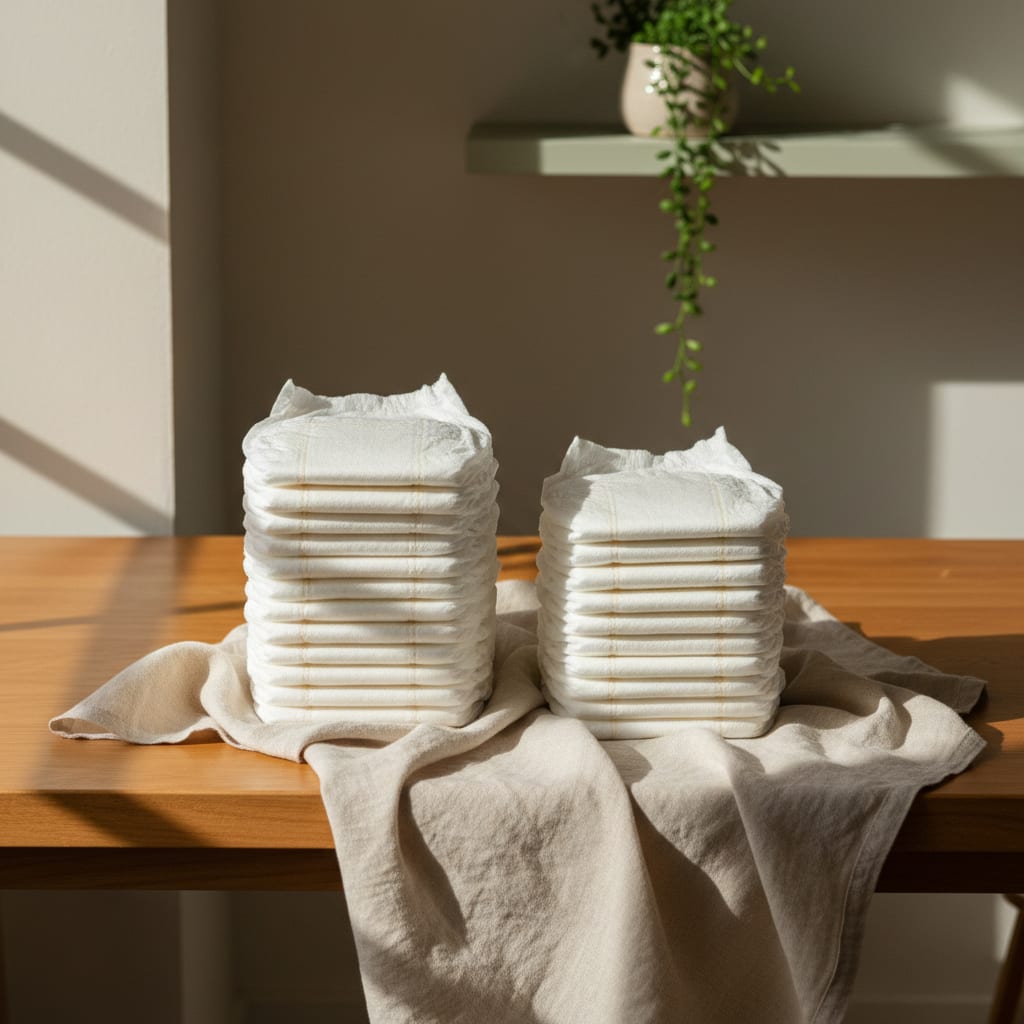
Bottom line up front: Kirkland diapers vs Huggies is the closest matchup in the diaper aisle, because the persistent, never-officially-confirmed belief is that Kimberly-Clark — the company that makes Huggies — also makes Kirkland Signature diapers. After running both on my own kids, that theory matched what I saw: near-identical daytime performance, with Huggies keeping a real edge in the newborn stage and in fit granularity, and Kirkland winning the price math by a wide margin. Past the newborn months, most families should buy Kirkland and stop thinking about it.
I bought every box of both with my own money, and affiliate links never change my verdicts. This post extends my Kirkland vs Pampers head-to-head — read that one if you’re deciding across all three brands.
The comparison table
| Kirkland Signature | Huggies (Little Snugglers/Little Movers tier) | |
|---|---|---|
| Rough cost per diaper | around $0.13–$0.20 | around $0.22–$0.35 |
| Sizes | starts at size 1 | preemie and newborn through toddler |
| Daytime absorbency | Very good | Very good |
| Blowout containment | Good | Better — the pocketed back waistband earns its reputation |
| Softness | Good | Slightly softer, especially small sizes |
| Wetness indicator | Yes | Yes |
| Where to buy | Costco membership required | Everywhere |
Prices swing with promotions and box counts, so treat those as ranges — but the ratio between the two has been stable for years, and the ratio is the story.
The Costco question, answered as honestly as anyone can
Costco doesn’t print its supplier on the box, and neither company confirms the relationship. What exists is years of circumstantial evidence — and the practical test, which is the one I can actually run. In daytime rotation on both of my kids, Kirkland behaved like a national mid-to-premium diaper: same change cadence, same no-irritation record, a wetness indicator that works, and tabs that don’t tear. Whether or not Huggies’ maker produces it, it performs like a diaper from that class, and that’s the only version of the answer that affects your budget.
The honest caveat: “made by the same manufacturer” would not mean “the same diaper.” Store-brand product lines are typically built to their own spec. The differences I describe below are real even if the factory theory is true.
Fit and containment: where Huggies earns its premium
Huggies’ signature is containment. The pocketed back waistband on Little Snugglers is the best blowout defense I’ve tested at this price tier, and in the early months — when blowouts are a lifestyle — that feature alone can justify the brand. Kirkland’s cut runs slightly larger and straighter, which fit my chunkier baby well but left more back gap on my lean one.
The other structural gap is at the very start: Kirkland’s range begins at size 1, with no preemie or newborn specialty sizes and no umbilical notch. Huggies covers the whole newborn stage properly. If you’re building a registry, this is why my minimalist registry checklist says not to bulk-buy any brand before birth: the first weeks belong to whichever newborn-tier diaper fits your actual baby.
Absorbency: a daytime tie, a modest overnight gap
On a normal two-to-three-hour change cadence I could not reliably tell these brands apart. Overnight, Huggies’ dedicated overnight tier held 11-to-12-hour nights more consistently on my heavy wetter; Kirkland made it most nights with the occasional soaked morning. Same pattern I found against Pampers: pay premium money for the sleeping hours only, and let the value brand handle the daylight. If overnight leaks are your specific war, the top of the market is covered in my Coterie review.
The price math
At a realistic eight changes a day, the gap between Kirkland and Huggies runs somewhere around $20 to $40 a month depending on size and sales — several hundred dollars over a year, easily four figures over a full diapering career with two kids. Fold in the Costco membership fee if diapers would be your only reason to have one; the math still usually clears.
Who each diaper suits
Choose Huggies if: you have a newborn (specialty sizes, umbilical notch, softest small sizes), a lean baby who gaps in straight-cut diapers, frequent blowouts (that back pocket is real), or no Costco membership.
Choose Kirkland if: your baby is past the newborn stage, builds average-to-chunky, and you’d rather put several hundred dollars a year toward literally anything else.
Do what I did: Huggies for the newborn stage and for nights, Kirkland for the daytime grind from size 1 onward. The blended cost lands close to Kirkland-only.
FAQ
Does Kimberly-Clark make Kirkland diapers?
It has never been officially confirmed on the packaging or by either company, but the belief is widespread and long-standing. What I can verify is behavior: Kirkland performs like a diaper from a major manufacturer’s mid-to-premium line. Treat the rumor as unproven and the performance as tested.
Are Kirkland diapers as good as Huggies?
For daytime changes past the newborn stage, functionally yes in my testing. Huggies keeps genuine advantages in newborn sizing, blowout containment and overnight consistency. Whether those are worth roughly 50 to 100 percent more per diaper depends entirely on which stage you’re in.
Do Kirkland and Huggies fit the same?
No — and fit is baby-shaped, not quality-shaped. Kirkland runs slightly larger and straighter; Huggies cuts curvier with a stretchier back waistband. If one brand keeps leaking on your baby, try the other cut before sizing up.
Which is cheaper per diaper, Kirkland or Huggies?
Kirkland, consistently — roughly $0.13–$0.20 per diaper against roughly $0.22–$0.35 for Huggies’ comparable tiers, with exact numbers moving on promotions. For how Kirkland stacks up against the other national brand, see the Kirkland vs Pampers breakdown; for the premium “clean” brands, start with Hello Bello vs Honest.
Final word
The Costco question makes a great headline, but the buying answer doesn’t depend on it: Huggies for the stages where its features matter, Kirkland for the long middle where they don’t. That’s most of the diaper years — and most of the savings.