Short answer: a baby should not sleep with a lovey before 12 months. AAP safe-sleep guidance keeps “pillows and pillow-like toys, quilts, comforters, mattress toppers, non-fitted sheets, blankets, toys, bumper pads” out of the sleep space, and states that those recommendations are “for babies up to 1 year of age.” Once your child is past the first birthday, a lovey in the crib becomes a reasonable choice, as long as it is the right kind of object. That means small and thin, washable, with features stitched on rather than attached, and nothing that can come off or wrap around a neck. Buy two identical ones.
Why the line sits at twelve months
The NIH Safe to Sleep campaign puts the case bluntly. A crib “with nothing in it except a fitted sheet covering the mattress may seem bare,” but “it is the safest option for baby.” It then lists what makes an object risky in an infant’s sleep space, and loveys are named directly. Items are a problem if they are soft or squishy (“pillows, stuffed toys, crib bumpers”), or if they are “Non-fitted, even if they are lightweight, small, or ‘tucked in’ (e.g., loveys/cloths…).” HealthyChildren, the AAP’s parent site, gives the reason: soft objects and loose bedding “can increase your baby’s risk of entrapment, suffocation or strangulation.”
So a lovey being small, thin or muslin does not make it safe under one year. One marketed “from birth” can be used from birth in your arms and on the play mat, not in the crib.
The timing is awkward. HealthyChildren notes that children tend to choose a comfort object “between months eight and twelve, and keep it for years to come,” often before it is allowed in the crib. Plan the introduction rather than improvising it at 2 a.m.
What makes a good first lovey (a spec sheet)
The checklist I would hold any lovey to before it goes into a toddler’s crib:
| Feature | What to look for | Why |
|---|---|---|
| Size | Small: a cloth square or a small plush with a cloth “blanket” body, not a full blanket or a large stuffed animal | It has to be something a toddler can grip and move off their own face |
| Fabric | Thin and breathable: cotton muslin or a light knit | Thick pile and heavy fill hold more against a face |
| Features | Eyes and nose embroidered, not glued or snapped on | Anything that can come off is a small part |
| Attachments | No ribbons, cords, loops, clips or tie-on tags | Strangulation is on the AAP’s list of risks |
| Electronics | None: no sound box, light or battery | That is a floor toy, not a sleep object |
| Weight | Not weighted in any way | Safe to Sleep names “weighted” items as a sleep-area danger |
| Care | Machine washable, and sold in a pair or easy to buy twice | You will be washing it a lot |
The small-parts point is federal law as well as common sense. Toys intended for children under 3 that present “a choking, aspiration, or ingestion hazard because of small parts” are banned. The rule names “stuffed, plush, and flocked animals” among the articles it covers, and the test includes parts “that can be detached or broken off during normal or reasonable foreseeable use” (16 CFR 1501, via govinfo.gov). A lovey labelled for babies from a mainstream maker should already comply. A carnival prize, novelty plush or old heirloom may not. For an older or hand-me-down piece, my secondhand sleep gear checklist covers what to look at first.
The format I would pick
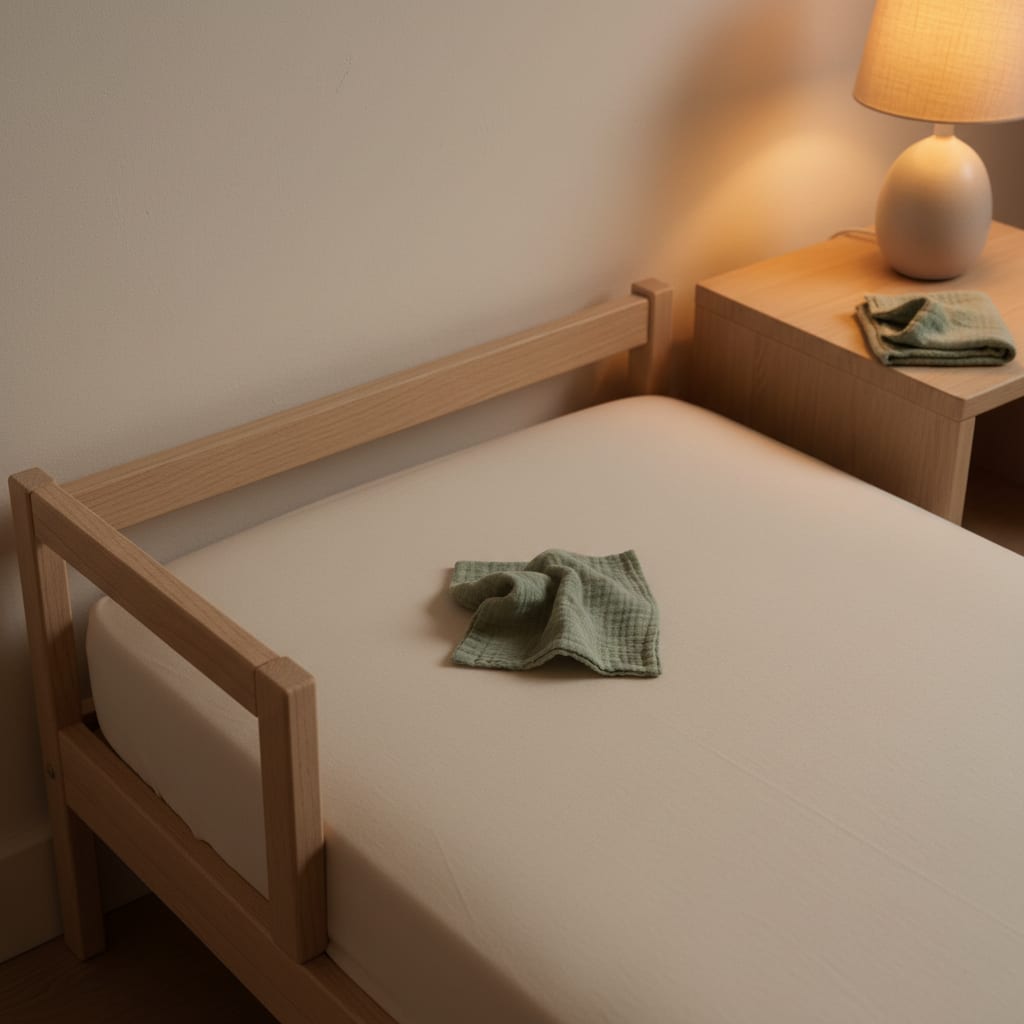
For a first lovey I would choose a plain muslin square over a plush animal. Muslin is thin enough to grip and throw off, dries fast and survives weekly washing better than most plush. The aden + anais Essentials Issie security blankets are a good example: 100% cotton muslin, sold as a two-pack, which solves the duplicate problem in the same purchase.
Plush loveys with a head and a small blanket body are the popular alternative. Check the face is stitched, check for ribbon trims, and buy the second one immediately. Skip a full-size blanket, a large stuffed animal a toddler could lie against, or any plush with a music box or battery compartment.
How to introduce a lovey before it is allowed in the crib
Because attachment often starts before twelve months, the useful work happens in daytime, in your arms:
- Pick one and use it consistently. HealthyChildren suggests parents may want to help a child “choose one and build it into their nighttime ritual.” Bring it into the routine during feeds, books and cuddles, then put it on a shelf when the baby goes into the crib.
- Let it pick up home. Part of why a lovey works, per HealthyChildren, is familiarity: it “has your child’s scent on it, and it reminds them of the comfort and security of their room.”
- Start rotating the duplicate early. HealthyChildren is specific here: “If you don’t start rotating them early, your child may refuse the second one because it feels too new and foreign.” Swap them every few days.
- Move it into the crib after the first birthday. Before you do, check it against the table above. If your child already has a lovey that fails the check (long ribbons, glued eyes, a blanket the size of a crib sheet), replace it with something close before it becomes the only one they will accept.
Common mistakes once it is in the crib
Tying or clipping it to the crib. HealthyChildren’s list of things to keep out of an infant’s sleep space includes “related products that attach to crib slats or sides.” A lovey tied to a rail so it “can’t get lost” is a strangulation risk. Loose is the safer state for it.
Letting the lovey stand in for warmth. A toddler who kicks off covers still needs a warm layer. A lovey is not that layer. The fix for a cold toddler is a walking sleep sack with foot openings, which I covered in the toddler who refuses a sleep sack.
Adding a pillow at the same time. A pillow is a separate decision on a later timeline, usually closer to two; when a toddler can use a pillow covers it.
Using it to replace the pacifier overnight. If the pacifier is going, introduce the lovey a couple of weeks first, so the child knows it before it has to do any work. The sequence is in bedtime after giving up the pacifier.
Will a lovey help a toddler sleep?
Sometimes, and modestly. A lovey gives a toddler something other than you to reach for at a night waking, which can shorten resettling. It will not fix a schedule problem: a toddler napping too late or going down overtired will wake whatever is in the crib. Betteroo’s outline of how a one-year-old’s day usually runs is a good benchmark, and the free Betteroo sleep quiz builds a plan around your child’s actual day.
HealthyChildren is also reassuring: transitional objects “are not a sign of weakness or insecurity, and there’s no reason to keep your child from using one.”
FAQ
When can a baby sleep with a lovey?
From 12 months. AAP safe-sleep guidance keeps soft objects, toys included, out of the sleep space for babies up to one year, and Safe to Sleep names loveys specifically, “even if they are lightweight, small.” Before the first birthday, use the lovey during awake time and take it out of the crib for sleep.
What kind of lovey is safest for a toddler?
A small, thin, breathable one with embroidered features, no ribbons or cords, no electronics, nothing weighted, and machine washable. A cotton muslin square meets all of those. Plush loveys can too, if the face is stitched and there are no trims.
Should I buy two of the same lovey?
Yes, and start rotating them early. HealthyChildren warns that a child may refuse a second one introduced late “because it feels too new and foreign.” Two-packs exist for exactly this reason.
My baby already sleeps holding a lovey and is not one yet. What now?
Keep it in the routine but take it out once your baby is asleep, until the first birthday. If you are unsure about anything in your baby’s sleep space, ask your pediatrician.