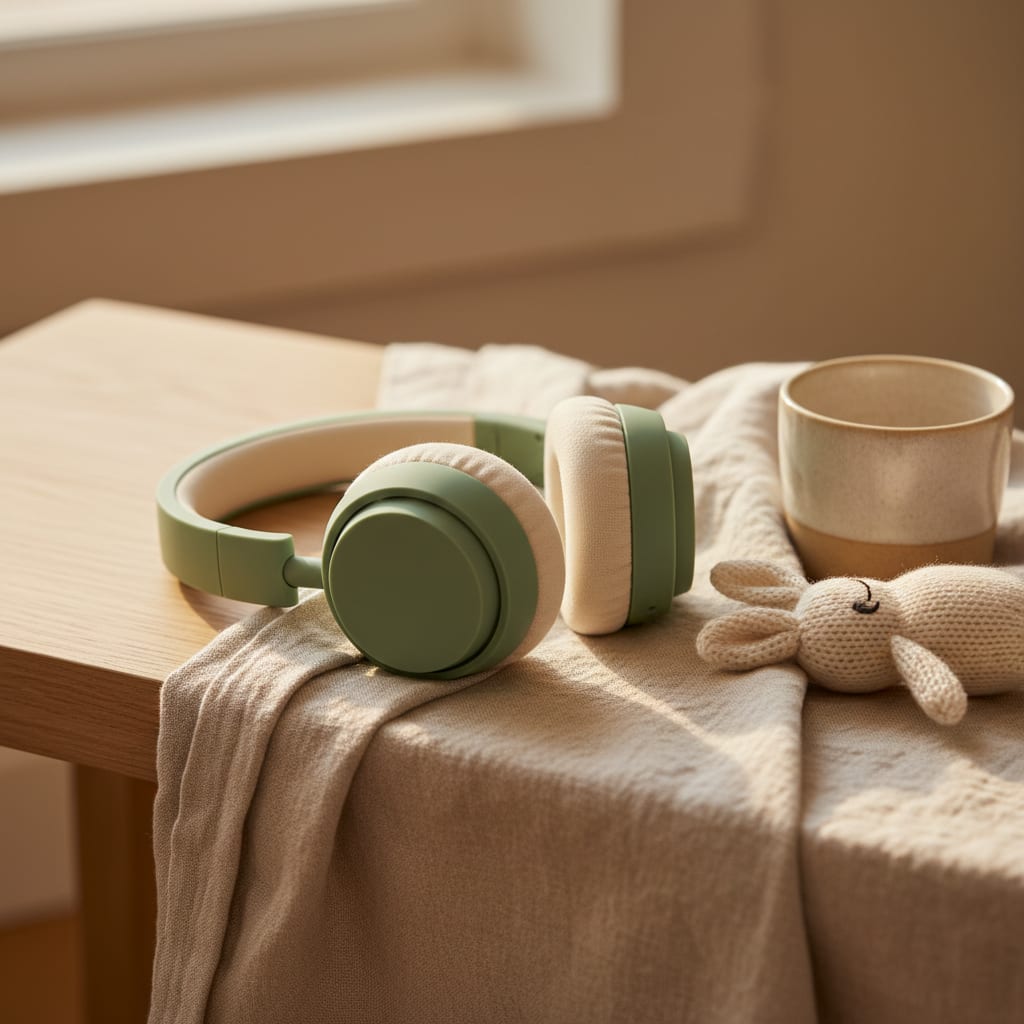
Bottom line up front: the best toddler headphones are a volume-limited pair rated for age 3 and up, set to its lowest limit, with a fit small enough to stay on. My picks among headphones for toddlers: BuddyPhones POP Fun (wireless, ages 3-9), BuddyPhones Explore+ (wired, ages 3-10) and CozyPhones’ soft headband for car seats and bedtime. The catch most parents miss is the second mode. Several kids’ headphones offer a louder setting, and JLab’s JBuddies Pop ships in its louder one: its maker says the limit is “95 dB as the default and 85 dB available.” Check the switch before the first use. Under age 3, none of the pairs below carries a maker age rating, and a speaker kept low is the safer choice.
Every limit, age and price below is the maker’s own figure, read on its website on 19 October 2026. Advertised volume limits are maker claims: I have not measured them, and nothing on this page should be read as an independent test. The hearing guidance comes from the World Health Organization’s safe-listening Q&A and the NIH’s National Institute on Deafness and Other Communication Disorders, both loaded the same day.
Toddler headphones compared
| Headphones | Maker age range | Connection | Maker’s volume limit | Price on maker site (19 Oct 2026) |
|---|---|---|---|---|
| BuddyPhones POP Fun | 3-9 | Bluetooth + wired | 85 dB SafeMode, 94 dB PopMode | $29.99 |
| BuddyPhones Explore+ | 3-10 | wired | 85 dB | $39.99 |
| CozyPhones 4.0 headband | 3+ | Bluetooth + wired | “Kids Mode” limited by default; no dB figure given | $29.99 |
| JLab JBuddies Pop Wireless | not stated | Bluetooth + wired | switch: 95 dB default, 85 dB option | $21.99 |
| tonies Headphones (for Toniebox) | 3+ | wired or Bluetooth | not stated on the product page | $24.99 wired, $34.99 Bluetooth |
| BuddyPhones School+ Wireless | 5-12 | Bluetooth | 75, 85 or 94 dB | $29.99 |
Why the volume limit matters, and which number to trust
NIDCD says sounds at or below 70 dBA are unlikely to cause hearing loss, but “long or repeated exposure to sounds at or above 85 dBA can cause hearing loss,” and “the louder the sound, the shorter the amount of time it takes.” It puts “music through headphones at maximum volume” at 94-110 dBA. That is the reason volume-limited kids’ headphones exist: an ordinary pair on an ordinary tablet can go well past the level NIDCD flags.
The WHO frames it as a weekly allowance. It says a listener can “safely listen to a sound level of 80dB for up to 40 hours a week,” and that at 90 dB “the safe listening time reduces to four hours per week.” Its general advice is to keep a device’s volume “no more than 60% of maximum.” For children, its advice is more cautious still: use speakers where possible, “avoid headphones where possible,” and where headphones are used, “prefer those with safe listening features like parental loudness control,” plus well-fitted, noise-cancelling pairs so a child does not turn the volume up to drown out a noisy room.
Three practical points follow:
- 85 dB is the common ceiling, not a target. Most kids’ headphones cap at 85 dB. By NIDCD’s figures that is the level where long exposure starts to matter, so a cap of 85 still needs a sensible volume and breaks.
- A louder mode undoes the point. POP Fun’s PopMode is 94 dB and JBuddies Pop’s default is 95 dB. If you buy either, set the lower mode and show older siblings where the switch is.
- Keep the device volume low too. A headphone limit is a ceiling, not a setting. The WHO’s 60% rule still applies on the tablet or player.
If you have read my guide to how loud white noise should be, the same logic runs through both: duration counts as much as loudness, and the number to trust is the one at the child’s ear.
Best all-round: BuddyPhones POP Fun
The BuddyPhones POP Fun is $29.99 on onanoff.com and, according to the maker, “designed to fit kids between the ages of 3 to 9.” It works over Bluetooth or with a cable when the battery runs down, and onanoff claims “24-hour battery life.” It has “two customizable modes: SafeMode (85dB) for extra hearing protection and PopMode (94dB) for vibrant sound.”
Why it is the pick: it covers the widest age range of the wireless pairs here starting at 3, it has a cable fallback for flights, and onanoff says it uses “only BPA- and phthalate-free plastics.” The one thing to do on day one is confirm it is in SafeMode. A 94 dB mode is louder than NIDCD’s 85 dBA line.
Best wired: BuddyPhones Explore+
The BuddyPhones Explore+ is $39.99 on onanoff.com, for ages 3 to 10, and is wired only. onanoff says it caps sound “at a safe 85dB.” There is no louder mode to forget about, no battery to charge, and no pairing. That makes it the simplest pair here for a three-year-old.
The other reason to buy it is sharing. onanoff’s BuddyCable system lets “up to 4 headphones” connect to one device through a stackable jack, so siblings can watch the same film on one tablet in the back seat. The trade-off is the cord, which a toddler will chew, yank and wrap around things. Supervise wired headphones, and put them away rather than leaving them in a crib or car seat.
Best for car seats and bedtime: CozyPhones headband
CozyPhones headband headphones solve a problem the others do not: in a car seat with a headrest, or lying down, cup-style headphones get pushed off. CozyPhones puts flat speakers inside a soft fleece headband, with “no ear cups to press and no hard band to dig in.” The current Bluetooth CozyPhones 4.0 is $29.99 on cozyphones.com, “for kids 3 and up,” with up to 16 hours of wireless play and a cable; the Amazon listing linked here is the brand’s wired headband.
Two cautions. CozyPhones says the 4.0 is “volume limited by default with Kids Mode,” but also offers a “Normal Mode for normal volume when the plane or car gets loud,” and it does not publish a dB figure for either mode. Keep it in Kids Mode. And a headband with a cord is not something to leave on a sleeping child. If your child falls asleep to a story, my Yoto vs Toniebox comparison covers players with sleep timers, which do the same job with a speaker and no headband at all.
Budget pick, with a catch: JLab JBuddies Pop
The JLab JBuddies Pop is $21.99 on jlab.com, with Bluetooth plus a 3.5 mm cable fallback and what JLab says is “50 total hours of playtime.” Its “hearing protection switch lets you cap output at 85 dB or 95 dB, with 95 dB as the default.” JLab also says the limiting “holds output at a safe maximum regardless of source device volume.”
It is good value, and its Share Mode lets two pairs play from one device. But 95 dB is the factory setting, so this is the pair where the first-use check matters most. JLab’s page also gives no age range for it, unlike its wired JBuddies Studio, which it recommends for ages 6 and up. For a three-year-old, I would choose one of the BuddyPhones pairs instead.
If you already own a Toniebox
tonies sells its own headphones, “only compatible with Toniebox 2 and Toniebox Lite”: wired at $24.99 and Bluetooth at $34.99 on tonies.com, both tagged for ages 3+. They fold, and tonies claims up to 40 hours on the Bluetooth pair. The product pages I read did not state a dB limit; tonies’ Toniebox page says parents set a maximum volume in the app, so set that before the first use. My Toniebox review covers the box itself.
Growing into it: BuddyPhones School+
For a child of five or older, BuddyPhones School+ Wireless ($29.99 on onanoff.com, ages 5 to 12) offers “three sound levels—75dB, 85dB, or 94dB,” which makes it the only pair here with a setting below 85. It also adds a detachable boom microphone for school apps. It is too big for most toddlers, so treat it as the next pair rather than the first.
Headphones for toddlers under 3
None of the headphones on this page carries a maker age rating below 3, and the WHO’s advice for children is to “avoid headphones where possible.” For a one- or two-year-old, a speaker at low volume is the better choice: a story player on the shelf, or a phone across the room. A toddler on a plane is the exception most parents face. There, a wired, 85 dB pair with no louder mode, used for a short stretch and taken off afterwards, keeps the risk small.
What to check before you buy any pair
- The maker’s age range, on the maker’s own page.
- Every mode the pair has, and which one it ships in. “Volume limited” on the box can describe the quiet mode only.
- Whether the limit is stated in dB at all. A pair that says “kid-safe” with no figure gives you nothing to check.
- Fit. WHO’s advice favours “well-fitted” headphones, because a loose pair leaks outside noise and invites the volume up.
- Breaks. The WHO suggests time away from the device “in a quiet space to allow their ears to rest.”
If stories or shows in headphones have become part of how your child falls asleep, Betteroo’s short sleep quiz for toddlers who need audio to drift off builds a plan around the whole bedtime.
FAQ
What are the best toddler headphones?
For a child of 3 or older, a volume-limited pair from the maker’s own age range, set to its lowest limit. BuddyPhones POP Fun (wireless, ages 3-9, 85 dB SafeMode) and BuddyPhones Explore+ (wired, ages 3-10, 85 dB) are my picks, with CozyPhones’ headband for car seats.
Are headphones safe for toddlers?
The WHO advises avoiding headphones for children where possible and, when they are used, choosing pairs with parental loudness control. None of the pairs on this page is rated by its maker for under-3s, so for younger toddlers a speaker at low volume is the safer choice.
What volume limit should toddler headphones have?
Most kids’ headphones cap at 85 dB. NIDCD says long or repeated exposure at or above 85 dBA can cause hearing loss, so treat 85 as a ceiling and keep the device volume low as well. BuddyPhones School+ also offers a 75 dB setting for older children.
Do volume-limiting headphones actually work?
The limits are the makers’ own claims, and I have not measured them. Some pairs also offer a louder mode, such as 94 or 95 dB, so a “volume limited” label may describe only the quiet setting. Check the mode, and set a low volume on the device too.
Are wireless or wired headphones better for a toddler?
Wired pairs have no battery and no pairing, and the simplest ones have no louder mode. Wireless pairs avoid a cord a toddler can chew or tangle. Either way, supervise use and never leave headphones on a sleeping child.