Bottom line up front: the best non-toxic sippy cup is a stainless steel or food-grade silicone cup with the fewest possible parts — and the single highest-value habit costs nothing: keep every plastic cup away from heat. US-market sippy cups have been effectively BPA-free for years, so the interesting questions have moved on: what replaced BPA in plastics, what heat and wear do to any plastic vessel, and whether the cup’s valve design actually helps your kid learn to drink. Material choice solves the first two; a straw or open-cup design solves the third.
I’ve washed, disassembled and fished-from-under-car-seats more cup systems than I care to count across two kids. Affiliate links never change my verdicts. And a promise from the queue this post came from: no fear-mongering — here’s what the evidence does and doesn’t support.
The materials, ranked by how little you have to think about them
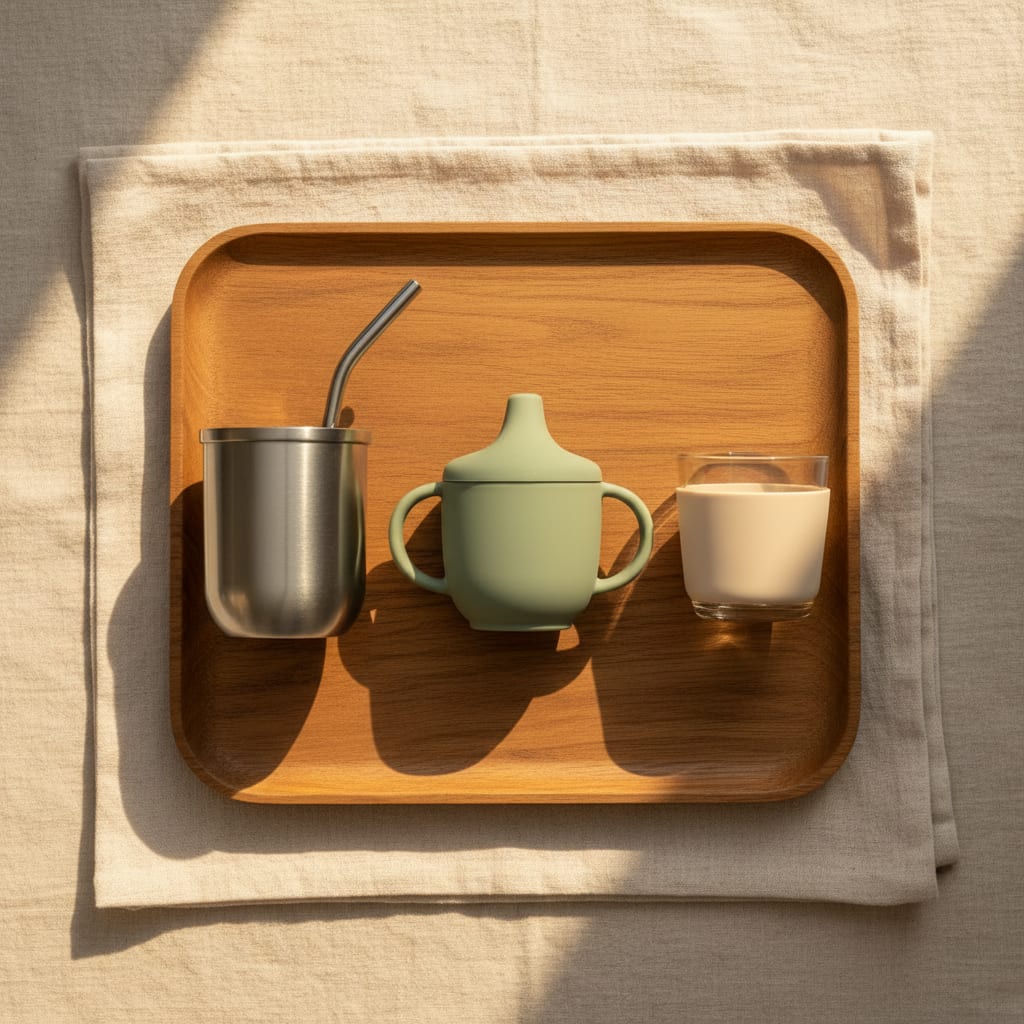
Stainless steel is the set-and-forget answer: inert for cold and room-temperature drinks, unbreakable, no aging behavior worth worrying about. Downsides are real but practical — you can’t see how much is left, it dents, it’s the priciest tier, and it should not hold acidic drinks for days on end (it also keeps water annoyingly cold, which your toddler will have opinions about either way).
Food-grade silicone is stable across normal use temperatures, soft enough for early drinkers, and dishwasher-safe. It’s the material of the training-cup class. Quirks: it grabs lint and dust like a magnet and can hold onto smells; a baking-soda soak fixes most of it.
Glass is the most inert of all and the least practical for anything that leaves the kitchen table. Silicone-sleeved glass cups are a fine at-home option; they’re still glass on tile floors.
Plastic (polypropylene and Tritan, mostly) is where the nuance lives. The BPA everyone learned to fear was banned from sippy cups in the US back in 2012, and mainstream bodies treat current food-contact plastics as safe as regulated. The honest caveats: some research has raised questions about whether certain BPA substitutes behave similarly, and heat plus wear measurably increases what any plastic sheds — including microplastics, whose health significance is still genuinely unsettled science. That’s not a reason to panic about the plastic cup at daycare. It is a reason, if you’re buying new anyway, to spend the extra few dollars on steel or silicone and downgrade the whole question to “solved.”
The practical rules that flow from this, for whatever plastic you do own: hand-wash it or use the top rack away from the heating element, never microwave it, don’t pour hot liquid into it, and retire cups that are cloudy, scratched or chewed.
Part count is the hidden spec
Every sippy cup is secretly a small plumbing project, and the valve is where cups go to die. A “spill-proof” cup with a five-piece valve assembly is five surfaces growing biofilm in crevices you can’t see — moldy valve discoveries are a rite of passage in every parent group. When I compare cups, I count parts the same way I counted them in the bottle teardown for gassy babies: fewer pieces, fully separable, no blind channels a brush can’t reach.
There’s also a developmental wrinkle worth knowing: pediatric dental and feeding guidance has drifted away from long-term use of hard-spout valve cups altogether, favoring straw cups and open cups, with a general aim of moving on from bottles around age one. A cup that requires suction against a sealed valve is optimized for your carpet, not your kid’s drinking skills. I treat spill-proof valve cups as a car-and-sofa tool, not the everyday cup.
Picks by class
Everyday training cup (roughly $10–$20): a small silicone or silicone-and-steel straw cup with a weighted or simple straw and three or fewer parts. The ezpz/Olababy-style tiny open cups are the speech-therapist favorite for supervised table practice and cost around $10.
Out-of-the-house cup (roughly $15–$25): an insulated stainless straw cup. Dent-collecting, sticker-collecting, essentially immortal — the cost-per-year math embarrasses every plastic cup in the house.
The car cup (under about $10): fine, buy the spill-proof plastic one for the vehicle. Keep it out of the dishwasher’s hot zone, check the valve weekly, and accept that it’s consumable.
The same materials logic extends shelf-wide — it’s the identical framework I use for baby lotions and shampoo: name the actual concern, find what’s verifiable, ignore the adjectives on the front of the package.
The cost math
A toddler needs roughly two to three cups in rotation, not the eight-cup rainbow set. Two steel straw cups at around $18 each plus a cheap car cup runs about $45 and covers ages one through preschool — steel survives to hand down to a sibling, which halves its effective cost. The plastic-set route looks cheaper at around $15–$20 up front but replaces itself every time valves die or cups scratch. This is one of the rare categories where the “non-toxic” pick and the cheapest-per-year pick are the same object.
FAQ
Are plastic sippy cups actually unsafe?
No — used as directed, regulators consider them safe, and BPA specifically was removed from this category over a decade ago. The fair summary of current science: questions remain about some substitute chemicals and about microplastics from worn, heated plastic, with no established harm at real-world exposures. Steel and silicone let you opt out of the open questions cheaply, which is why they’re my default — that’s prudence, not proof of danger.
What should I look for in a “non-toxic” claim?
Mostly ignore the phrase — it has no legal definition. Look instead for the material itself (18/8 stainless, 100% food-grade silicone), a stated compliance with food-contact regulations, and a brand that publishes what its parts are made of. A parts diagram on the website is weirdly one of the best trust signals in this category.
When should my baby start using a sippy cup?
Somewhere around six months is the common starting point for practicing with a straw or open cup alongside milk feeds, with a general goal of weaning off bottles around one year. Every kid’s timeline wobbles, and if yours has feeding difficulties, that’s a pediatrician or feeding-therapist question rather than a cup-shopping one.
Straw cup or 360-style rimless cup?
Both beat a hard spout developmentally. Straw cups travel better and are easier for most kids to master; 360-style cups mimic open-cup drinking but add a suction valve with real cleaning burden. My rotation: open cup at the table, straw cup everywhere else, and the 360 only if your kid simply refuses straws.