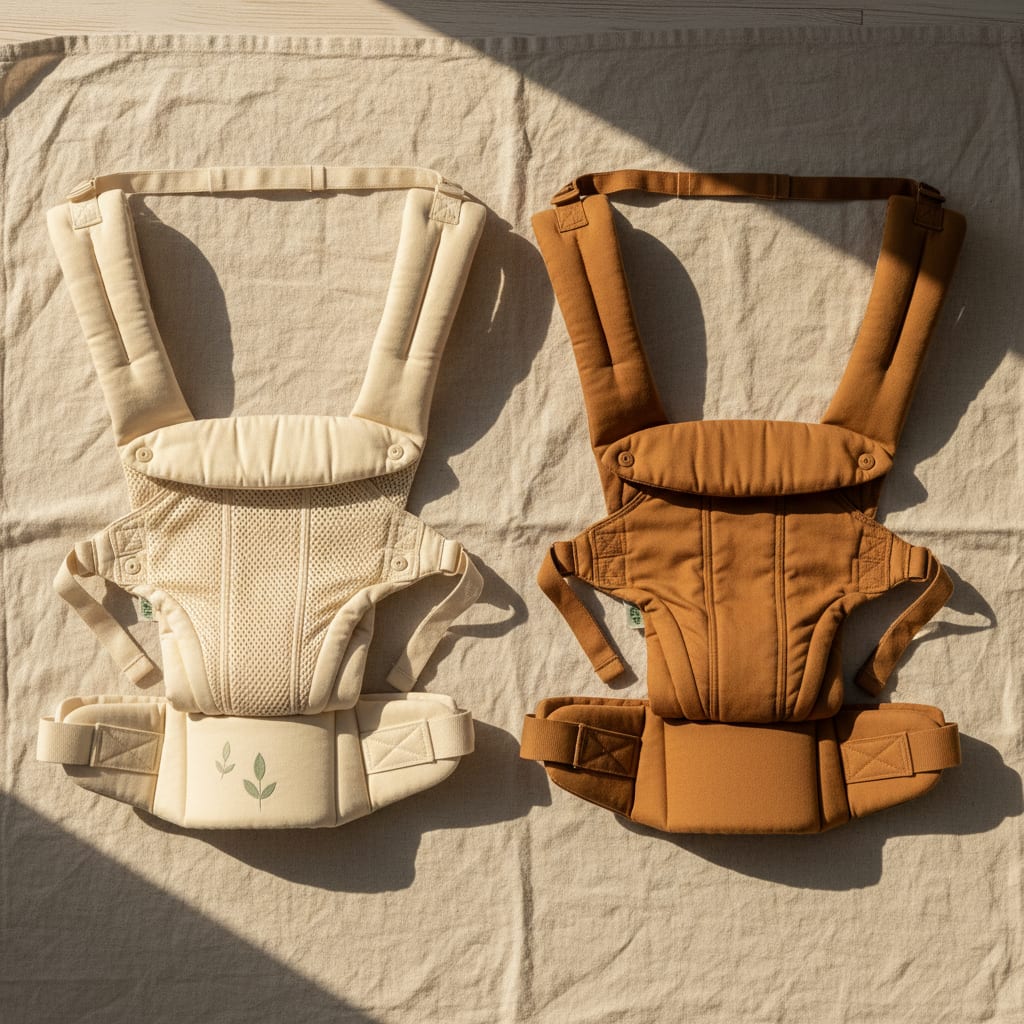
Bottom line up front: BabyBjorn is the easier carrier to get on and off, and Ergobaby is the more comfortable carrier once you are past about an hour. The BabyBjorn Harmony and the Ergobaby Omni Breeze now overlap heavily — four carrying positions each, breathable mesh, padded lumbar support, no infant insert needed — so the real split is buckle geometry and weight distribution. Harmony runs 7 to 40 pounds; Omni Breeze runs 7 to 45. If most of your carries are twenty minutes, buy BabyBjorn. If most are ninety, buy Ergobaby.
I own carriers from both brands, bought with my own money. Affiliate links never change my verdicts.
The comparison table
| BabyBjorn Harmony | Ergobaby Omni Breeze | |
|---|---|---|
| Weight range | 7–40 lbs | 7–45 lbs |
| Positions | Newborn, facing in, facing out, back | Inward, forward, hip, back |
| Newborn insert | Not needed | Not needed |
| Fabric | 3D mesh | SoftFlex mesh |
| Waist and shoulders | Padded waist, padded shoulder straps | Padded lumbar waistband, crossable shoulder straps |
| Getting it on | Steps into place, buckles at the shoulders from the front | Waistband first, then straps over the shoulders |
| Best at | Short carries, quick transfers, sleeping-baby extraction | Long carries, back carries, wider weight range |
Where BabyBjorn actually wins
The buckle layout is the product. A Harmony is designed to be put on and taken off from the front, which is the difference between transferring a sleeping baby into a cot and waking them while you fumble behind your back. On a school-run-and-supermarket day where the baby goes in and out five times, that ergonomics-of-the-hands advantage beats any strap padding.
The mesh is genuinely good, the newborn position is straightforward without an insert to lose, and the whole thing is easier to hand to a partner who has never used a carrier. For the true newborn stage, BabyBjorn’s Baby Carrier Mini — roughly 7 to 25 pounds — is the simplest carrier I have used, and there is a real argument for buying a cheap simple one for the first months rather than a flagship you will grow into.
Where it stops: the Harmony’s 40-pound limit and its narrower waistbelt mean the load sits higher and further forward than Ergobaby’s. Past an hour with a heavy baby, you feel that in your shoulders and lower back, and no amount of adjustment moves it.
Where Ergobaby actually wins
The Omni Breeze is built around its lumbar waistband, which is what lets it hold 45 pounds without the weight climbing into your shoulders. The crossable shoulder straps are the other thing worth paying for: crossing them changes the fit for narrow shoulders and short torsos, and it is the single feature that decides whether a carrier fits a small frame at all — the argument I make at length in my carriers for petite parents roundup.
The trade-off is fiddle. Ergobaby carriers ask you to clip a waistband, seat the baby, then reach the shoulder buckles, and getting a sleeping baby out is a two-person job more often than it should be. The older Omni 360 (now sold as the Omni Classic) is the same design in a warmer fabric and usually cheaper; if you do not live somewhere hot, it is the better-value version of this carrier and the mesh is the only thing you give up.
For newborn-only use, Ergobaby’s Embrace — 7 to 25 pounds, soft knit, two positions — competes directly with the BabyBjorn Mini and is the more forgiving of the two on a post-partum body.
Heat, which decides more purchases than fit
Both flagship carriers are mesh, and both are still warmer than a wrap. A structured carrier presses a hot baby against a hot adult; the fabric only decides how quickly the sweat evaporates.
If you are having a summer baby, the honest hierarchy is: a ring sling is coolest, a stretchy wrap next, mesh soft-structured carriers after that, and non-mesh cotton panels last. My Solly wrap review covers what the wrap end of that scale is genuinely like to live with, including the parts nobody photographs.
Safety notes that apply to both
Carrier naps happen, so the airway rules matter more than the brand. Baby’s face visible and clear of fabric, chin off the chest, high enough that you can kiss the top of the head, and the seat wide enough to support thigh-to-thigh in an M-shape. Facing-out carries should be short and reserved for a baby with solid head and neck control, because an outward-facing baby cannot turn away from the world when they have had enough.
And a carrier is not a sleep surface. If your baby only settles against you, that is worth understanding rather than gear-shopping around — Betteroo’s explainer on contact naps and why they happen is the clearest one I have read on the subject.
Buy A if, buy B if
Buy the BabyBjorn Harmony if your carries are short and frequent, you will be putting the carrier on and off alone, more than one adult will use it, or you value a sleeping-baby exit above all else.
Buy the Ergobaby Omni Breeze if you carry for long stretches, you want back-carrying to be genuinely comfortable, your baby is on the bigger end, or you have a short torso and need crossable straps.
Buy neither yet if you are shopping before the baby arrives and cannot try them on. Carrier fit is a body-shape question, and the fashion-brand assumption that one panel fits everyone is exactly what I take apart in my Artipoppe alternatives piece. Borrow, try, then buy.
FAQ
Is BabyBjorn or Ergobaby better for a newborn?
Both work from around 7 pounds with no insert. BabyBjorn is easier to fit correctly on a first try, which matters when you are recovering and nervous. Ergobaby’s newborn position is equally sound but takes more adjustment to get the seat and head support right.
Which carrier is better for back pain?
Ergobaby, in almost every case. Its padded lumbar waistband is designed to transfer weight to the hips, and its crossable straps let you change where the load sits. BabyBjorn’s Harmony is comfortable but keeps more of the weight forward and higher.
Can you use these carriers facing out?
Both offer a facing-out position. Keep those carries short, use them only once your baby has strong head and neck control, and turn the baby back in at the first sign of overstimulation. An outward-facing baby has no way to opt out of the view.
Do I need the mesh version?
If you live somewhere hot or have a summer baby, yes — it is the difference between a carrier you use and one you avoid. In a cool climate the non-mesh versions are cheaper and perfectly comfortable, and the Omni 360 is the obvious saving.
How long will a carrier like this last?
Both cover newborn through toddler on paper — 40 pounds for the Harmony, 45 for the Omni Breeze — but most families stop daily carrying well before that, usually somewhere between eighteen months and two and a half years, when the child would rather walk. Buy for the first eighteen months and treat the rest as a bonus.